

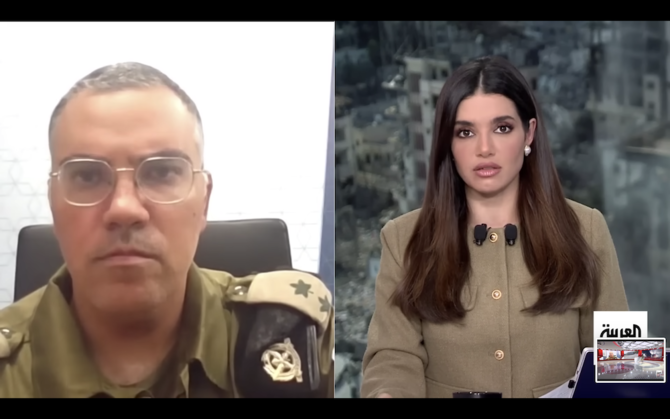


LONDON: Last week, Layal Alekhtiar, one of Al-Arabiya News Channel’s main anchors, was getting ready for yet another long day in front of the camera as the Israeli-Hamas conflict continued to intensify.
Alekhtiar, an experienced Lebanese journalist who has worked for outlets such as US-funded Alhurra and Lebanon’s LBC, was well equipped for what the day could hold for her. After all, she had interviewed prime ministers, foreign secretaries and a host of other high-level officials and delegates.
That day, however, she was told one of her interview subjects was Avichay Adraee, a lieutenant colonel in the Israel Defense Forces who serves as the head of the Arab media division of the force’s Spokesperson’s Unit.
Alekhtiar shuffled her notes, prepared and ready to conduct the interview with integrity as she does with every other guest on her program.
What she was not ready for was the barrage of harassment, abuse and hate targeted at her by loyalists of Hezbollah — the Iran-backed Lebanese militia — that came soon after.
Thousands of replies and comments accusing Alekhtiar of being a traitor and Israeli spy flooded her X and Instagram accounts.
“I conducted the interview respectfully, asked all the necessary questions, and I ended the interview, that’s it, nothing more. I didn’t praise him, but I didn’t insult him either,” Alekhtiar told Arab News.
“A respectable journalist will respect their guest, no matter who it may be, even if it’s someone from the opposition.”
In one of her most recent posts mourning a fellow journalist, Giselle Khoury, who had just lost a years long battle with cancer, the comments ranged from “RIP” to ones wishing death upon her.
“I hope we’ll be saying goodbye to you with some missile to blow you up,” one comment read.

“I hope we’ll be saying goodbye to you with some missile to blow you up,” one comment read.
Another said: “May God have mercy on her and I hope we will see you with her soon.”

“I hope we’ll be saying goodbye to you with some missile to blow you up,” one comment read.

One comment on Instagram even went as far as asking her “What will you think when Avichay Adraee deprives you of your son?”

“What will you think when Avichay Adraee deprives you of your son?”
Alekhtiar said: “Lebanese journalists have interviewed Israelis in the past, Palestinians are interviewing Israelis right now… How will you get a second point of view (if you do not)? You are obliged to as a journalist.”
Indeed, she is not the only Lebanese journalist to have interviewed Israelis or Israeli officials. The late and renowned anchor Najwa Qassem interviewed Israeli orientalist and political analyst Edy Cohen on Al Arabiya, and Sky News Arabia’s Algerian presenter Fadila Souissi interviewed Israeli Prime Minister Benjamin Netanyahu in 2022.
The issue, however, did not stop there. After the online smear campaign kicked off, a reporter from a group of “journalists of the South” stated that they will not let her into Lebanon and will report her.
They then raised the issue of the country’s Military Court on the basis that Israel and Lebanon are technically at war, and being in contact with enemy officials would be treasonous.
The group of journalists and ex-detainees of Israel, which included Syrian News Channel’s Hussein Mortada, filed a lawsuit which stated:
“Attorney Ghassan Al-Mawla has filed a report before the Military Court against the Zionist Layal Al-Ekhtiar, who claims to be a journalist (report no. 20355/2023, dated 12/10/2023), for conducting an interview on the the Hebrew channel (referring to Al Arabiya) with the Zionist killer, Avichay Adraee.”
“Every communication is a contribution to the shedding of Palestinian blood, including children, women, and the elderly, and we as detainees will not spare any of these traitors and we will hold them accountable.”

The lawsuit filed by the group of journalists and ex-detainees of Israel. (Supplied)
Shortly after, Alekhtiar claims she received calls from insiders at the Lebanese government warning her not to return to her home country as she could be arrested on the spot.
“Currently I can’t go to Beirut, journalists and politicians have advised me not to go to Lebanon because I will be arrested,” she told Arab News as her voice cracked, fighting back tears.
“People are trying to intimidate journalists. They’re saying ‘look at what we can do, we can stop you and prevent you from entering the country,’” she said, adding: “What I’m sure of is, I won’t back down or change. I won’t change my beliefs.
“If I get scared and am silenced, this will happen to any other journalist.”
Alekhiar is not new to assault or attacks from pro-Hezbollah trolls online. In 2021, she was subjected to a smear campaign by “individuals allied to Hezbollah” and was threatened with murder via text.
The threats followed her previous tweet commenting on a Qassem Soleimani statue in Beirut and quoting a surah from the Qur’an.
As for now, the journalist has decided to stay in Dubai, while members of her family who are based in Beirut are being subjected to harassment as an intimidation tactic used against her.
“If you want to criticize and start a hate campaign, at least stick to the ethics of journalism and ethics of political communication. It doesn’t have to be personal and it doesn’t need to involve my family,” she said.


