

Special court postpones Pakistan ex-PM Khan’s indictment in state secrets’ case

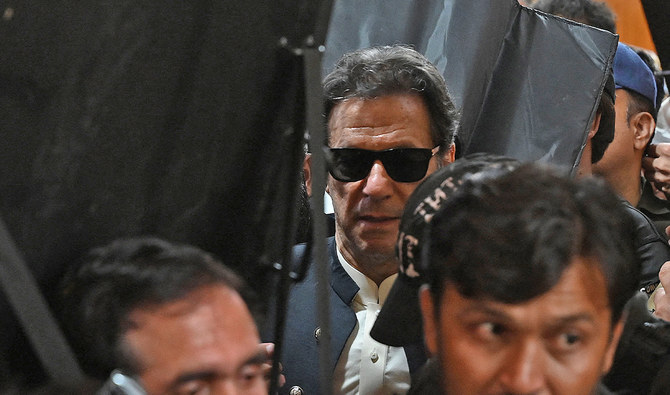
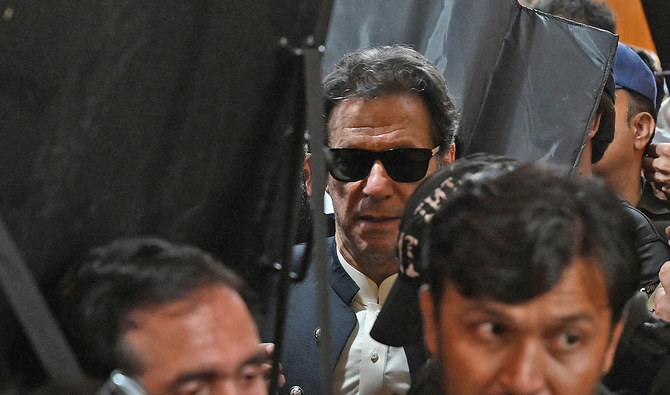
Security personnel with ballistic shields escort former Pakistan's prime minister Imran Khan (C) as he leaves after appearing at the High Court in Lahore on May 19, 2023. (Photo courtesy: AFP/File)
Short Url
Updated 17 October 2023
Follow

Special court postpones Pakistan ex-PM Khan’s indictment in state secrets’ case

  • Case centers around diplomatic cable that Khan says is proof his ouster in 2022 was part of ‘foreign conspiracy’
  • Khan says legal cases registered against him including cipher case are based on “politically motivated” charges

ISLAMABAD: A special court in Pakistan on Tuesday postponed the indictment of jailed former prime minister Imran Khan till next week in a case related to accusations of leaking official secrets.

The saga, which has come to be popularly known as the cipher case, relates to an alleged diplomatic correspondence between Washington and Islamabad that Khan says was proof that his ouster in a parliamentary vote of no-confidence in April 2022 was part of a US conspiracy to remove him. Washington has repeatedly denied Khan’s accusations. 

Khan says the US got involved in the plot to oust him after his visit to Moscow and less than a month before his removal, he waved a letter to a crowd during a public rally, claiming it was a cipher from a foreign nation calling for the end of his government. 

Khan later revealed that country to be the US and said the secret diplomatic letter spoke of dire consequences if he continued to get closer to Russia.

Khan had traveled to Moscow on the eve of Russia’s invasion of Ukraine in February 2022 and says the US and Pakistan’s own army, at the behest of the US, were opposed to him for pursuing an independent foreign policy, and thus banded together to overthrow his government. All three deny the charge.

“The hearing in the cipher case is adjourned until October 23,” a lawyer for Khan, Sher Afzal Marwat, told Arab News after Tuesday’s hearing. 

The indictment was postponed, the lawyer said, after Khan’s defense team argued that the indictment could not take place “without providing us copies of the challan [charge sheet].”

Khan is in jail since August 5 after he was convicted in a separate case involving the sale of state gifts. He was initially kept at the high-security Attock prison, but was later moved to Adiala jail. He has also been remanded in jail custody in the cipher case.

Khan says that the slew of cases registered against him after his ouster from office since April 2022 are all based on “politically motivated” charges.

When asked about Khan’s health and state of mind, his lawyer said:

“Imran Khan was content and upbeat … he has asked his workers to stay peaceful.”


Rating firm S&P says it won’t rush Iran war downgrades, sees risks for countries like Pakistan

Updated 12 March 2026
Follow

Rating firm S&P says it won’t rush Iran war downgrades, sees risks for countries like Pakistan

  • Agency says it is monitoring indebted energy importers as higher oil prices strain finances
  • Gulf economies seen better placed to weather shock, though Bahrain flagged as vulnerable

LONDON: S&P Global ‌said it would not make any knee-jerk sovereign rating cuts following the outbreak of war in the ​Middle East, but warned on Thursday that soaring oil and gas prices were putting a number of already cash-strapped countries at risk.

The firm’s top analysts said in a webinar that the conflict, which has involved US and Israeli strikes ‌against Iran and Iranian ‌strikes against Israel, ​US ‌bases ⁠and Gulf ​states, ⁠was now moving from a low- to moderate-risk scenario.

Most Gulf countries had enough fiscal buffers, however, to weather the crisis for a while, with more lowly rated Bahrain the only clear exception.

Qatar’s banking sector could ⁠also struggle if there were significant ‌deposit outflows in ‌reaction to the conflict, although there ​was no evidence ‌of such strains at the moment, they ‌said.

“We don’t want to jump the gun and just say things are bad,” S&P’s head global sovereign analyst, Roberto Sifon-Arevalo, said.

The longer the crisis ‌was prolonged, though, “the more difficult it is going to be,” he ⁠added.

Sifon-Arevalo ⁠said Asia was the second-most exposed region, due to many of its countries being significant Gulf oil and gas importers.

India, Thailand and Indonesia have relatively lower reserves of oil, while the region also had already heavily indebted countries such as Pakistan, Bangladesh and Sri Lanka whose finances would be further hurt by rising energy prices.

“We ​are closely monitoring ​these (countries) to see how the credit stories evolve,” Sifon-Arevalo said.