

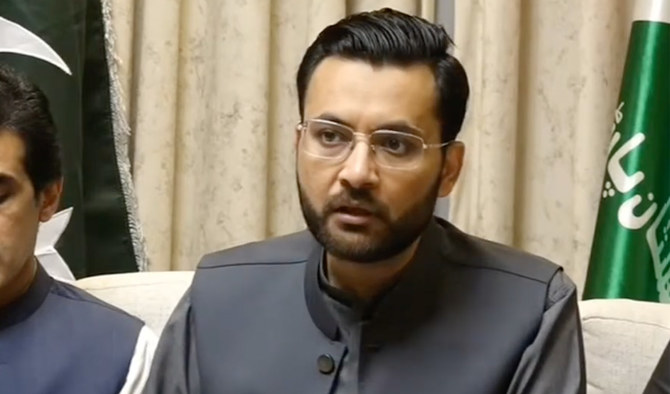

ISLAMABAD: Farrukh Habib, one of the closest aides of former Prime Minister Imran Khan, said on Monday he was leaving his Pakistan Tehreek-e-Insaf (PTI) party, accusing its leader of opting for a “path of violence” and sowing hatred among the public for the armed forces.
Habib is among a long line of Khan allies that have defected amid a widening crackdown on his PTI party since May 9, when his supporters damaged government and military properties in nationwide street protests that Khan and top leaders of his party are accused of masterminding. Earlier this month, another two key Khan associates, Sadaqat Ali Abbasi and Usman Dar, who had been under arrest for weeks, suddenly appeared in TV interviews and renounced ties with the PTI.
Habib had also been on the run since May but was arrested late last month in Gwadar in southwestern Pakistan. His whereabouts had been unknown until he appeared in a press conference on Monday to announce he was parting ways with Khan, who is currently serving a three-year jail term in a corruption case. Habib said he was joining the Istehkam-i-Pakistan Party (IPP), formed in July by estranged associates of Khan. The outfit is widely believed to be a ‘king’s party’ that is being primed as a viable alternative to the PTI, arguably the most popular political party in the country.
“Our [PTI] struggle, which should have been a democratic one, we deviated from that struggle and took the country towards violence,” Habib said, speaking about the events of May 9.
Khan and the PTI should have waited for elections and led a peaceful struggle against the government of then prime minister Shehbaz Sharif instead of taking “the path of violence,” the now estranged PTI leader said.
Referring to Khan, Habib accused the PTI chief of telling his supporters to take to the streets, block roads, and engage in violence.
“Because of that violence, a message was consistently given through which the minds of innocent people, as a result of cult following, were hijacked,” Habib said. “And they were told that Pakistan's institutions [army] are working against them and that they are not letting them take part in politics. The seeds of hatred were consistently sown.”
“Instead of the ballot, you were telling them to opt for the bullet," Habib said, addressing Khan. “Instead of the ballot, you were telling them to attack their own institutions.”
Habib described Khan as a “promoter of violence,” and said he had joined the PTI for very different reasons.
“I joined the Imran Khan that spoke about … a new Pakistan and who told us about social justice and the State of Medinah. People were not instigated in the State of Medinah to stand up against their state and fight against them.”
It is widely believed that PTI leaders who have quit the party have been made to do so by the all-powerful military, which denies interfering in politics.
“Another day, another drama of an abducted person coming on TV only to quit PTI & say a few words against IK,” PTI’s social media lead Jibran Ilyas wrote on X.
“Anyone who knows him [Habib] would know how he must have been forced to say & do this.”
Khan says corruption cases against him are fabricated and politically motivated and that his associates are being forced out of the PTI under duress from the government and the military in a manoeuvre to dismantle his party before elections scheduled early next year.
He has been embroiled in a tussle with the military since he was removed from power last year in a parliamentary vote which he says was orchestrated by the country's top generals. The military denies this.


