

Pakistan looks to tame high inflation with fuel price cuts — PM

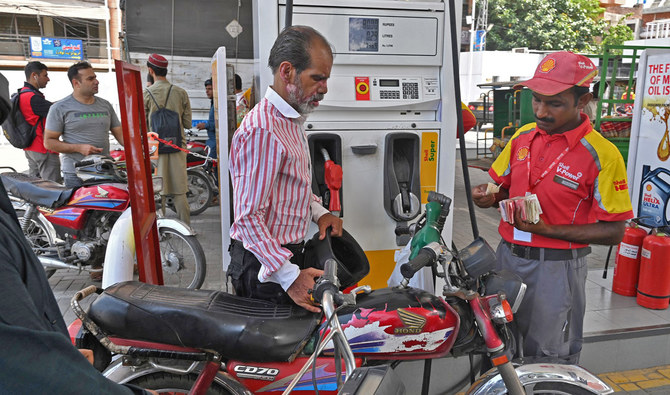
An employee fills petrol in a motorcycle at a fuel station in Lahore, Pakistan, on August 1, 2023. (AFP/File)
Short Url
Updated 16 October 2023
Follow

Pakistan looks to tame high inflation with fuel price cuts — PM

  • Pakistan is embarking on a tricky path to economic recovery under a caretaker government after a $3 billion IMF bailout
  • Effective Monday, petrol dropped by Rs40 to Rs283.38 rupees a litre, while high-speed diesel cost fell by Rs15 to Rs303.18

KARACHI: The Pakistani government is looking to tame inflation with fuel price cuts and a price-control mechanism, caretaker Prime Minister Anwaar ul Haq Kakar said on Monday. 

The South Asian country is embarking on a tricky path to economic recovery under a caretaker government after a $3 billion loan programme approved by the International Monetary Fund in July averted a sovereign debt default, but with conditions that complicated efforts to control inflation. 

"Consequent to substantial reduction in fuel prices, I have directed the concerned authorities at Federal and Provincial level to activate a strict price control mechanism," Kakar said in a post on X, formerly known as Twitter. 

He added that efforts should be maintained in transferring the benefit of the cut on prices of commodities. 

Effective Monday, the price of petrol dropped by 40 Pakistani rupees to 283.38 rupees a litre, while high-speed diesel cost fell by 15 rupees to 303.18 a litre, as per the ministry. 

The finance ministry, in a press release, said the decreasing trend of petroleum prices in the international market and the appreciation of the rupee against the U.S. dollar as reasons for the cut. 

Pakistan's inflation rate rose to 31.4% year-on-year in September from 27.4% in August, primarily due to high fuel and energy prices. 

The rupee hit all-time lows in August before recovering in September to become the best performing currency following a clampdown by authorities on unregulated FX trade. 

Analysts, however, expect the fuel price cut to be short- lived and ineffective at taming inflation. 

"The current cut in fuel prices has been led by a lower ex-refinery price, which is a function of international prices and the rupee parity. The sustainability of this cut is subject to future movements in these factors," said Amreen Soorani, Head Of Research at JS Global Capital. 

She added that the crackdown in illicit trade had been a key factor in the appreciating rupee against the dollar and that continued efforts on the same path would likely keep the rupee trend stable. 

"Pakistan is a trade deficit country with limited dollar inflow avenues in its balance of payments. In the longer term, present information suggests the rupee would likely continue a depreciating trend, albeit, ongoing efforts may limit the quantum of depreciation," she added. 

Fahad Rauf, Head of Research at Ismail Iqbal Securities, pointed out the downward sticky nature of prices. 

"When the fuel prices go up, the transportation cost and product prices also rise, but when the prices fall, the impact is not passed on to consumers to same extent," Rauf added. 

The war between Islamist group Hamas and Israel poses one of the most significant geopolitical risks to oil markets since Russia's invasion of Ukraine last year, analysts say. 

"...we believe the oil price warrants a risk premium of USD5–10/bbl, due to the supply risk," ANZ research said in a note on Monday. 


At OIC meeting, Pakistan calls on world to halt Israel’s annexation of West Bank

Updated 8 sec ago
Follow

At OIC meeting, Pakistan calls on world to halt Israel’s annexation of West Bank

  • Israel this month decided to approve land registration procedures in parts of the West Bank for the first time since 1967
  • FM Ishaq Dar demands end to Palestinian displacement, reconstruction of Gaza, pathway to independent Palestinian state

ISLAMABAD: Pakistan on Friday called on the international community to stop Israel from annexing the occupied West Bank, demanding a “political pathway” toward an independent Palestinian state.
Israel decided this month to approve land registration procedures in parts of the West Bank for the first time since 1967, drawing sharp criticism from Muslim nations along with several European countries, which described it as a move to ease the path for settlement expansion and annexation.

Speaking at an extraordinary ministerial session of the Organization of Islamic Cooperation (OIC), Pakistani Foreign Minister Ishaq Dar said the development carries profound implications not only for the Palestinian people but also for the credibility of international law, United Nations charter and the integrity of the multilateral system.

“Israel continues with impunity to expand illegal settlements and enforce de facto annexation in the Occupied West Bank. These actions, flagrantly violate international law including UN Charter, UN Security Council Resolution 2803 [endorsing President Donald Trump’s peace plan for Gaza], undermine all diplomatic efforts and threaten the very foundation of a just and lasting peace,” Dar said.

“These violations embolden further aggression, erode regional stability and trample on the rights and dignity of the Palestinian people. The international community must decisively act and act now to halt these violations, uphold international law and ensure delivery of the assurances made in good faith to the group of eight Arab-Islamic countries, including Pakistan.”

The West Bank is among the territories that the Palestinians seek for a future independent state. Much of it is under Israeli military control, with limited Palestinian self-rule in some areas run by the Western-backed Palestinian Authority (PA). More than 500,000 Israelis live in settlements and outposts in the West Bank, excluding Israeli-annexed East Jerusalem, alongside nearly three million Palestinians.

Dar recalled that leaders and the foreign ministers of the group of eight Arab-Islamic countries, including Pakistan, engaged with United States President Donald Trump on the sidelines of the UN General Assembly on Sept. 25 to help end the bloodshed in Gaza, ensure unimpeded humanitarian access, secure a permanent and sustainable ceasefire and advance a comprehensive peace process for the Palestinian brothers and sisters.

“During these consultations, we, the group of eight, ensured that the non-annexation of the Occupied West Bank remained firmly on the agenda and assurances were given to us in New York that the annexation of West Bank would not take place,” he said.
“In view of the serious gravity of the situation, we need to collectively ensure, first, an immediate reversal of all Israeli measures aimed at de-facto annexation of the Occupied Palestinian Territory, including West Bank, which constitutes a red line for any just resolution of the issue of Palestine.”

Pakistan is among the Group of Eight Arab Islamic countries, which also includes Saudi Arabia, Jordan, the United Arab Emirates, Qatar, Indonesia, Egypt and Türkiye. Islamabad does not have diplomatic relations with Israel and maintains a firm policy of non-recognition, rooted in its support for an independent Palestinian state in the Middle East with Al-Quds Al-Sharif as its capital.

Speaking at the meeting, Dar called for an immediate end to all “forms of displacement, democratic manipulation and collective punishment” of the Palestinians, a ceasefire in and reconstruction of Gaza as well as “a credible, irreversible and time-bound political horizon” leading to the establishment of a Palestinian state.