

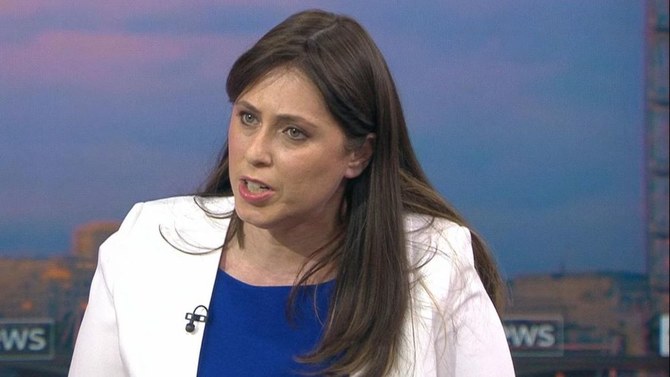

LONDON: Israel’s Ambassador to the UK Tzipi Hotovely has said there is “no humanitarian crisis” in the Gaza Strip ahead of an expected military offensive against the enclave — contradicting organizations including the UN and the World Health Organization.
Ahead of its offensive, Israel has cut off water, fuel, electricity and food supplies into Gaza. Israeli Defense Minister Yoav Gallant described it as “a complete siege,” adding: “We are fighting human animals and we are acting accordingly.”
Sky News presenter Kay Burley told Hotovely: “I’m asking you about the innocent civilians losing their lives at the moment, and now you’re saying it’s not a humanitarian crisis — how can you say that?” Hotovely replied: “The humanitarian crisis at the moment is in Israel.”
The UN and numerous humanitarian groups have warned that a catastrophe is unfolding across Gaza, an area of just 365 sq. km that is home to over 2 million people.
WHO spokesman Tarik Jasarevic said Israel’s demands for civilians to relocate in such numbers and at such short notice is “a death sentence” for many Palestinians, adding that it is “impossible to evacuate vulnerable hospital patients from the north of Gaza.” He said: “Asking health workers to (move vulnerable patients in a war zone) is beyond cruel.”
The archbishop of Canterbury noted that the Anglican-run Ahli Hospital in the north of Gaza was among several medical facilities to have already been hit by Israeli rockets, leaving staff injured and patients with nowhere to go. “They are running low on medical supplies. They are facing catastrophe,” Justin Welby said in a statement.
He called for humanitarian corridors to be opened, a demand that has also come from relief agencies and groups including Amnesty International, in order to transport patients to safety and bring in humanitarian supplies.
Ahmed Al-Mandhari, WHO regional director, said “mobile patients” from 22 health facilities had been evacuated south, but most remain trapped in the north, adding that no official corridors have been opened.
Jasarevic said Gaza’s hospitals are at “breaking point,” with all major facilities in the north having far exceeded their existing capacity. He added that there have been numerous recorded Israeli strikes on medical facilities.
Medics have also warned that patients in critical condition requiring ventilators or energy-intensive treatments are at risk without fuel or electricity from Israel, and with power from generators dwindling.
UN observers have warned that hospital wings could start shutting down this week without power.
UN Undersecretary-General for Humanitarian Affairs Martin Griffiths said on X that “the noose around the civilian population in Gaza is tightening.”
Philippe Lazzarini, head of the UN Relief and Works Agency for Palestine Refugees, said more than 423,000 people across Gaza have already been displaced, with over 270,000 in UNRWA shelters.
He added that the Israeli relocation order would “only lead to unprecedented levels of misery and further push people in Gaza into the abyss.”
His UNRWA colleague Juliette Touma said people are fast running out of water. “Gaza is running dry,” she told the Associated Press, adding that UN teams have even begun rationing their staff’s water supplies.
UNRWA spokesperson Inas Hamdan said “clean water has actually run out” at a number of shelters, with many forced to drink dirty water or even resort to seawater.


