

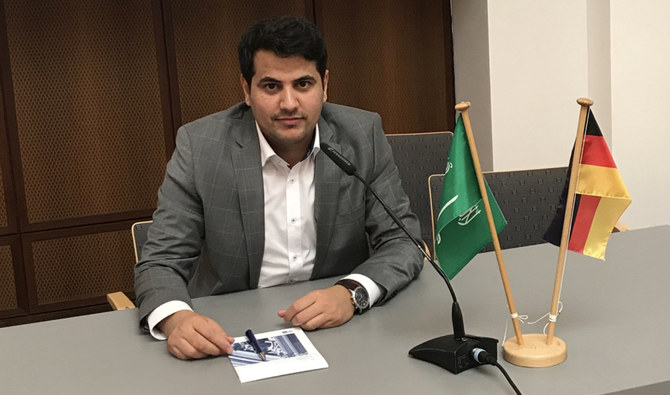
Rakan Al-Shammari — a Saudi success story

Al-Shammari said his educational journey began in the desert, where he studied until the third grade of primary school, living in tents and drinking well water. (Al-Shammari’s Instagram)
Short Url
Updated 15 October 2023
Follow

Rakan Al-Shammari — a Saudi success story

MAKKAH: Saudi engineer Rakan Al-Shammari has left an indelible mark on the railway industry in Germany.

His journey began with the pursuit of electrical engineering studies and he later taught at several German universities.

Al-Shammari’s path to success began while working as a project manager at Rail Power System GmbH. His dedication and passion for trains led him to excel in the field. The journey was not without its difficulties, as it required him to learn German, pursue bachelor’s and master’s degrees, and eventually take on teaching responsibilities.

Al-Shammari said: “In 2006, after graduating from high school, I applied for the Custodian of the Two Holy Mosques Foreign Scholarship Program. I spent a year studying the German language, followed by preparatory studies, and then I joined the University of Kassel to major in electrical and communications engineering. During my final year at university, I undertook practical training at the German Railways Company.”

He noted that after completing the practical experience, he pursued further education as a graduate student. “While studying for my master’s, I was offered a position as a lecturer at the university under a contractual arrangement, where I taught electricity to first and second-year students.”

He received a job offer in 2017 and joined a company specializing in railway project management in Germany. “This company managed new construction projects, particularly in infrastructure, as the German Railway Company itself does not execute such projects,” he noted.

Al-Shammari told Arab News that his educational journey began in the desert, where he studied until the third grade of primary school, living in tents and drinking well water. He later attended Al-Yarmouk Primary School in the city of Rafha for grades four to six and completed his secondary education in the city of Al-Uwaiqliyah.

Al-Shammari firmly believes that Saudi Arabia is on the cusp of a transportation revolution and is already reaping the rewards. He emphasized that the Kingdom will emerge as a developed country in the coming years, not solely reliant on oil and energy, but also due to the strength of its people and leadership, and their commitment to continual development and competition.

He expressed pride in having visionary leaders who invest in the talents of their citizens. He also noted Germany’s openness to creative minds and its support for them, attracting skilled individuals from around the world. He believes that effective resource management enhances the economy and strengthens Germany’s global position.

Al-Shammari acknowledged the initial difficulties he faced in studying in Germany, as it was his first experience living outside his familiar surroundings.

His advice to everyone is to embrace their sense of responsibility, seize opportunities, and pursue continuous learning in order to contribute to their country. He also emphasizes the importance of diversifying educational sources and collaborating with experts and scholars to develop a unique persona capable of competing on a global scale.

Finally, Al-Shammari expressed gratitude to the Saudi leadership, his family and friends, and the Saudi Cultural Mission in Germany. He acknowledged the mission’s continuous support, including increased stipends for Saudi students who excelled academically, enabling them to perform to the best of their abilities during their scholarships.


Pakistan, Saudi Arabia explore joint investment push in high-growth regions

Updated 4 sec ago
Follow

Pakistan, Saudi Arabia explore joint investment push in high-growth regions

  • Both sides discuss combining Pakistan’s production capacity with Saudi capital and regional market access
  • Government says Saudi side expressed interest in corporate farming in Pakistan, particularly in rice sector

KARACHI: Pakistan and Saudi Arabia are looking to jointly tap high-growth regional markets and align production and capital strengths, according to an official statement on Wednesday, following talks between Commerce Minister Jam Kamal Khan and Saudi Investment Assistant Minister Ibrahim Al-Mubarak in the Kingdom.

The two countries have long maintained close bilateral ties that have evolved into a multidimensional strategic partnership.

In October last year, the two countries launched an Economic Cooperation Framework aimed at shifting relations beyond aid toward sustainable trade, investment and development links. The framework followed the signing of a joint security agreement a month earlier, under which aggression against one would be treated as an attack on both.

“A key focus of the discussion was the joint exploration of regional markets, particularly Central Asia, Africa, and ASEAN, identified as high-growth regions offering significant opportunities for collaboration,” according to a statement circulated by Pakistan’s commerce ministry after the meeting.

“The two sides agreed that Pakistan and Saudi Arabia, by leveraging their respective strengths, can position themselves as complementary partners — combining Pakistan’s production capabilities with Saudi Arabia’s capital strength, market access, and regional connectivity,” it added.

The Saudi side expressed interest in corporate farming in Pakistan, particularly in the rice sector, with discussions covering mechanization, storage and logistics to enable consistent, long-term exports under structured arrangements.

Talks also covered broader cooperation in agriculture and food security, including rice, fodder, meat and other agri-products, with the potential involvement of Saudi financing institutions in supporting export-linked agricultural and infrastructure projects.

Corporate farming and mechanization were discussed as long-term solutions to productivity challenges in crops such as cotton, where declining yields and high manual input costs have hurt competitiveness, the statement said.

Human resource development emerged as another area of focus, with both sides noting shortages in mid-tier skills such as nurses, caregivers, technicians and hospitality staff.

The Saudi side expressed openness to replicating vocational “train-to-deploy” models in Pakistan that link training programs directly with overseas employment opportunities.

The meeting also examined opportunities in building materials, pharmaceuticals, sports goods, footwear and light manufacturing, with both sides agreeing to pursue sector-specific workshops and business-to-business engagements to translate policy alignment into tangible trade and investment flows.