

Pakistanis protest Israeli airstrikes on Gaza, march in solidarity with Palestinian people

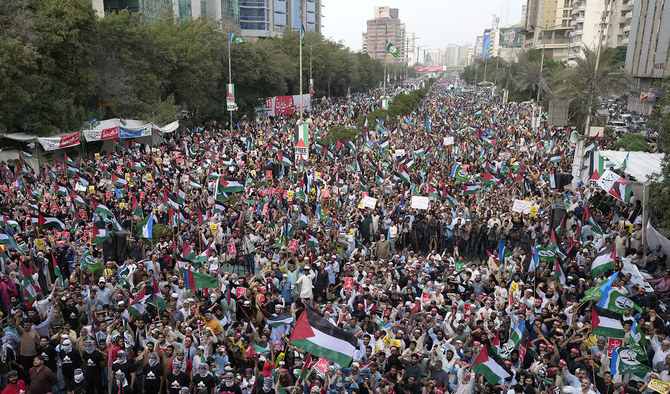
Supporters of the religious and political party Jamaat-e-Islami attend a demonstration against Israeli airstrikes on Gaza, to show solidarity with Palestinian people, in Karachi, Pakistan, on October 15, 2023. (AP)
Short Url
Updated 15 October 2023
Follow

Pakistanis protest Israeli airstrikes on Gaza, march in solidarity with Palestinian people

  • The Jamaat-e-Islami party chief warns of a potential 'third world war,' laying siege to the US embassy in Islamabad
  • Civil society members hold separate demonstration, demanding end to Israeli atrocities against the people of Gaza

KARACHI: Thousands of men, women and children marched on Sunday in Pakistan's commercial hub of Karachi to express solidarity with the Palestinian people amid relentless Israeli bombardment on Gaza, which has forced nearly 1 million people to flee their homes. 

Israel has intensified its bombardment of Gaza since Palestinian group, Hamas, launched a multi-pronged attack on the Jewish nation last week. The attack claimed at least 1,300 lives, while Israel’s bombing of Gaza has resulted in the killing of at least 2,450 Palestinians. 

Israel has also blockaded Gaza, effectively preventing food, fuel and water from reaching the densely populated territory of over two million people. The actions have drawn widespread anger and sparked protests in Pakistan. 

On Sunday, Jamaat-e-Islami, a Pakistani religious party, organized a massive rally in Karachi, where the speakers warned of far-reaching consequences of the Israeli aggression against the Palestinians. 

“We want to emphasize that if Israel was not stopped, it may lead to a third world war,” JI chief Sirajul Haque warned, while addressing participants of the rally on the city's main thoroughfare, Shahrah-e-Faisal. 

“The US president has announced his support for Israel. We want to convey to the US president that if he continues to support Israel, we will lay siege to the US embassy in Islamabad.” 

The rally drew large crowds of Pakistani people from different walks of life, who carried placards in support of the people of Gaza. 

Zobia Ahmed, who attended the march along with her husband, three daughters and parents, said the situation demanded of everyone to protest Israeli actions. 

“There are small kids, people who have been oppressed, the supply of food, and everything has been stopped” she said. "So, if Muslims do not stand up against that and against the martyrdoms that happened, who will stand up?" 

Quratul Ain, 17, said she attended the march in solidarity with Palestinians, who were facing an "imminent genocide." 

“The world needs to stand up and take a stand against what is happening. It is a genocide,” the 17-year-old said.  

“It feels like an absolute luxury to us to have a clean glass of water today, to be able to sleep in a clean bed, and to have a peaceful life,” she said, noting the people of Gaza were sleeping under open skies without access to basic necessities. 

Separately, members of the civil society gathered outside the Karachi Press Club to express solidarity with Palestinians. 

“We stand against all violations of the international humanitarian law,” said Shehzad Ghias Shaikh, a v-logger and influencer. "What's happening in Palestine is apartheid, it's genocide and occupation, and we stand against all of those things." 

Dr. Mehrub Moiz Awan, a transgender rights activist, said the message of their march was to ask the government to stand with the people of Palestine. 

“We are standing against the colonization of the land of Palestine and we are all for an end to the senseless, brutal occupation the people of Gaza and Palestine have been facing for the past many years,” Awan said. 

Nargis Rehman, convener of the Karachi Citizens Forum group, said the Jews faced injustice in Europe and the Europeans should take them back. 

“What kind of justice is it to occupy another's land and make them refugees in their own country,” she questioned. “This oppression is, in fact, an arrangement for war.” 


World Bank approves $400 million to expand water, sanitation services in Pakistan’s Punjab

Updated 4 sec ago
Follow

World Bank approves $400 million to expand water, sanitation services in Pakistan’s Punjab

  • Project aims to improve access for 4.5 million people and curb waterborne diseases
  • Program to prioritize women’s participation and climate-resilient urban infrastructure

ISLAMABAD: The World Bank this week approved $400 million for a new project to expand access to safe water, sanitation and hygiene services for around 4.5 million people in Pakistan’s most populous Punjab province, aiming to curb waterborne diseases and reduce long-term public health costs.

The project, known as the Punjab Inclusive Cities Program (PICP), is the second phase of the World Bank-supported Pakistan Urban Water, Sanitation and Hygiene Services Multiphase Programmatic Approach. It will focus on rehabilitating water supply networks, sewerage systems and wastewater treatment plants, while expanding stormwater drainage infrastructure across 16 secondary cities in Punjab.

Punjab faces persistent challenges in providing safe drinking water and adequate sanitation, with many urban households relying on contaminated sources. Weak infrastructure and limited hygiene services contribute to high rates of waterborne diseases such as diarrhea, typhoid and hepatitis, which disproportionately affect children and low-income communities.

“Reducing child stunting is essential for Pakistan’s future. Through the Punjab Inclusive Cities Program, we are investing in safe water, sanitation, and hygiene services to break the cycle of malnutrition and disease that holds back so many children from reaching their full potential,” the World Bank quoted its Country Director for Pakistan, Bolormaa Amgaabazar, as saying in a statement.

“In collaboration with the Punjab Government, the program represents a significant step forward in improving urban infrastructure and strengthening local institutions, thereby laying the foundation for healthier communities and a more prosperous Pakistan.”

Child stunting, a form of chronic malnutrition that leaves children too short for their age, is often linked to repeated infections, poor sanitation and unsafe drinking water, and remains a major public health concern in Pakistan.

Beyond water and sanitation, the project will also support solid waste management systems to improve sanitary waste disposal, extending services to an additional two million people in Punjab’s urban areas. The program will strengthen the capacity of local governments, including efforts to improve revenue generation and long-term service sustainability.

“The program complements infrastructure investments with capacity building and revenue generation, helping to ensure that service delivery is well sustained,” the statement quoted Amena Raja, Senior Urban Specialist at the World Bank, as saying.

“It will also help Punjab’s cities better withstand floods and droughts, ensuring urban development is both environmentally responsible and resilient to climate change.”

The program includes a gender-focused component, prioritizing the hiring of women in decision-making roles, establishing gender-compliant service desks and supporting skills development. It also aims to mobilize private capital to support water and sanitation services in Punjab’s secondary cities.

Pakistan has been a member of the World Bank since 1950 and has received more than $48 billion in assistance since. The Bank’s current portfolio in the country comprises 54 projects with total commitments of $15.7 billion, while its private-sector arm, the International Finance Corporation, has invested about $13 billion since 1956.

Earlier this year, Pakistan and the World Bank signed a first-of-its-kind agreement for a plan to focus $20 billion in lending to the cash-strapped nation over the coming decade on development issues like the impact of climate change as well as boosting private-sector growth.