Israeli communications minister seeks shutdown of Al Jazeera bureau

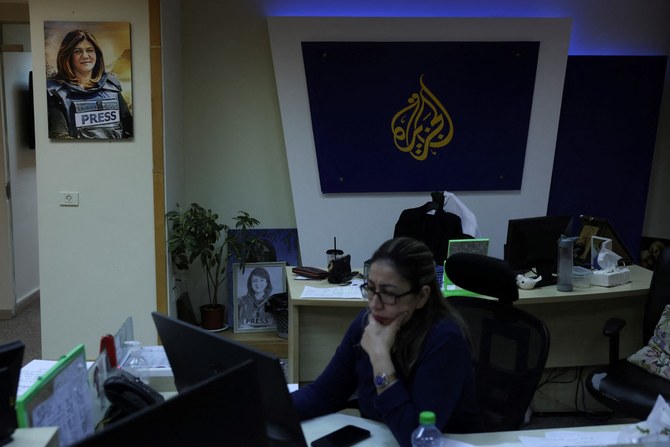
A picture of slain Al Jazeera journalist Shireen Abu Akleh hangs on the wall as a fellow journalist works inside the news channel's office in the West Bank city of Ramallah, on May 9, 2023. (AFP)
Short Url
Updated 15 October 2023
Follow

Israeli communications minister seeks shutdown of Al Jazeera bureau

  • Israel accused the Qatari news station of pro-Hamas incitement

JERUSALEM: Israel’s communications minister said on Sunday he was seeking a possible closure of Al Jazeera’s local bureau, and accused the Qatari news station of pro-Hamas incitement and of exposing Israeli soldiers to potential attack from Gaza.
The proposal to shut down Al Jazeera had been vetted by Israeli security officials and was being vetted by legal experts, Shloma Karhi said, adding that he would bring it to the cabinet later in the day.
Al Jazeera and the government in Doha had no immediate comment.
“This is a station that incites, this is a station that films troops in assembly areas (outside Gaza) ... that incites against the citizens of Israel — a propaganda mouthpiece,” Karhi told Israel’s Army Radio.
“It is unconscionable that Hamas spokespeople’s message goes through this station,” he said, adding: “I hope we will finish with this today.” It was not clear if the latter statement referred to a cabinet discussion or implementation of a closure. 


Tunisian filmmaker wins $1 million global AI film contest in Dubai

Updated 10 January 2026
Follow

Tunisian filmmaker wins $1 million global AI film contest in Dubai

  • The French-language short film, “Lily,” was created entirely using Google’s generative AI tools
  • The winning film was selected from 3,500 film submissions

DUBAI: Tunisian filmmaker Zoubeir Jlassi on Saturday won the inaugural $1 million AI film award, launched in collaboration with Google’s Gemini, for his short movie, “Lily.”

He was declared the winner in a ceremony held during the second day of the 1 Billion Followers Summit in Dubai where Sheikha Latifa bint Mohammed bin Rashid Al-Maktoum, chairperson of the Dubai Culture and Arts Authority, presented the award.

The French-language short film, “Lily,” created entirely using Google’s generative AI tools — including Gemini, Veo 3, Imagen and Flow — was named after the filmmaker’s daughter, who inspired the story.

The nine-minute film follows a lonely archivist haunted by a doll caught on his car bumper during a hit-and-run accident, forcing him to confront his guilt, confess to the police, and reunite the doll with the injured child in the hospital.

AI-generated behind the scenes shots of the winning film Lily. (Instagram: @zoubeirjlassi)

“My daughter has a doll, which is also called Lily. This doll lived with us through our moments of grievances, joy, and victories,” Jlassi told Arab News.

He said the film, which took a month to complete, portrays the doll as the protagonist’s silent witness and secretkeeper, ultimately prompting his moral awakening and bringing him back to life. The film’s message, he added, is that routine can dull self-awareness, preventing people from confronting their own truths and taking responsibility for their mistakes.

“With this film, I hope to inspire aspiring filmmakers to dream, take ideas from their archives, execute them and share them on their own platforms without relying on large production budgets or expensive equipment,” he told Arab News.

“This is the beauty of technology; it unleashes creativity without limits.”

The winning film was selected from 3,500 film submissions from 16 countries, with organizers saying the award aimed to encourage the use of AI in producing meaningful films and enhance the creators’ ability to deliver humanitarian stories.

It also looked to empower young people to leverage technology in boosting their creativity and creating artworks that bridge cultures.

AI-generated behind the scenes shots of the winning film Lily. (Instagram: @zoubeirjlassi)

The shortlisting process took place over multiple stages. A jury of international technology experts and filmmakers selected 12 films based on the storytelling originality, narrative structure, visual aesthetics, creative use of AI technologies, overall creativity, emotional impact, and adherence to transparency and ethical principles.

The five finalists were selected after public voting of the works selected by the jury, organizers said.

Each film had to be powered by at least 70 percent generative AI tools from Google — including Veo, Imagen and Flow — or third-party platforms that run on Gemini’s technology. The tech company said that the entries underwent advanced technical assessment and AI verification to ensure submissions met the criteria.

The remaining finalists were “Portrait No. 72” by Rodson Verr Suarez of the Philippines; “Cats Like Warmth” by South Korean director Lee Su Yeol; “Heal” by Egyptian director Mohamed Gomaa; and “The Translator” by US-based Pylyp Li.

The top five AI-generated short films were screened on the first day of the 1 Billion Followers Summit, a gathering of content creators aiming to explore how new media can drive positive change and fuel sustainable economic growth.