Blinken holds talks on Hamas-Israel conflict in Bahrain, Qatar

1 / 2
Qatari Emir Sheikh Tamim bin Hamad meets US Secretary of State Antony Blinken. (QNA)
2 / 2
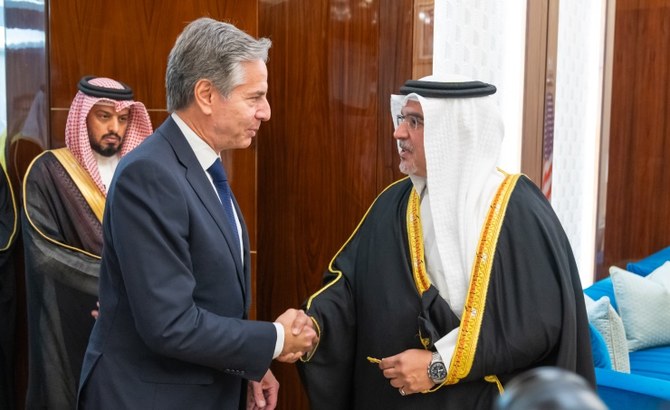
Bahraini Crown Prince Salman bin Hamad meets US Secretary of State Antony Blinken. (BNA)
Short Url
Updated 14 October 2023
Follow

Blinken holds talks on Hamas-Israel conflict in Bahrain, Qatar

LONDON: Bahrain’s Crown Prince Salman bin Hamad on Friday stressed the importance of providing humanitarian relief, food, water, electricity, medical aid and civilian protection in the Gaza Strip, state-run news agency BNA reported.

During a meeting with US Secretary of State Antony Blinken in the capital, Manama, he emphasised his country’s support for the de-escalation of violence and for peace efforts to promote regional security and stability.

Israeli strikes over the past week have leveled neighborhoods in Gaza, which has also been cut off from food, water and medical supplies, and is under a total power blackout.

The crown prince said that Bahrain supported all regional and global efforts to achieve security and stability, which served as a foundation for continued regional and global development, with the US and its allied countries playing a crucial role in consolidating the foundations of international peace and security.


The Gaza Health Ministry said on Friday that about 1,900 people had been killed in the Palestinian enclave in the past week, with more than half being under the age of 18, or women, while more than 1,300 Israelis were killed in the Hamas attack last Saturday.

“Secretary Blinken and the crown prince discussed Hamas’ terrorist attacks in Israel and the importance of preventing the conflict from widening and maintaining stability in the region,” the US State Department said in a statement. “The secretary reaffirmed the strong strategic partnership between the United States and Bahrain.”

Prince Salman also affirmed the strength of bilateral relations between Bahrain and the US, which further bolstered strategic partnerships.

“The Comprehensive Security Integration and Prosperity Agreement was highlighted as a cornerstone for joint Bahrain-US cooperation across various sectors, notably security, defense, advanced technology, trade and investment, as well as its contributions to strengthening regional security and economic development,” BNA said.

Earlier on Friday, Blinken held talks with Qatar’s emir and foreign minister in Doha as part of an extensive Middle East tour that included Israel and Jordan.

Emir Sheikh Tamim bin Hamad stressed during the meeting the importance of efforts aimed at de-escalation, opening safe corridors in Gaza for aid and humanitarian efforts, and ensuring that the conflict did not expand regionally.

He also stressed Qatar’s firm position on condemning the targeting of civilians.


Blinken said on social media platform X after the meeting: “Spoke with Qatar’s Amir today about the terrorist attacks in Israel and the ongoing conflict with Hamas. I expressed appreciation for Qatar’s efforts to secure the return of hostages.

“The efforts of our regional partners will be critical to prevent the conflict from spreading,” he said in another post.

Blinken expanded his trip from Israel and Jordan to include all of the Gulf Arab countries and Egypt, making it his biggest tour of the region since taking office.

Speaking during a joint press conference with Blinken, Qatari Prime Minister and Minister of Foreign Affairs Mohammed Bin Abdulrahman said that his country’s “priorities within the diplomatic approach is to seek a cease-fire, protect the civilians, release the captives, and to work hard in order not to spread violence in the region because this will have bad consequences.

“We also changed our viewpoints regarding humanitarian corridors to keep the assistance and aid reaching the Palestinians, particularly within the deterioration of the situation in Gaza Strip. It is a disaster, what we can see in Gaza Strip and shortage of basic needs, no electricity — because of the bombardment,” he added.

Blinken said that the US and Qatar wanted to prevent the conflict from spreading, adding that they “discussed in detail our efforts to prevent any actor — state or non-state — from creating a new front in this conflict.

“We’re also working intensively together to secure the release of hostages, including American citizens being held by Hamas in Gaza. I’m grateful for the urgency that Qatar is bringing to this effort.”

Protesters block Beirut roads after Cabinet approves new taxes that raise fuel prices

Updated 6 sec ago
Follow

Protesters block Beirut roads after Cabinet approves new taxes that raise fuel prices

  • On Tuesday, taxi drivers and others shut down key routes and warn they can escalate
  • The government says the money supports salary and pension boosts for public workers after the currency collapse
BEIRUT: Protesters blocked main roads in and around Beirut on Tuesday after Lebanon’s Cabinet approved new taxes that raise fuel prices and other products to fund public pay hikes.
The Cabinet approved a tax of 300,000 Lebanese pounds (about $3.30) on every 20 liters (5.3 gallons) of gasoline on Monday. Diesel fuel was exempted from the new tax, as most in Lebanon depend on it to run private generators to make up for severe shortages in state electricity.
The government also agreed to increase the value-added tax on all products already subject to the levy from 11 to 12 percent, which the parliament still has to approve.
The tax increases are to support raises and pension boosts of public employees, after wages lost value in the 2019 currency collapse, giving them the equivalent of an additional six months’ salary. Information Minister Paul Morcos said the pay increases were estimated to cost about $800 million.
Though the Mediterranean country sits on one of the largest gold reserves in the Middle East, it suffers ongoing inflation and widespread corruption. The cash-strapped country also suffered about $11 billion in damages in the 2024 war between Israel and the Hezbollah militant group.
Anger over fuel hike
Ghayath Saadeh, one of a group of taxi drivers who blocked a main road leading into downtown Beirut, said the country’s leaders “consider us taxi drivers to be garbage.”
“Everything is getting more expensive, food and drinks, and Ramadan is coming,” he said. “We will block all the roads, God willing, if they don’t respond to us.”
When the Lebanese government proposed new taxes in 2019, including a $6 monthly fee for using Internet calls through services such as WhatsApp, mass protests broke out that paralyzed the country for months. Demonstrators called for the country’s leaders to step down over widespread corruption, government paralysis and failing infrastructure, and for an end to the country’s sectarian power-sharing system.
Lebanon has been under international pressure to make financial reforms for years, but has so far made little progress.
Weapons plan discussed
Also Monday, the cabinet received a report from the Lebanese army on its progress on a plan to disarm non-state militant groups in the country, including Hezbollah.
Last month, the army announced it had completed the first phase of the plan, covering the area south of the Litani River, near the border with Israel. The second phase of the plan will cover segments of southern Lebanon between the Litani and the Awali rivers, which includes the port city of Sidon.
Morcos, the information minister, said following the cabinet session that the second stage is expected to take four months but could be extended “depending on the available resources, the continuation of Israeli attacks and the obstacles on the ground.”
The disarmament plan comes after a US-brokered ceasefire nominally ended a war between Hezbollah and Israel in November 2024. Since then, Israel has accused Hezbollah of rebuilding and has continued to launch near-daily strikes in Lebanon and to occupy several hilltop points on the Lebanese side of the border.
Hezbollah has insisted that the ceasefire deal only requires it to disarm south of the Litani and that it will not discuss disarming in the rest of the country until Israel stops its strikes and withdraws from all Lebanese territory.