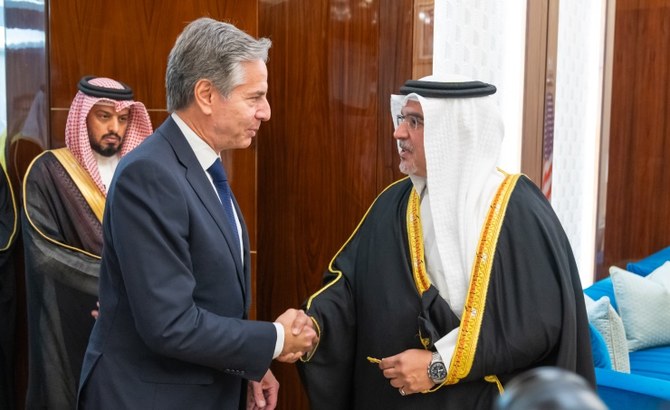

LONDON: Bahrain’s Crown Prince Salman bin Hamad on Friday stressed the importance of providing humanitarian relief, food, water, electricity, medical aid and civilian protection in the Gaza Strip, state-run news agency BNA reported.
During a meeting with US Secretary of State Antony Blinken in the capital, Manama, he emphasised his country’s support for the de-escalation of violence and for peace efforts to promote regional security and stability.
Israeli strikes over the past week have leveled neighborhoods in Gaza, which has also been cut off from food, water and medical supplies, and is under a total power blackout.
The crown prince said that Bahrain supported all regional and global efforts to achieve security and stability, which served as a foundation for continued regional and global development, with the US and its allied countries playing a crucial role in consolidating the foundations of international peace and security.
The Gaza Health Ministry said on Friday that about 1,900 people had been killed in the Palestinian enclave in the past week, with more than half being under the age of 18, or women, while more than 1,300 Israelis were killed in the Hamas attack last Saturday.
“Secretary Blinken and the crown prince discussed Hamas’ terrorist attacks in Israel and the importance of preventing the conflict from widening and maintaining stability in the region,” the US State Department said in a statement. “The secretary reaffirmed the strong strategic partnership between the United States and Bahrain.”
Prince Salman also affirmed the strength of bilateral relations between Bahrain and the US, which further bolstered strategic partnerships.
“The Comprehensive Security Integration and Prosperity Agreement was highlighted as a cornerstone for joint Bahrain-US cooperation across various sectors, notably security, defense, advanced technology, trade and investment, as well as its contributions to strengthening regional security and economic development,” BNA said.
Earlier on Friday, Blinken held talks with Qatar’s emir and foreign minister in Doha as part of an extensive Middle East tour that included Israel and Jordan.
Emir Sheikh Tamim bin Hamad stressed during the meeting the importance of efforts aimed at de-escalation, opening safe corridors in Gaza for aid and humanitarian efforts, and ensuring that the conflict did not expand regionally.
He also stressed Qatar’s firm position on condemning the targeting of civilians.
Blinken said on social media platform X after the meeting: “Spoke with Qatar’s Amir today about the terrorist attacks in Israel and the ongoing conflict with Hamas. I expressed appreciation for Qatar’s efforts to secure the return of hostages.
“The efforts of our regional partners will be critical to prevent the conflict from spreading,” he said in another post.
Blinken expanded his trip from Israel and Jordan to include all of the Gulf Arab countries and Egypt, making it his biggest tour of the region since taking office.
Speaking during a joint press conference with Blinken, Qatari Prime Minister and Minister of Foreign Affairs Mohammed Bin Abdulrahman said that his country’s “priorities within the diplomatic approach is to seek a cease-fire, protect the civilians, release the captives, and to work hard in order not to spread violence in the region because this will have bad consequences.
“We also changed our viewpoints regarding humanitarian corridors to keep the assistance and aid reaching the Palestinians, particularly within the deterioration of the situation in Gaza Strip. It is a disaster, what we can see in Gaza Strip and shortage of basic needs, no electricity — because of the bombardment,” he added.
Blinken said that the US and Qatar wanted to prevent the conflict from spreading, adding that they “discussed in detail our efforts to prevent any actor — state or non-state — from creating a new front in this conflict.
“We’re also working intensively together to secure the release of hostages, including American citizens being held by Hamas in Gaza. I’m grateful for the urgency that Qatar is bringing to this effort.”