

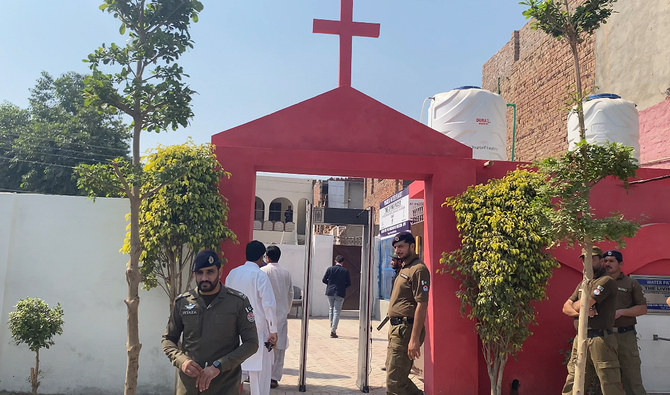

JARANWALA: The government has repaired over 20 churches damaged during a mob attack in August against a Christian community in a central Pakistani town and disbursed two million rupees each to affected families, officials said on Thursday.
The mob assault, the worst case of communal violence in decades, broke out in Jaranwala city on August 16 after two Christians were accused of desecrating the Holy Qur’an.
Suspects found guilty under Pakistan’s blasphemy laws can be sentenced to death. While authorities have yet to carry out capital punishment for a blasphemy offence, often mere accusations can incite mobs to violence and lynching.
In a government-organized visit of foreign media journalists to Jaranwala on Thursday, authorities said they had repaired nearly all destroyed churches and awarded financial compensation to families whose homes were damaged by the mob.
“In all, nearly 22 churches were affected and the government has spent over Rs124 million [$443,649] to restore them all,” Abdullah Nayyar Sheikh, deputy commissioner of Faisalabad, said.
Of the 22 churches the official spoke of, Arab News visited seven, including three main churches, which had been completely burnt.
“Several churches required extensive reconstruction to meet both the structural security standards of the building department and the satisfaction of the Christian community,” Sheikh said.
Faisalabad’s City Police Officer (CPO), Captain (retired) Muhammad Ali Zia, said a dedicated team headed by a senior official was now investigating the case, in which over 300 people had been arrested to date.
“Twenty-two FIRs [police complaints] have been registered for these churches and more than 300 people arrested so far,” he said, adding that a well-manned police contingent was deployed in the area to check against further violence.
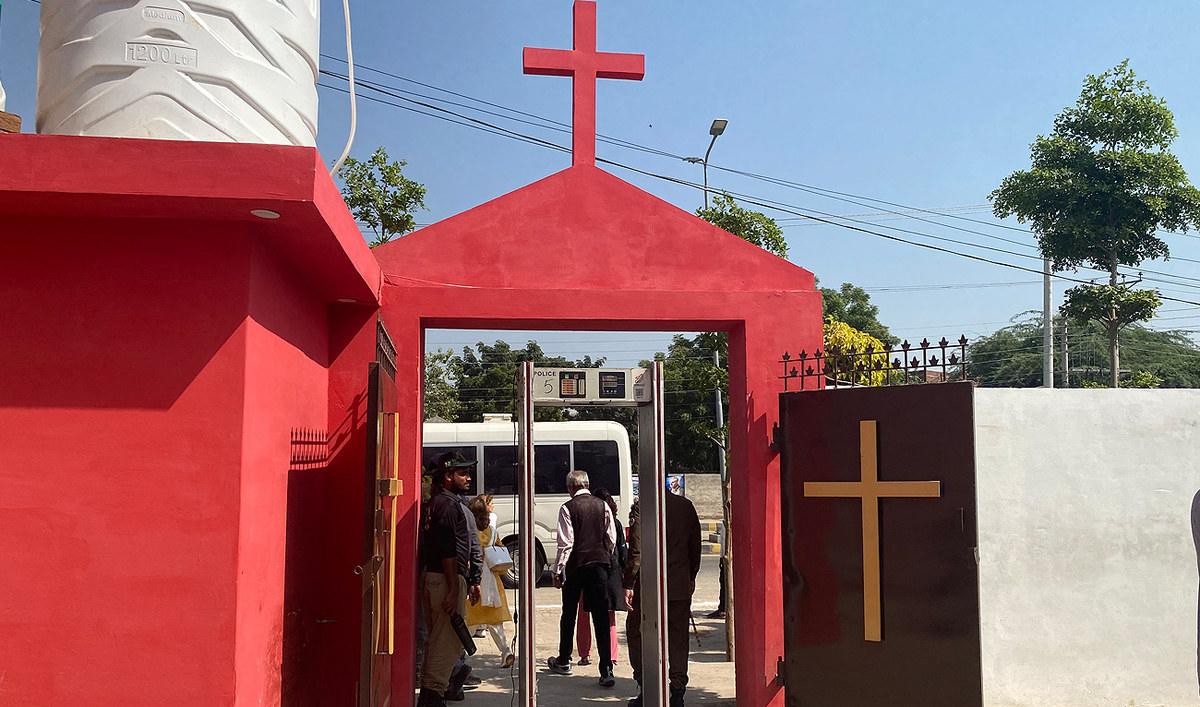
Police stand guard outside the restored church in Jaranwala on the outskirts of Faisalabad on October 12, 2023, as the Pakistani government reconstructed churches that were targeted during the mob attack over blasphemy allegations on August 16. (AN Photo)
Sheikh said authorities had set up a relief camp right after the mob attack, which provided shelter to 52 families and had a temporary school.
“Until electricity, water and gas were not restored, we delivered the meals to these families and provided them relief goods which included different items to get their homes back running, such as towels, blankets and even toys for the kids, sanitation kits and everything for school children,” he added.
Faisalabad’s City Police Officer (CPO), Captain (retired) Muhammad Ali Zia, said a dedicated team headed by a senior official was investigating the case in which over 300 people had been arrested.
“Twenty-two FIRs [police complaints] have been registered for these churches and more than 300 people have been arrested so far,” he said, adding that a well-manned police contingent was deployed in the area to prevent further violence.
Zia said Muslim residents of Jaranwala offered that Christians use their mosques until their churches were restored, while police had set up 57 centers across the Punjab province to work on interfaith initiatives in a bid to ensure greater social harmony.
Major Mashooq Masih, the bishop of the area, corroborated that 22 churches had been restored after the attack and said five Christian police personnel were deployed at the interfaith center in Faisalabad district address problems of the community on priority. He did not confirm the monetary compensation officials said had been paid.
“The administration also invited our pastors and bishops to mosques during Friday prayers and Maulanas [Muslim religious leaders] to the churches to promote good relations between the two communities,” Masih added.
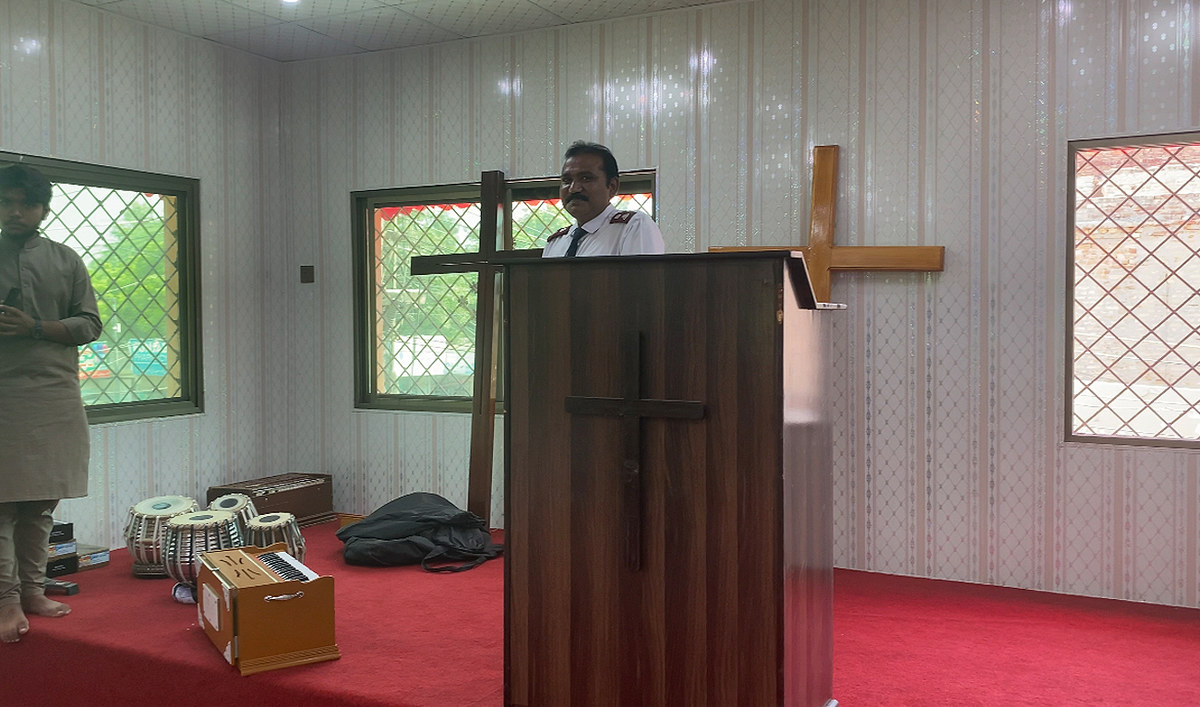
Bishop Major Mashooq Masih gestures inside the restored church in Jaranwala on the outskirts of Faisalabad on October 12, 2023, as the Pakistani government reconstructed churches that were targeted during the mob attack over blasphemy allegations in August this year. (AN Photo)
Zia said Muslim residents of Jaranwala offered that Christians use their mosques until their churches were restored, while police had set up 57 centers across the Punjab province to work on interfaith initiatives in a bid to ensure social harmony.
Major Mashooq Masih, the bishop of the area, corroborated that 22 churches had been restored after the attack and said five Christian police personnel were deployed at the interfaith center in Faisalabad district to address problems of the community on priority.
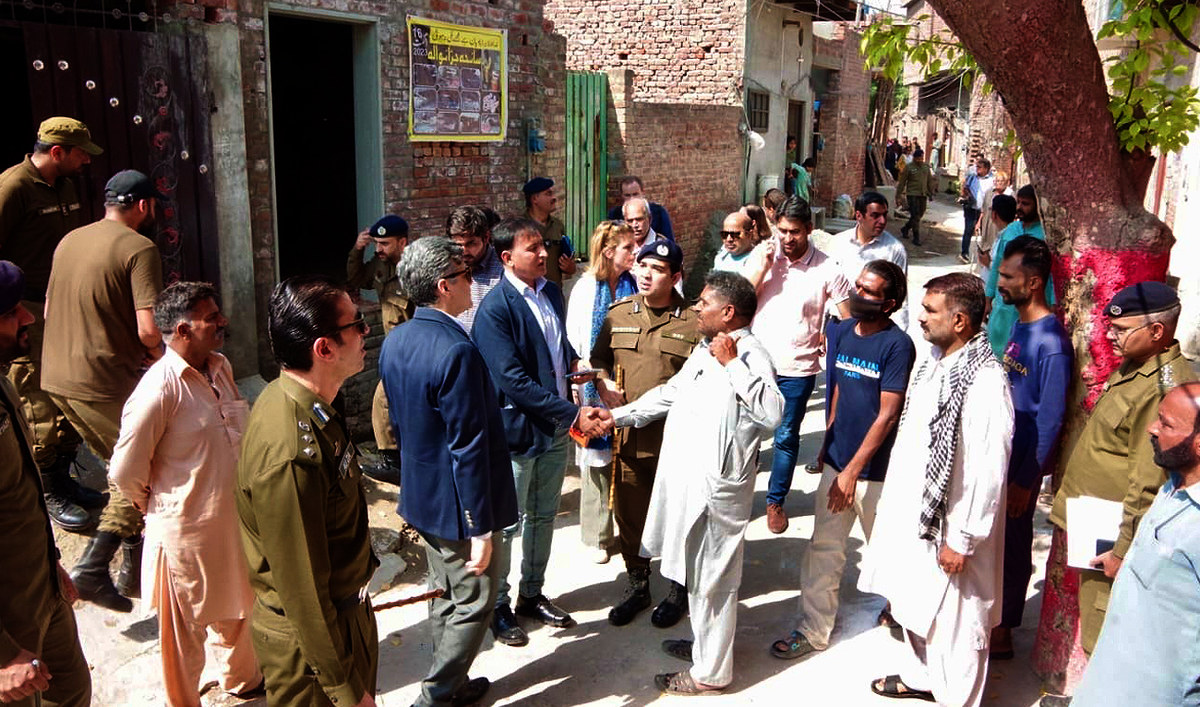
Security officials and foreign media representatives interact with the Christian community in Jaranwala on the outskirts of Faisalabad on October 12, 2023, as the Pakistani government reconstructed churches that were targeted during the mob attack over blasphemy allegations in August this year. (AN Photo)
“The administration also invited our pastors and bishops to mosques during Friday prayers and Maulanas [Muslim religious leaders] to the churches to promote good relations between the two communities,” Masih added.
In August, days after the attack, Mohsin Naqvi, the chief minister in Punjab province where Jaranwala is located, had announced that families whose homes were destroyed or damaged by the mob would each get Rs2 million, or around $7,000, in compensation.
Deputy Commissioner Sheikh said 80 families had been compensated. Arab News met several Christians during Thursday's media visit who said they had received the funds. Caretaker Prime Minister Anwaar-ul-Haq Kakar had also visited Jaranwala on August 21 to express solidarity with the Christian community, and distributed cheques to some of the affected households.
But Christian community members said it was hard to overcome the trauma of the August attack despite the efforts of the government.
“Everything is fine in terms of what the government has done,” Hina Shehbaz, who witnessed the mob attack, told Arab News, confirming that her family had been paid Rs2 million.
“Still, there are moments when we fear the possibility of a similar incident occurring again.”


