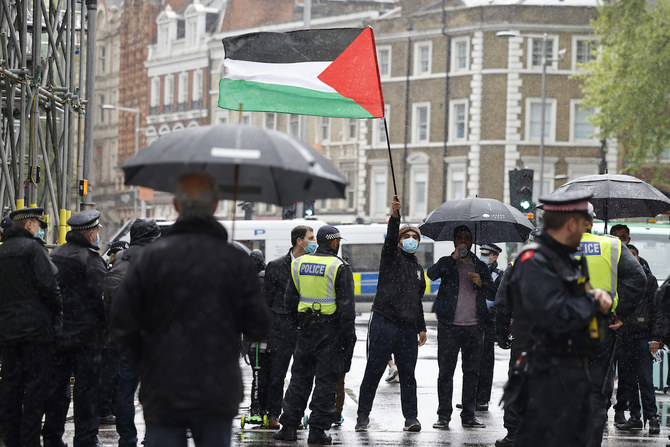
LONDON: London’s Metropolitan Police Deputy Commissioner Dame Lynne Owens said on Thursday there will be no crackdown on people waving the Palestinian flag.
The announcement comes after UK Home Secretary Suella Braverman called on police chiefs on Tuesday to take a tough line, not just against shows of support for Hamas — which is proscribed as a terrorist organization in Britain — but also toward some pro-Palestinian displays.
“Behaviors that are legitimate in some circumstances, for example the waving of a Palestinian flag, may not be legitimate such as when intended to glorify acts of terrorism,” she said in her letter.
Owens said that, in accordance with the law, the Met cannot interpret broad support for the Palestinian cause as automatically supporting Hamas or any other proscribed group, even when it comes shortly after an attack carried out by that group.
“An expression of support for the Palestinian people more broadly, including flying the Palestinian flag, does not, alone, constitute a criminal offense,” Owens said in an open letter to Jewish communities.
“Of course, behavior at protests goes beyond what is and isn’t seen as support for proscribed groups,” she said.
The letter added that religiously motivated abuse or intimidation will not be tolerated and officers will take action when they see it.
Earlier on Monday, a large demonstration in support of Palestinians in Gaza gathered outside the Israeli Embassy in London.
The event’s organizers, including UK groups Friends of Al-Aqsa, the Palestine Solidarity Campaign, and the Muslim Association of Britain are planning another protest on Saturday outside the BBC headquarters.
“We will police them without fear or favor and I expect our officers to act where they see offenses, including expressions of support for proscribed organizations or any instance of religious hatred,” Owen said.

London police rule out crackdown on people waving Palestinian flag
Short Url
https://arab.news/gyhf8
London police rule out crackdown on people waving Palestinian flag
- Decision follows UK Home Secretary Suella Braverman’s call for ‘tough line’ on shows of support for Hamas
Army chief says Switzerland can’t defend itself from full-scale attack
ZURICH: Switzerland cannot defend itself against a full-scale attack and must boost military spending given rising risks from Russia, the head of its armed forces said.
The country is prepared for attacks by “non-state actors” on critical infrastructure and for cyberattacks, but its military still faces major equipment gaps, Thomas Suessli told the NZZ newspaper.
“What we cannot do is defend against threats from a distance or even a full-scale attack on our country,” said Suessli, who is stepping down at the end of the year.
“It’s burdensome to know that in a real emergency, only a third of all soldiers would be fully equipped,” he said in an interview published on Saturday.
Switzerland is increasing defense spending, modernizing artillery and ground systems and replacing aging fighter jets with Lockheed Martin F-35As.
But the plan faces cost overruns, while critics question spending on artillery and munitions amid tight federal finances.
Suessli said attitudes toward the military had not shifted despite the war in Ukraine and Russian efforts to destabilize Europe.
He blamed Switzerland’s distance from the conflict, its lack of recent war experience and the false belief that neutrality offered protection.
“But that’s historically inaccurate. There are several neutral countries that were unarmed and were drawn into war. Neutrality only has value if it can be defended with weapons,” he said.
Switzerland has pledged to gradually raise defense spending to about 1 percent of GDP by around 2032, up from roughly 0.7 percent now – far below the 5 percent level agreed by NATO countries.
At that pace, the Swiss military would only be fully ready by around 2050.
“That is too long given the threat,” Suessli said.
The country is prepared for attacks by “non-state actors” on critical infrastructure and for cyberattacks, but its military still faces major equipment gaps, Thomas Suessli told the NZZ newspaper.
“What we cannot do is defend against threats from a distance or even a full-scale attack on our country,” said Suessli, who is stepping down at the end of the year.
“It’s burdensome to know that in a real emergency, only a third of all soldiers would be fully equipped,” he said in an interview published on Saturday.
Switzerland is increasing defense spending, modernizing artillery and ground systems and replacing aging fighter jets with Lockheed Martin F-35As.
But the plan faces cost overruns, while critics question spending on artillery and munitions amid tight federal finances.
Suessli said attitudes toward the military had not shifted despite the war in Ukraine and Russian efforts to destabilize Europe.
He blamed Switzerland’s distance from the conflict, its lack of recent war experience and the false belief that neutrality offered protection.
“But that’s historically inaccurate. There are several neutral countries that were unarmed and were drawn into war. Neutrality only has value if it can be defended with weapons,” he said.
Switzerland has pledged to gradually raise defense spending to about 1 percent of GDP by around 2032, up from roughly 0.7 percent now – far below the 5 percent level agreed by NATO countries.
At that pace, the Swiss military would only be fully ready by around 2050.
“That is too long given the threat,” Suessli said.
© 2025 SAUDI RESEARCH & PUBLISHING COMPANY, All Rights Reserved And subject to Terms of Use Agreement.


