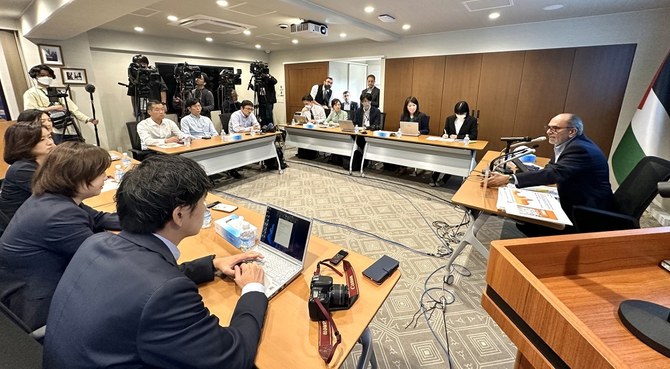
TOKYO: Waleed Siam, the Representative of Palestine in Japan, sought sympathy for the people of Gaza in a press conference in Tokyo on Wednesday and accused the West of hypocrisy and using a “narrow lens” to view the situation in the Middle East.
“I stand before you to address the enduring Israeli-Palestinian conflict,” he said in his opening remarks.
“Regrettably, some see history through a narrow lens, focusing solely on the recent violence. We must recognize that the Palestinian people have endured one deadly year after another, a matter of grave concern that has persisted far too long, bringing untold suffering to both Palestinian and Israeli populations.”
“I’d like to begin by clarifying that we, the Palestinian people, unequivocally reject any dehumanizing rhetoric, such as that propagated by the ultra-right-wing Israeli government, which has labeled us as animals.”
Siam said the victims of the conflict are not to blame. “We should hold the international community accountable, especially those nations that have supported Israel’s military occupation and perpetuated injustices.”
He added that there was a certain indifference by some nations in holding Israel accountable for their actions, accusing Israel of prioritizing “occupation and colonization over peace, brazenly violating international law for decades.”
He also wanted to focus on the terrible humanitarian conditions that some Palestinians have to live in.
“Palestinians in Gaza are enduring dire living conditions,” he said. “No water, no electricity, no medical supplies, these are closeby to those found in concentration camps. It is heart-wrenching to witness the support for illegal settlements and the encouragement of the illegal settlers to continue their racist attacks on Palestinian citizens on Palestinian land.”
Siam said the settlers are given arms to attack Palestinians, while other attacks target religious holy sites such as the Alaina Mosque.
“Retaliation cannot be the answer,” he said. “We currently witness the execution of civilians under the pretext of legitimate self-defense. According to international law, the occupier cannot claim self-defense. UN resolutions affirm the right of occupied peoples to resist in any form they choose.”


![]()
![]()

Palestine ambassador in Japan accuses West of hypocrisy

Short Url
https://arab.news/j58dx
Palestine ambassador in Japan accuses West of hypocrisy
- “I stand before you to address the enduring Israeli-Palestinian conflict,” Waleed Siam said
- He said the victims of the conflict are not to blame


Latest updates


© 2026 SAUDI RESEARCH & PUBLISHING COMPANY, All Rights Reserved And subject to Terms of Use Agreement.