
RIYADH: Energy firm NEOM Green Hydrogen Co. is considering investments and potential expansions across Saudi Arabia and beyond, a top official has revealed.
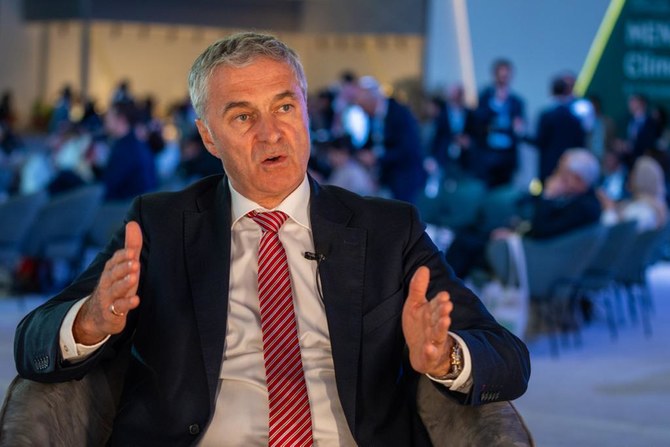
In an interview with Arab News on the sidelines of the Middle East and North Africa Climate Week in Riyadh, the company’s CEO, David Edmondson, discussed the energy transition journey in the MENA region, highlighting that a facility is slated to begin full-scale production of green ammonia by the end of 2026.
“We are interested in the next phase of investment. We’re doing various feasibility studies on what we could do, debottlenecking the existing plant and potentially looking at future investments. I can see additional investments in NEOM Hydrogen Co. but also across the whole of Saudi Arabia and in the MENA region,” said Edmondson.
He added: “No one has ever built a plant of this size or scale before. So this is the first of its kind, and we’re about four or five times bigger than any other plant that’s being considered even right now.
“We would like to provide additional investments to address the domestic market. However, the focus really right now is getting this project up and running and moving.”
Edmondson added that Saudi Arabia will soon become a global leader in exporting green hydrogen, attracting investors in the sector.
“Technologies keep developing. The investment situation is constantly changing. But I think with the commitments that Saudi Arabia has made through its Vision 2030, the aspirations they have to become a leading exporter, it provides a very positive location for investing at this level and exporting green hydrogen to the world,” said the executive.
Edmondson confirmed that the first wind turbines have been delivered to the port of NEOM, with hydrogen storage tanks arriving in November.
“We’re expecting to start producing ammonia, that is green ammonia, by the summer of 2026 and expect full production by the end of 2026,” he added.
NGHC is a joint venture between ACWA Power, Air Products, and NEOM.
Apart from limiting carbon emissions and promoting sustainable development in Saudi Arabia, this project is expected to contribute to the country’s diversification efforts.
The firm is set to sell its goods through US-based company Air Products, which has agreed a 30-year offtake, according to Edmondson.
“They’ve made very specific downstream commitments in Europe, in the UK, Germany and the Netherlands. They’ve got receiving terminals. They’ll break that back down to hydrogen and then they will sell that locally. So those investments are already going on,” he said.
He further noted that the NGHC reached financial closure for its green hydrogen plant in May.
It finalized backing agreements with 23 local, regional, and international banks and investment firms to construct a green hydrogen production facility with a total investment value of $8.4 billion.
He added: “We actually committed back in 2020 to arrive at $900 million of shareholder funding to continue the work, to start placing the contracts that we needed to with financial close. We now have all the financing we need.”
The structure is being built at Oxagon, within Saudi Arabia’s $500-billion project NEOM.
Edmondson added that NGHC is currently in its next investment phase and is busy expanding its operating team.
“We’re already hiring our operations teams. We obviously have to provide training to those individuals. We want to provide opportunities for local Saudis. So yes, we are interested in the next phase of investment,” said Edmondson.
During the talk, the CEO noted that the plant aims to produce 600 tons a day of carbon-free green hydrogen by 2026.
“The project is really focused on the export market because back in 2019 and 2020, there wasn’t really a domestic market that was fully established. A lot is changing and I imagine in the next 2 to 3 years, the local market will continue to evolve and develop,” said Edmondson.
He added that all the products are for exports, saying: “If you look at that in light of the Vision 2030 commitments, the Kingdom is looking to export 4 million tons per year of low-carbon hydrogen by 2030. So we’re making 250,000 tons of that by 2026.”
Edmondson further emphasized that NGHC’s efforts will play a significant role in fulfilling the Kingdom’s adherence to becoming the world’s largest exporter of carbon-free hydrogen.
“Saudi Arabia is committed to being the largest exporter of low-carbon hydrogen. They've made some very bold aspirations. Clearly, NEOM Green Hydrogen Co. is at the beginning of that journey. We expect many others to follow,” said Edmondson.
He further highlighted that the world will soon see a variety of vehicles powered by hydrogen fuel, adding: “We'll see busses, trucks, trains even operated on hydrogen.”
Earlier in October, Saudi Arabia’s national railway company entered into an agreement with French rail transportation giant Alstom to commence testing for its ambitious hydrogen train project.
According to a Saudi Press Agency report, both entities will embark on operational experiments and studies to assess the trains’ compatibility with the environment, setting the stage for their future deployment.
Addressing the ongoing energy transition and climate-related concerns, Edmondson pointed out that the upcoming COP28 conference in the UAE this winter will act as a turning point for addressing the challenges posed by global warming.
“The dialogue on climate change has been going on for many years. I think there have been a lot of people who don't believe it. Increasingly it’s more obvious, and I think particularly to the younger generation will inherit the earth. So they see the urgency behind it,” he said.
Although significant investments are transpiring in green technology, the CEO added that limiting the global average temperature rise of 1.5 degrees Celsius as outlined in the Paris Agreement remains a challenge.