JERUSALEM: The bodies of about 1,500 Hamas fighters have been found in Israeli territory, an Israeli military spokesman said, adding that it had largely gained control of the country’s south and “restored full control” across the border.
Speaking on the fourth day of fighting spokesperson Lieutenant-Colonel Richard Hecht said no Hamas fighters had crossed into Israel since Monday night, although the risk of infiltrations was still possible.
Israel has previously reported that 900 of its soldiers and civilians had been killed.
Meanwhile Palestinian authorities say about 700 people have been killedin Gaza and the West Bank.
Hundreds killed in fourth day
Israeli forces continued to bombard downtown Gaza City, home to Hamas’ centers of government into the early hours of Tuesday, after Israel’s prime minister vowed retaliation against the Islamic militant group that would “reverberate for generations.”
The 4-day-old siege has already claimed 1,600 lives, as Israel saw gunbattles in the streets of its own towns for the first time in decades and neighborhoods in Gaza were reduced to rubble. Hamas also escalated the conflict, pledging to kill captured Israelis if strikes targeted civilians without warning.
Israel said Hamas and other militant groups in Gaza were holding more than 150 soldiers and civilians snatched from inside Israel after the attack caught its military and intelligence apparatus completely off guard.

Palestinians fleeing their homes amid Israeli strikes ride a donkey cart carrying their belongings, in Gaza City on Oct. 10, 2023. (Reuters)
The Israeli military said it had largely gained control in the south and “restored full control” over the border.
Spokesman Lt Col Hecht said 300,000 reservists had been mobilized, prompting speculation that the Israelis were planning a ground assault into the Mediterranean coastal territory.
The last ground assault was in 2014.
Thousands of Israelis were evacuated from more than a dozen towns near Gaza.
Elsewhere tanks and drones were deployed to guard against breaches at the Gaza border fence. In Gaza, tens of thousands fled their homes as airstrikes continued to level buildings.
Speculation over possible Israeli ground assault
The Israeli military revised on Tuesday a recommendation by one of its spokespeople that Palestinians fleeing its air strikes in the Gaza Strip should head to Egypt, saying in a follow-up statement that the main crossing on that border was currently closed.
Briefing foreign reporters, Lt Col Hecht advised Palestinian refugees to “get out” through the Rafah crossing on Gaza's southern border with Egypt.
But his office later issued a statement that read: “Clarification: The Rafah crossing was open yesterday, but now it is closed”.
The Israeli military said it had largely gained control in the south and “restored full control” over the border.
Spokesman Lt Col Hecht said 300,000 reservists had been mobilized, prompting speculation that the Israelis were planning a ground assault into the Mediterranean coastal territory.
The last ground assault was in 2014.
Thousands of Israelis were evacuated from more than a dozen towns near Gaza.
Elsewhere tanks and drones were deployed to guard against breaches at the Gaza border fence. In Gaza, tens of thousands fled their homes as airstrikes continued to level buildings.
Egypt border closed
The Israeli military revised on Tuesday a recommendation by one of its spokespeople that Palestinians fleeing its air strikes in the Gaza Strip should head to Egypt, saying in a follow-up statement that the main crossing on that border was currently closed.
Briefing foreign reporters, Lt Col Hecht advised Palestinian refugees to “get out” through the Rafah crossing on Gaza's southern border with Egypt.
But his office later issued a statement that read: “Clarification: The Rafah crossing was open yesterday, but now it is closed”.
On Monday evening, Egyptian security sources said operations at Rafah had been disrupted by a strike on the Gaza side.
“We have only started striking Hamas,” Israeli Prime Minister Benjamin Netanyahu said in a nationally televised address.
“What we will do to our enemies in the coming days will reverberate with them for generations.”
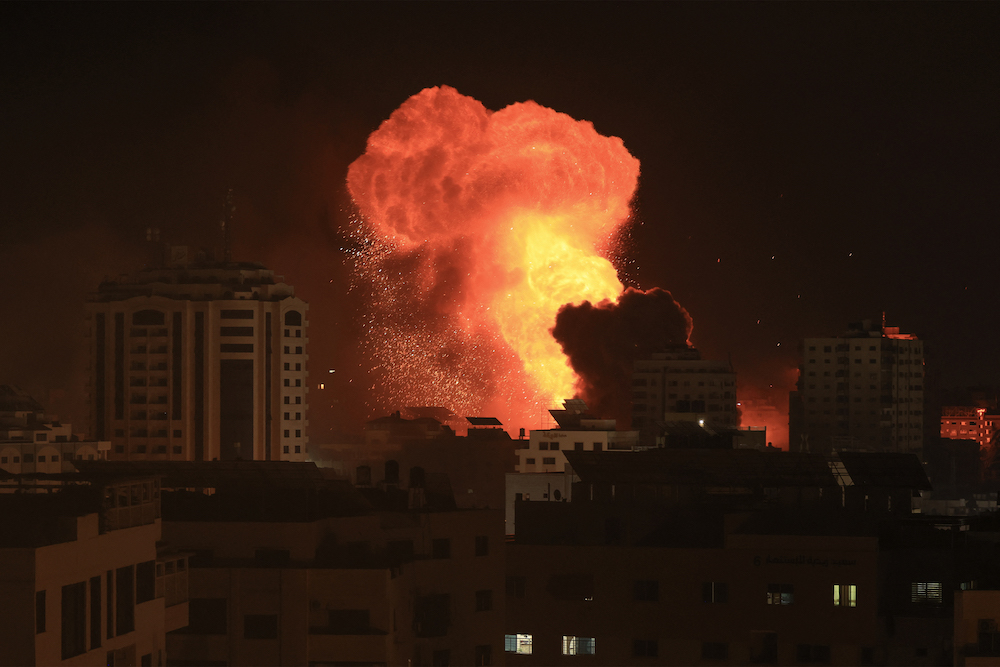
A fireball erupts during Israeli bombardment of Gaza City on Oct. 9, 2023. (AFP)
On Monday the bodies of more victims of the surprise attack by Hamas’ into southern Israeli towns were found.
In the tiny farming community of Be’eri there were 100 bodies found — that’s about around 10 percent of its population — following a standoff with gunmen.
In response to Israel’s aerial attacks, the spokesman of Hamas’ armed wing, Abu Obeida, said Monday night that the group would kill one Israeli civilian captive any time Israel targeted civilians in their homes in Gaza “without prior warning”.
Israeli Foreign Minister Eli Cohen warned Hamas against harming any of the hostages, saying, “This war crime will not be forgiven.”
Netanyahu appointed a former military commander to manage the hostage and missing persons crisis.
Israel and Hamas have clashed in repeated conflicts through the years, often sparked by tensions around holy sites.
This time, the context has become potentially more explosive.
Ending the deadlock with violence
Both sides talk of shattering with violence a yearslong Israeli-Palestinian deadlock left by the failing peace process.
The surprise weekend attack by Hamas left a death toll unseen since the 1973 war with Egypt and Syria.
That fomented calls to crush Hamas no matter the cost, rather than continuing to try to bottle it up in Gaza.
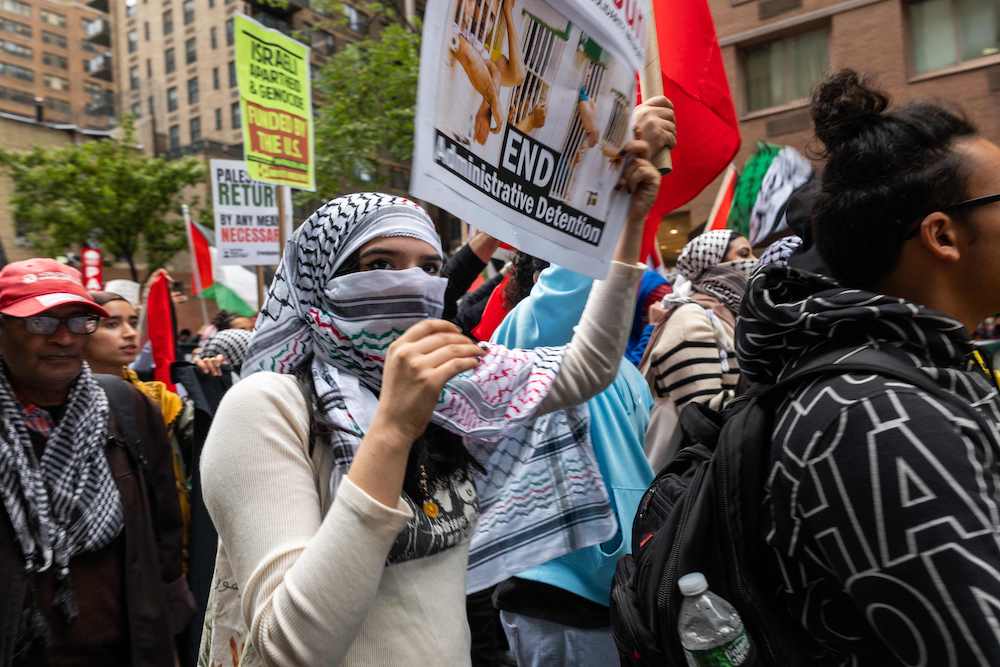
Palestinian supporters participate in a rally in midtown Manhattan following continued fighting in Israel and Gaza on Oct. 09, 2023 in New York City. (Getty Images/AFP)
Israel is run by a hard-right government, dominated by ministers who reject Palestinian statehood.
Hamas, in turn, says it is ready for a long battle to end an Israeli occupation it says is no longer tolerable.
Desperation has grown among Palestinians, many of whom see nothing to lose under endless Israeli control and increasing settler attacks in the West Bank, the blockade in Gaza and what they see as the world’s apathy.
Devastation continues
Attacks by both sides created more scenes of devastation Monday.
In Israel’s southern coastal city of Ashkelon, a man holding a crutch with one hand and an older boy with the other joined evacuees being shepherded from a street after a rocket blew out the front of a house.
In Gaza, Palestinians passed the bodies of the dead through dense crowds of men in the rubble in the Jebaliya refugee camp.
Early Monday evening, the sound of explosions echoed over Jerusalem when a volley of rockets fired from Gaza hit two neighborhoods — a sign of Hamas’s reach.
Israeli media said seven people were wounded.
Israeli warplanes carried out an intense bombardment of Rimal, a residential and commercial district of central Gaza City, after issuing warnings for residents to evacuate.
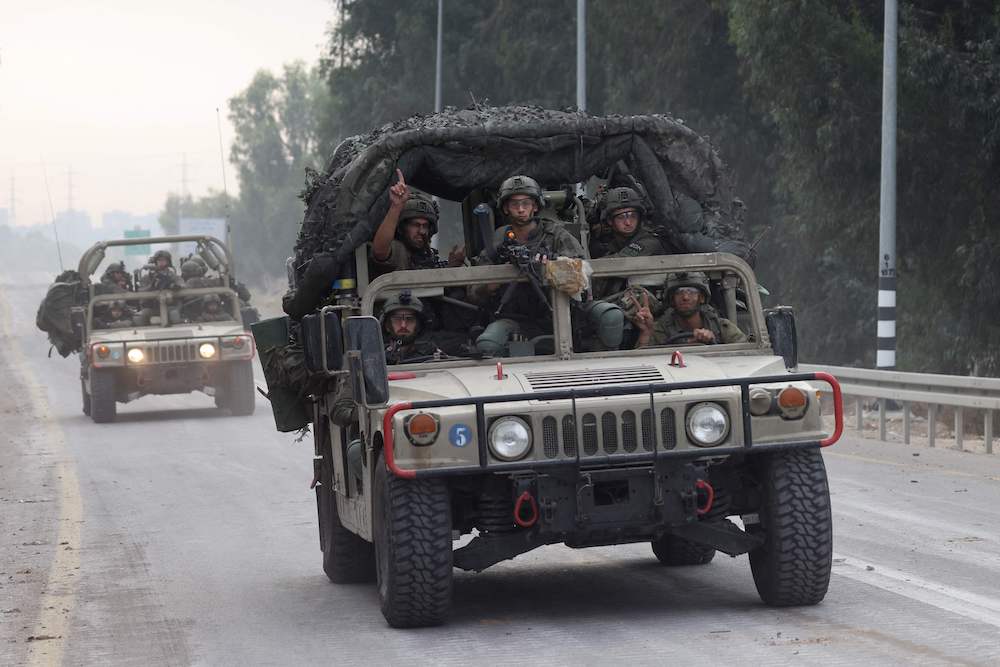
Israeli soldiers patrol a road near the border fence with Gaza on Oct. 10, 2023. (AFP)
Amid continuous explosions, the building housing the headquarters of the Palestinian Telecommunications Company was destroyed.
Israeli airstrikes on Gaza have razed 790 housing units and severely damaged 5,330, the UN Office for the Coordination of Humanitarian Affairs said early Tuesday.
Damage to three water and sanitation sites have cut off services to 400,000.
Israeli Defense Minister Yoav Gallant ordered a “complete siege” on Gaza, saying authorities would cut electricity and block the entry of food and fuel.
Tens of thousands of Gaza residents continued to flee.
The UN said Tuesday that more than 187,000 of Gaza’s 2.3 million people have left their homes — the most since a 2014 air and ground offensive by Israel uprooted about 400,000.
UNRWA, the UN agencies for Palestinian refugees, is sheltering more than 137,000 people in schools across the territory. Families have taken in some 41,000 others.
In the southern Gaza city of Rafah, an Israeli airstrike early Monday killed 19 people, including women and children, said Talat Barhoum, a doctor at the local Al-Najjar Hospital.
After breaking through Israeli barriers with explosives at daybreak Saturday, an estimated 1,000 Hamas gunmen rampaged for hours, gunning down civilians and snatching people in towns, along highways and at a techno music festival attended by thousands in the desert. Palestinian militants have also launched around 4,400 rockets at Israel, according to the military.