

Pakistan condemns Indian chief minister’s ‘irresponsible’ remarks on ‘taking back’ Sindh province

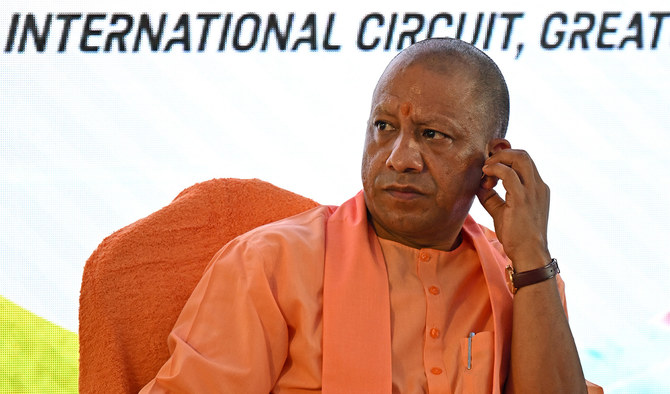
The chief minister of India's Uttar Pradesh state Yogi Adityanath attends an 'Invest India' conference before the start of the Indian MotoGP Grand Prix at the Buddh International Circuit in Greater Noida on the outskirts of New Delhi, on September 24, 2023. (AFP/File)
Short Url
Updated 09 October 2023
Follow

Pakistan condemns Indian chief minister’s ‘irresponsible’ remarks on ‘taking back’ Sindh province

  • Uttar Pradesh Chief Minister Yogi Adityanath said on Sunday that there is no reason why India cannot ‘take back Sindhu’
  • Pakistan’s foreign office spokesperson advises India to avoid nurturing ‘hegemonic and expansionist ambitions’

ISLAMABAD: Pakistan’s foreign office spokesperson on Monday criticized the recent statement by the chief minister of India’s Uttar Pradesh state regarding Sindh, saying that the “highly irresponsible” remarks reflect the leader’s expansionist mindset. 

Addressing a convention in Lucknow, Uttar Pradesh Chief Minister Yogi Adityanath said on Sunday that if Ram Janmabhoomi— a site in Ayodhya believed by Hindus to be the birthplace of Rama— can be taken back after 500 years, then there is no reason why India cannot take back Sindhu, the region around the Indus River in southern Pakistan. 

“We condemn the highly irresponsible remarks made by the Chief Minister of Uttar Pradesh, a key member of India’s ruling dispensation and a follower of the bigoted Hindutva ideology, at the National Sindhi Convention in Lucknow,” Foreign Office Spokesperson Mumtaz Zahra Baloch said in a statement. 

The site in the northern town of Ayodhya was bitterly contested for decades with both Hindus and Muslims laying claim to it. India’s majority Hindus say the site was holy to them long before Muslim Mughals razed a temple at the spot and built the Babri mosque there in 1528.

A Hindu mob destroyed the mosque in 1992, triggering riots that killed about 2,000 people across India, most of them Muslims.

Baloch condemned Adityanath for using Ram Janmabhoomi’s reclamation as a template for reclaiming Pakistan’s Sindh province. 

“Clearly, the Chief Minister’s provocative remarks are inspired by the gratuitous assertion of ‘Akhand Bharat’ (undivided India),” she said. 

“These remarks manifest a revisionist and expansionist mindset that seeks to subjugate the identity and culture of not only India’s neighboring countries but also its own religious minorities.”

Baloch urged Indian leaders to resolve disputes with neighboring countries to build a peaceful South Asia instead of nurturing “hegemonic and expansionist ambitions.”


Pakistan reviews austerity measures amid Middle East crisis, urges strict nationwide implementation

Updated 5 sec ago
Follow

Pakistan reviews austerity measures amid Middle East crisis, urges strict nationwide implementation

  • Deputy Prime Minister Ishaq Dar chairs review meeting of austerity steps
  • Officials briefed on salary cuts, school closures, four‑day week, petrol conservation

ISLAMABAD: Pakistan’s government on Wednesday assessed progress on a sweeping set of austerity measures introduced to mitigate the country’s economic strain from sharply rising global oil prices and supply disruptions linked to the ongoing war in the Middle East.

Prime Minister Shehbaz Sharif this week announced a series of austerity steps, including a four‑day work week for government offices, requiring 50  percent of staff to work from home, cutting fuel allowances for official vehicles by half, grounding up to 60  percent of the government fleet and closing all schools for two weeks to conserve fuel amid the global oil crisis.

The measures were unveiled in response to global oil market volatility triggered by the conflict involving the United States, Israel and Iran, which has disrupted supply routes such as the Strait of Hormuz and pushed crude prices sharply higher, straining Pakistan’s heavily import‑dependent energy sector.

“The meeting stressed the importance of strict and transparent adherence to the austerity measures, promoting fiscal responsibility and prudent use of public resources,” Deputy Prime Minister and Foreign Minister Senator Mohammad Ishaq Dar said in a statement.

He was chairing a meeting of the Committee for Monitoring and Implementation of Conservation and Additional Austerity Measures, constituted under the directions of the PM, bringing together federal and provincial officials to review execution of the broad cost‑cutting plan. 

Dar emphasized the government’s commitment to enforcing the PM’s austerity steps nationwide. The committee’s review also covered reductions in departmental expenditure, deductions from salaries of senior officials earning over Rs. 300,000 ($1,120), and coordination with provincial administrations to ensure uniform implementation of the plan.

Participants at the meeting reiterated that all ministries and divisions must continue strict monitoring and reporting, with transparent oversight mechanisms, as Pakistan navigates the economic pressures from the prolonged Middle East crisis and its fallout on global energy and trade markets.