


NEW YORK: Palestine’s permanent observer to the UN on Sunday urged the international community not to let Israel “double down on its terrible choices,” but to instead encourage it to change course and remind it that “there is a path to peace, where neither Palestinians nor Israelis are killed. And it is the one diametrically opposed to the one Israel has embarked on.”
Riyad Mansour was speaking to reporters outside the Security Council chamber at the UN headquarters in New York, as ambassadors from the 15-nation body walked past for emergency consultations behind closed doors, called for by Malta and later by the UAE, to discuss the escalation in Israel and Gaza.
More than 700 Israelis have been killed in an unprecedented, wide-ranging incursion into Israel by Hamas gunmen accompanied by thousands of rockets launched by the group. At least 415 Palestinians have been killed in Israeli airstrikes on Gaza.
No statement was agreed by council members during the meeting, with Chinese Ambassador Zhang Jun telling reporters on his way out that that is “abnormal.”
Mansour lamented that “history for some media and politicians starts when Israelis are killed. Our people have endured one deadly year after another.
“We came to the Security Council month after month warning of the consequences of Israeli impunity and international inaction.”
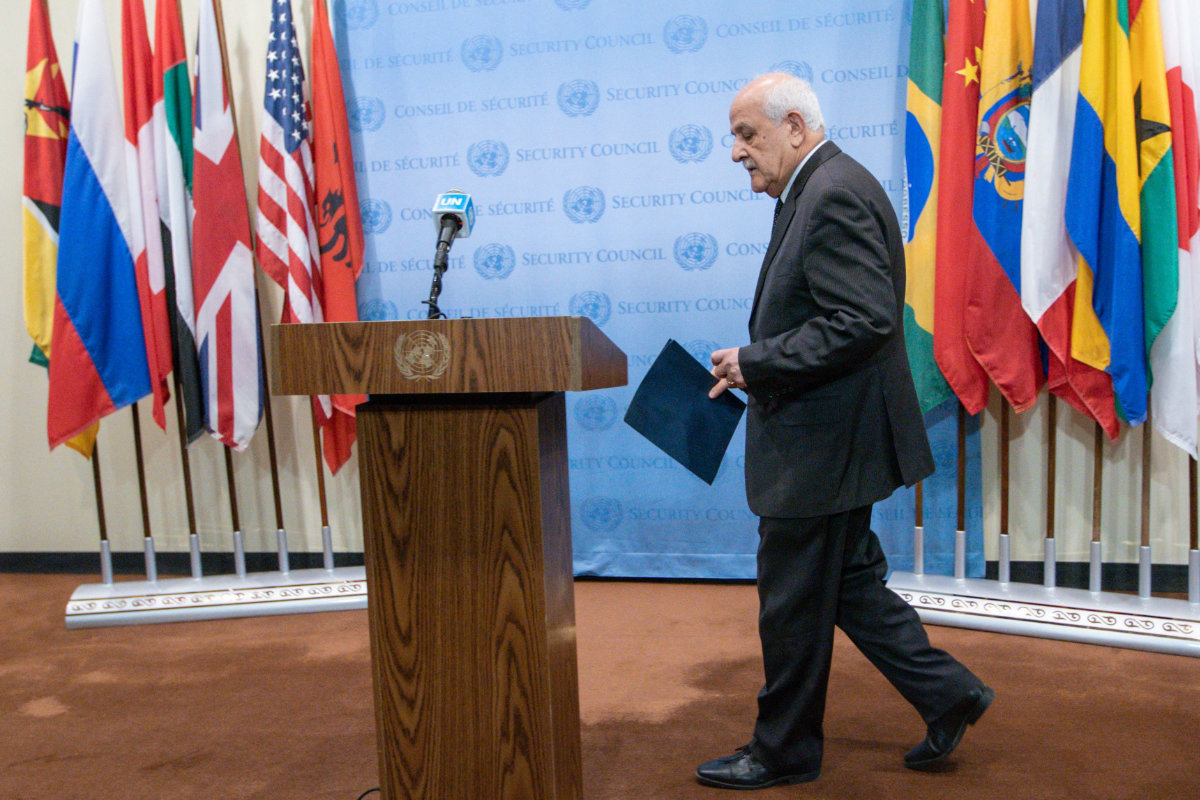
Ambassador Riyad Mansour, Permanent Observer of the State of Palestine to the United Nations, arrives to address a press conference before the UN Security Council meeting on October 8, 2023 in New York City. (Getty Images/AFP)
The Palestinian people have chosen the peaceful route, he said, adding that it is incumbent upon the world to support this choice.
“Last October, we stated before the Security Council: The Palestinian people will be free, one day or the other, one way or another. We chose the peaceful way, the one the international community advocates for. Do not let Israel prove us wrong, for our sake and theirs,” said Mansour.
“When Israel now tries to justify yet another assault by the same faulty premise, no one should say or do anything to encourage it down this path.
“We know only too well that the messages about ‘Israel’s right to defend itself’ will be interpreted by Israel as license to kill, to pursue on the very path that led us here.”
He added that “370 Palestinians have been killed already in a day, including children, some barely a few months old. Entire families were killed in their sleep. Will this bring security? Will this advance peace?”
While Israel has long maintained that the siege of Gaza and its “repeated assaults” on the enclave were intended to weaken Hamas’s military capabilities and ensure Israel’s security, Mansour said “clearly and expectedly” Israel failed to achieve any of its goals.
“The only thing (Israel) did accomplish was inflicting terrible suffering on an entire civilian population,” he added.
“It is time for an immediate end to the violence and the bloodshed, and it is time to end this blockade and to open a political horizon.”
Mansour questioned the lack of international protection for Palestinians when international law is violated by the occupying power, raising fundamental moral and legal questions about the unequal treatment of Palestinian lives.
He argued that protecting Palestinian civilians is not only a moral obligation but also a crucial step toward achieving peace.
“Where is the international protection the Palestinian people are entitled to when the occupying power violates international law and harms those it is obliged to protect? Aren’t Palestinian lives worth saving?
“The Palestinian civilians killed, the Palestinian children killed in occupied Palestine, could have been spared. Isn’t that a moral and legal obligation and a contribution to peace? Why nothing is done when those killed are Palestinians?
“We need to think hard of what logic we want to see prevail here. If this is about vengeance, then many Palestinians will feel they have much to avenge. If this is about peace, then the way to it is not through further entrenching oppression and occupation but by ending it.
“You cannot say ‘nothing justifies killing Israelis’ and then provide justifications for killing Palestinians. We are not sub-humans. We will never accept a rhetoric that denigrates our humanity and reneges our rights, a rhetoric that ignores the occupation of our land and oppression of our people.”
Mansour urged the international community to consider a different path, one that prioritizes the lives and rights of the Palestinian people.
He called for equal measures of freedom and security, emphasizing that standing up against occupation is not just the right thing to do morally, but also legally and politically.
Gilad Erdan, Israel’s permanent representative to the UN, also speaking before the Security Council meeting, described Hamas’s attack as “Israel’s 9/11,” accusing the group of executing a “barbaric pogrom, murdering in cold blood,” and labeling its actions as “blatant, documented war crimes.”
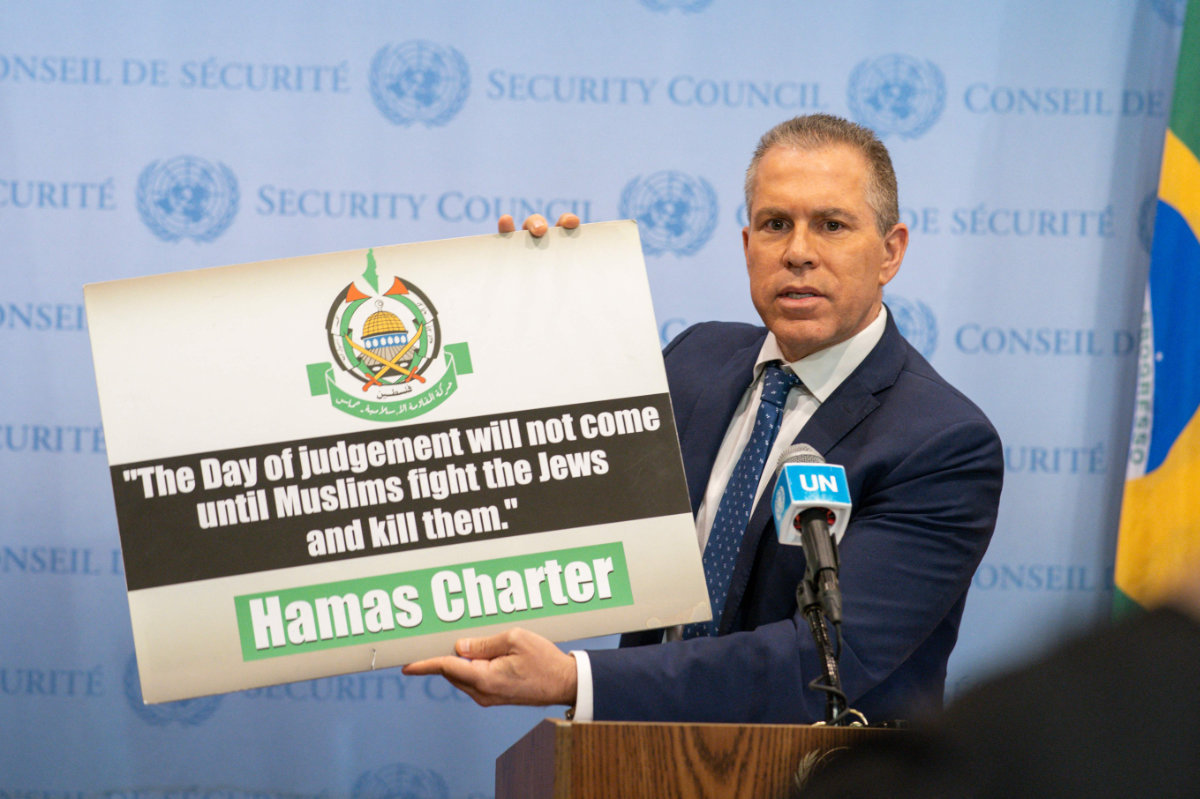
Israel's Ambassador to the UN Gilad Erdan holds up a sign as he speaks to reporters before the UN Security Council on October 8, 2023 in New York City. (Getty Images/AFP)
Israel demands that the Security Council “unequivocally” condemn Hamas and show “steadfast support” for Israel in defending itself, he said.
“The international community, and particularly the UN and the Security Council, have a very short memory when it comes to Israel. The terror that we endure quickly becomes a side note, but this time will not be the same.”
Comparing Hamas to Daesh and Al-Qaeda, Erdan argued that the world’s attempts to reason with Hamas have failed.
“Today, we are shattering the paradigm. The error of reasoning with these savages is over. Now is the time to obliterate Hamas’s infrastructure, to completely erase it so that such horrors are never committed again. And the international community must give Israel its full support,” he said.
“Mark my words, Israel may be under attack today, but this is … a war on the free world. It is a war on civilization.
“Israel is at the forefront of the war on terror, and if we do not succeed, the whole world will pay the price.”


