

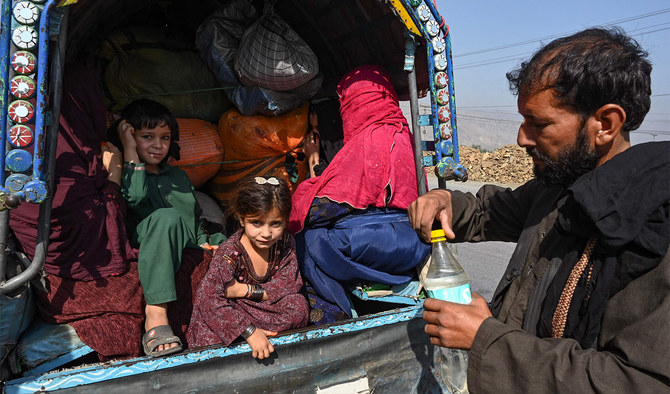

KARACHI: Balochistan’s Caretaker Information Minister Jan Achakzai said on Sunday Pakistan had made a firm commitment to address the issue of illegal immigrants and enhance border security in a bid to resolve safety concerns and foster a conducive atmosphere for foreign companies looking to enter the local market.
Pakistan has become increasingly anxious about the presence of Afghans while grappling with an ongoing economic crisis and a sharp rise in militant attacks in the country.
One of its top ministers said last week Afghan nationals were involved in 14 out of 24 suicide bombings since the beginning of the year, prompting the government to warn “illegal immigrants,” mostly Afghans, to leave the country by November 1 or face forcible expulsion.
The Taliban government in Kabul called the decision “unacceptable” while maintaining that Afghans were not to blame for Pakistan’s security problems.
“We have to make Pakistan an investment-friendly country,” Achakzai told a news conference at a local hotel in Karachi. “Currently, a lot of GCC [Gulf Cooperation Council] investment is coming into Pakistan. We have to turn ourselves into a normal state. No normal state can afford to have lose borders.”
“We have to reinstate the sanctity of our frontiers,” he continued. “This means that we have to implement the passport regime and decide the citizenship status of people in the country.”
Achakzai maintained the policy had nothing to do with Afghanistan’s geopolitics or Pakistan’s bilateral relations with that.
“We have decided to expel the illegal immigrants once and for all,” he added.
The provincial minister acknowledged that people working for the Pakistani state institutions were responsible for the current situation where several Afghan nationals had managed to cross the border without proper travel documents.
“If there was no connivance, these people would not have managed to enter Pakistan,” he said. “But the army chief has said this quite openly now that if the FC [Frontier Constabulary] or other law enforcement personnel were found complacent in such activities, they would be court-martialed and put into prison.”
Achakzai said the government had made the decision “at the highest level” to take strict action against anyone facilitating illegal immigrants.
He informed it had also decided to curb “hundi,” an informal mechanism to transfer money that operates outside the banking system and is generally used for remittances and trade-related transfers.
He described it as the single biggest challenge to economy, facilitating all the wrongdoings related to the Afghan transit trade.
The government recently imposed a 10 percent processing fee on several transit trade items, pointing out that many of them were landing into its market instead of being used in Afghanistan.
In response to a question, Achakzai said Pakistan would also keep the finger prints of all illegal immigrants while deporting them to prevent their return.
“This policy is not country-specific,” he continued. “We will not take any measure that runs against international or local laws. We will send illegal immigrants back to their respective countries in a dignified manner while staying within our international obligations.”
“If we get any complaint against the police related to mistreatment [of people], we will investigate it,” he added. “But now we have decided that sending back illegal immigrants is our state policy and we will not tolerate any pressure on us on the basis of this.”


