

The Republican field is blaming Joe Biden for dealing with Iran after Hamas’ attack on Israel

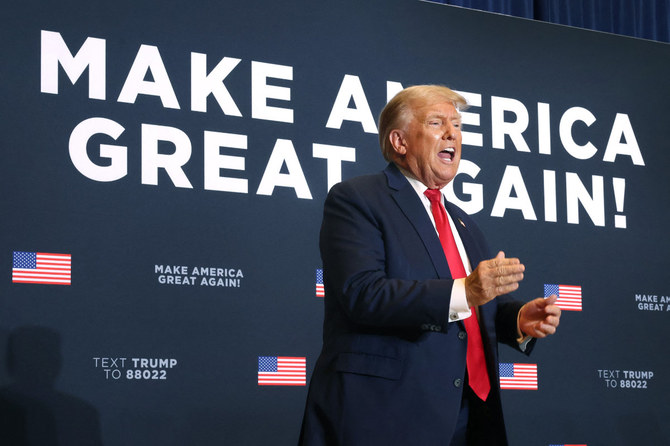
Republican presidential candidate former President Donald Trump at a rally on October 07, 2023 in Cedar Rapids, Iowa. (AFP)
Short Url
Updated 08 October 2023
Follow

The Republican field is blaming Joe Biden for dealing with Iran after Hamas’ attack on Israel

  • Trump and others claim transfer of $6 billion in "American taxpayer dollars" to Iran used to finance Hamas
  • Biden officials earlier explained the $6 billion figure is not US taxpayer money, but frozen South Korean oil payments to Iran
  • Funds have absolutely nothing to do with the Hamas attacks, White House spokesperson explains

WATERLOO, Iowa: Former President Donald Trump and other GOP contenders tried to lay blame on the Biden administration after Hamas militants launched the deadliest attack on Israel in decades, citing a $6 billion transfer to Iran that administration officials insisted Saturday had yet to be spent.

Hamas’ surprise early morning attack during a major Jewish holiday Saturday marks a new foreign policy front in a presidential election that has already been unusually dominated by foreign affairs. Russia’s ongoing invasion of Ukraine has divided the Republican field, with some like Trump and Florida Gov. Ron DeSantis questioning the US’s continued involvement, while others like former Vice President Mike Pence insist that supporting the Ukrainian military is vital to US national security interests.
On Saturday, the candidates appeared united, standing with Israel.
“The Hamas terrorist invasion of Israeli territory and the murder of Israeli soldiers today and the brutal murder of citizens is an act of savagery that must and will be crushed,” Trump said at an appearance in Waterloo, Iowa.
Trump, like others, directly blamed the $6 billion — “American taxpayer dollars helped fund these attacks,” he said in an earlier statement — and argued that, under Biden, the US is perceived as being “weak and ineffective” on the global stage, opening the door to hostility.
“They didn’t have that level of aggression with me. They didn’t have it. This would have never happened with me either,” Trump claimed, adding later in Cedar Rapids that Biden had “betrayed Israel” with the deal.
Biden on Saturday decried the “unconscionable” assault and pledged to ensure Israel has “what it needs to defend itself” after the attack.
Much of the Republican criticism focused on a complex deal announced by the Biden administration in September to release five US citizens detained in Iran. As part of the deal, roughly $6 billion in frozen Iranian assets that were being held in South Korea were transferred to an account in Doha, Qatar.
Although Hamas is a Sunni Muslim group, it has a militant wing that has long nurtured close ties with Iran, a source of funding and a Shiite powerhouse. Hamas and Iran are brought together by a shared enmity toward Israel.
Administration officials said Saturday that no money in the Doha account so far has been spent.
The $6 billion figure is not US taxpayer money, senior Biden administration officials stressed at the time of the deal, but rather payments made by South Korea to Iran to buy oil in recent years. The funds had been stuck in South Korea due to US sanctions. That money is now held in a restricted account in Doha, and is meant to be used for solely humanitarian purposes — such as food and medicine for Iranians — and handled by what the administration described as vetted non-Iranian vendors.
Iranian President Ebrahim Raisi has said his country would spend the money “wherever we need it,” although the US has said in response that it would exercise rigorous oversight over how the funds are disbursed and that it could freeze the assets again if needed.
DeSantis, in a video statement, accused Biden of “policies that have gone easy on Iran” and have “helped to fill their coffers. Israel is now paying the price for those policies. We’re going to stand with the State of Israel, they need to root out Hamas and we need to stand up to Iran.”
And South Carolina Sen. Tim Scott alleged the attack was “the Biden $6 billion ransom payment at work.”
“We didn’t just invite this aggression, we paid for it,” he said in a statement.
Adrienne Watson, a spokeswoman for the White House National Security Council, said she could not directly address Republican criticism due to federal restrictions.
“But I can clarify the facts: Not a single cent from these funds has been spent, and when it is spent, it can only be spent on things like food and medicine for the Iranian people,” she said Saturday in a statement. “These funds have absolutely nothing to do with the horrific attacks today and this is not the time to spread disinformation.”
Brian Nelson, the undersecretary for terrorism and financial intelligence at Treasury, also stressed that “these restricted funds cannot go to Iran” and that “any suggestion to the contrary is false and misleading.”
Pence also blamed Biden, saying the current administration “projects weakness on the world stage” and “kowtows to the mullahs in Iran.” But in an appearance in Iowa, Pence also turned the focus on his GOP rivals who have been advocating more isolationist policies, particularly on Ukraine, calling the attack a “testament to the fact that we need new leadership in the White House, but we also need leadership in the Republican Party that understands the stakes, that understands we achieve peace through strength.”
“I call on Donald Trump, Vivek Ramaswamy, and Ron DeSantis,” he said, “to abandon the language of appeasement — to say that we will stand strong with Israel, we will stand strong with Ukraine, we will stand as the leader of the free world.”


After accepting US deportees, South Sudan wanted sanctions relief for top official, documents show

Updated 57 min 57 sec ago
Follow

After accepting US deportees, South Sudan wanted sanctions relief for top official, documents show

  • In July, South Sudan became the first African country to receive third-country deportees from the US

JUBA: After agreeing to accept deportees from the United States last year, South Sudan sent a list of requests to Washington that included American support for the prosecution of an opposition leader and sanctions relief for a senior official accused of diverting over a billion dollars in public funds.
The requests, contained in a pair of diplomatic communications made public by the State Department this month, offer a glimpse into the kind of benefits that some governments may have sought as they negotiated with the US over the matter of receiving deportees.
In the documents, the US expresses “appreciation” to South Sudan for accepting the deportees and details the names, nationalities and crimes for which each individual was convicted.
In July, South Sudan became the first African country to receive third-country deportees from the US, Rwanda, Eswatini, Ghana and Equatorial Guinea have since received deportees.
The eight deportees to South Sudan included nationals of Mexico, Cuba, Vietnam, Laos, Myanmar and South Sudan itself.
Contentious deportations
They arrived in the South Sudanese capital of Juba after spending weeks on a US military base in Djibouti, where they were held after a US court temporarily blocked their deportation. Six of the eight men remain at a residential facility in Juba under the supervision of security personnel.
South Sudanese national Dian Peter Domach was later freed, according to the Ministry of Foreign Affairs, while Jesus Munoz-Gutierrez, a Mexican, was repatriated in September.
South Sudanese officials have not publicly said what long-term plan is in place for those still in custody. The third-country deportations were highly contentious, criticized by rights groups and others who expressed concern South Sudan would become a dumping ground.
Details of the deal between the US and South Sudan remain murky. It is still unclear what, if anything, South Sudan may have actually received or been promised. The documents only offer a glimpse into what the South Sudanese government hoped to get in return.
In other cases, Human Rights Watch said it saw documents showing the US agreed to pay Rwanda’s government around $7.5 million to take up to 250 deportees. The US will give Eswatini $5.1 million to take up to 160 deportees, according to the group.
For South Sudan, in one communication dated May 12 and marked confidential, South Sudan’s Ministry of Foreign Affairs raised eight “matters of concern which the Government of South Sudan believes merit consideration.” These ranged from the easing of visa restrictions for South Sudanese nationals to the construction of a rehabilitation center and “support in addressing the problem of armed civilians.”
Request to lift sanctions
But an eye-catching ask was for the lifting of US sanctions against former Vice President Benjamin Bol Mel as well as Washington’s support for the prosecution of opposition leader Riek Machar, the now-suspended first vice president of South Sudan who faces treason, murder and other criminal charges in a controversial case.
The allegations against Machar stem from a violent incident in March, when an armed militia with historical ties to him attacked a garrison of government troops. Machar’s supporters and some activists describe the charges as politically motivated.
Bol Mel is accused of diverting more than a billion dollars earmarked for infrastructure projects into companies he owns or controls, according to a UN report. He wielded vast influence in the government and was touted by some as Kiir’s likely successor in the presidency until he was dismissed and placed under house arrest in November.
Bol Mel was also viewed as a key figure behind the prosecution of Machar, one of the historical leaders of South Sudan’s ultimately successful quest for independence from Sudan in 2011.
Machar was Kiir’s deputy when they fell out in 2013, provoking the start of civil war as government troops loyal to Kiir fought forces loyal to Machar.
A 2018 peace agreement brought Machar back into government as the most senior of five vice presidents. His prosecution has been widely criticized as a violation of that agreement, and has coincided with a spike in violence that the UN says killed more than 1,800 people between January and September 2025.
The UN has also warned that a resurgence of fighting has brought the country “back to the edge of a relapse into civil war.” Machar is under house arrest in Juba while his criminal trial proceeds slowly.
In its communications with the US, South Sudan also asked for sanctions to be lifted over South Sudanese oil companies “to encourage direct foreign investments,” and for the US to consider investing in other sectors including fossil fuels, minerals and agriculture.
When asked if the US government had provided or promised South Sudan anything in return for accepting the deportees, a State Department official said, “In keeping with standard diplomatic practice, we do not disclose the details of private discussions.”
A spokesman for South Sudan’s Ministry of Foreign Affairs, Thomas Kenneth Elisapana, declined to comment.
US aid cuts
Despite accepting the US request to admit deportees, relations between the two governments have been strained in recent months.
In December, the US threatened to reduce aid contributions to the country, accusing the government of imposing fees on aid groups and obstructing their operations.
The US has historically been one of the largest donors to South Sudan, providing roughly $9.5 billion in aid since 2011. Over the years, South Sudan’s government has struggled to deliver many of the basic services of a state, and years of conflict have left the country heavily reliant on foreign aid.