

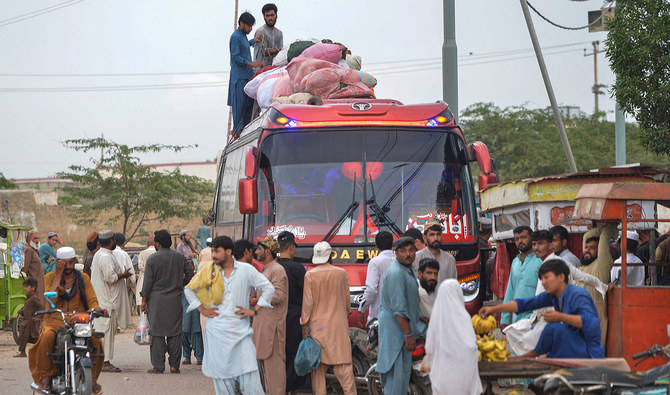

ISLAMABAD: The United Nations High Commissioner for Refugees (UNHCR) and the International Organization for Migration (IOM) on Saturday offered support to Pakistan in developing a mechanism to register and manage Afghan nationals, as Islamabad gears up to forcefully repatriate illegal immigrants in the country from next month.
Pakistan’s caretaker administration said on Tuesday it would allow illegal immigrants in the country till Nov. 1 to leave the country voluntarily after which it would forcefully deport them. Caretaker Interior Minister Sarfraz Bugti said after Nov. 1, entry into Pakistan would be allowed only on the basis of visas and passports.
The announcement came amid a steep rise in terror attacks in Pakistan, making Islamabad anxious about the presence of Afghan nationals in the country. The decision is a blow for Afghan nationals in the country, who as per Pakistani officials, traveled to Pakistan in hundreds of thousands since foreign forces left Afghanistan and the Taliban took over Kabul in 2021.
“UNHCR and IOM have a longstanding and strong collaboration with the Government of Pakistan and stand ready to provide support in developing a comprehensive and sustainable mechanism to register and manage Afghan nationals, including those who may be in need of international protection,” UNHCR and IOM said in a joint press statement.
Even before the Taliban took over Kabul, Pakistan hosted some 1.5 million registered refugees, one of the largest such populations in the world, according to the United Nations refugee agency. More than a million others are estimated to live in Pakistan unregistered.
The UN agencies said Afghanistan was suffering a humanitarian crisis with several human rights challenges, particularly for women and girls. It said Pakistan’s move to deport Afghan nationals would have “serious implications” for all who were forced to leave Afghanistan and may face “serious protection risks” upon return.
“The forced repatriation of Afghan nationals has the potential to result in severe human rights violations, including the separation of families and deportation of minors,” the statement read.
The agencies urged all countries to suspend the forceful repatriation of Afghan nationals and ensure their return takes place in a safe and dignified manner.
Pakistan’s move to threaten the deportation of Afghan nationals has drawn a sharp reaction from Kabul, with Afghan government spokesperson Zabiullah Mujahid on Wednesday terming the decision as “unacceptable.”
Mujahid said Afghan nationals in Pakistan were not involved in the country’s security problems, calling on Islamabad to “tolerate them.”
The recent spike in violence in Pakistan is also owed to the breakdown of a fragile truce between the government and the proscribed Tehreek-e-Taliban Pakistan (TTP) militant network, whose leadership is said to be based in Afghanistan, last November.
Pakistan lost over 60 people in two suicide bombings that targeted a mosque and a religious congregation on Nov. 29, prompting the government to ask all illegal immigrants to leave the country by next month or face forced expulsion.


