KARACHI: In a first, Pakistan’s southern Sindh province has decided to establish a femicide observatory, with the province’s police surgeon revealing on Friday the critical initiative will guide policymakers in their efforts to combat violence against women.
Femicide observatories are organizations or institutions dedicated to monitoring, researching and analyzing intentional killings of women or girls due to their gender. These observatories often collect data, publish reports and provide insights into the patterns, causes, and consequences of such cases to raise awareness about the issue and advocate for policy changes to prevent these killings.
According to UN Women, one in three women worldwide is affected by violence rooted deeply in gender inequality and discrimination. In 2021 alone, intentional violence claimed the lives of over 81,000 women and girls, with familial violence accounting for 45,000 of those victims.
A report from Human Rights Watch released this year indicates that violence against women and girls — including rape, murder, acid attacks, domestic violence and forced as well as child marriages — also remained widespread in Pakistan in 2022. Rights advocates estimate that so-called “honor killings” claim the lives of approximately 1,000 women in the country each year.
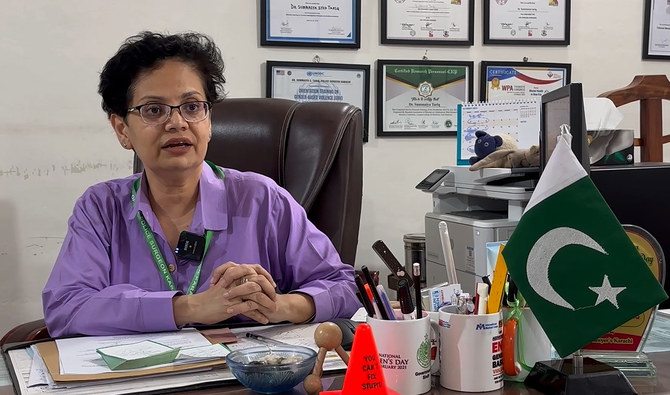
“What the government intends to do now is to set up a femicide registry,” Dr. Summiya Syed Tariq, the police surgeon, told Arab News while sharing the provincial administration’s decision to build the observatory.
She informed that provincial health minister, Dr. Saad Khalid Niaz, gave her the go-ahead to implement the project earlier in the day and deserved appreciation for endorsing such a critical initiative.
According to the Sustainable Social Development Organization (SSDO) in Sindh, where the new observatory is set to be launched, media reports indicated 1,348 cases of violence against women since the beginning of the year to July 31.
These data include 881 kidnappings, 234 domestic violence incidents, 130 reported rapes, 85 honor killings and 18 workplace harassment cases. It is pertinent to mention that these figures likely represent just a fraction of the true scope of incidents, given the historical underreporting and the prior absence of a dedicated femicide observatory.
Dr. Tariq stressed the new initiative aims to provide authorities with a clearer picture of the gender-based violence landscape. Until now, statistics lumped male and female deaths together. However, the new observatory will specifically focus on female victims who are targeted by family members due to their gender, allowing for more targeted interventions.
“Previously, it was just like female dead bodies versus male dead bodies. But now we are differentiating them. We are saying the female dead bodies targeted by family members. This is the femicide data [of] women or the girls who were targeted because of their gender,” she said.
Dr. Tariq revealed her department was also actively gathering data on sexual violence against boys, and mentioned another significant initiative in the pipeline focused on addressing domestic abuse against elderly parents — a topic that has largely been overlooked until now.
Emphasizing the crucial role of accurate data, she noted that it served as the bedrock for effective policy formulation. With reliable statistics, policies can be specifically tailored to meet the unique needs of vulnerable populations.
“When you start talking about the numbers, they start figuring in the policies,” she added. “Till now, we don’t have data, we don’t have separate data. So [when] we get data, we have numbers, we have a policy, that’s how things work. The first step is always the numbers.”


![]()

In a groundbreaking move, Pakistan’s Sindh province to establish country’s first femicide observatory
Short Url
https://arab.news/5yqq3
In a groundbreaking move, Pakistan’s Sindh province to establish country’s first femicide observatory
- Sindh Police Surgeon Dr. Summiya Syed Tariq says the observatory will help policymakers deal with violence against women
- Femicide observatories are dedicated to monitoring and analyzing intentional killings of women and girls due to their gender
Latest updates


Recommended


© 2026 SAUDI RESEARCH & PUBLISHING COMPANY, All Rights Reserved And subject to Terms of Use Agreement.