

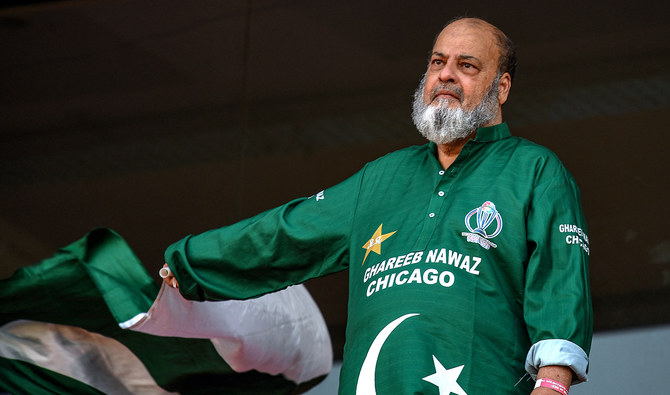

HYDERABAD: He has survived a heart attack, suffers from diabetes and has just traveled more than 8,200 miles (13,300km) to watch a cricket match.
Meet Chacha Mohammad Basheer, likely the only native Pakistan supporter inside the Rajiv Gandhi International Stadium where his beloved team began their World Cup campaign on Friday.
“I am the only Pakistani here but my voice and enthusiasm are equal to 100-150 people in the stadium,” Basheer told AFP ahead of the match with the Netherlands.
The 67-year-old Chicago-based Basheer was dressed in a Pakistan flag shirt and even carried a national flag in his hand.
Basheer has already been caught up in the decades-long political tension between Pakistan and India which means this World Cup marks the first time in seven years that a Pakistan team has played in the country.
He claims he was close to being detained last week at Hyderabad airport when he chanted “Pakistan Zindabad” (“Long live Pakistan”) slogans and waved a Pakistan flag to greet Babar Azam’s team.
“The police took my flag as it was not allowed so I gave it to them,” said Basheer. “But the team’s welcome was fantastic.”
Delays in processing visas has thwarted plans for droves of Pakistan fans to cross the border and support their team.
As a US passport holder, Basheer was able to sidestep that chaos.
“I’m sad that no Pakistani fans have been allowed here, but I’m sure that once the tournament progresses they will come in large numbers as they are waiting for visas,” said Basheer, whose Indian wife is from Hyderabad.
“Pakistan is my country of birth,” added Karachi-born Basheer.
“I am lucky that my wife is from India so I have affection for both countries.”
The strained relations between India and Pakistan have stalled bilateral cricket ties between the two countries since 2012 but they meet only in multi-nation events like the World Cup, World T20 and Asia Cup.
The arch-rivals will clash in a high-octane World Cup game in Ahmedabad on October 14 where Basheer will meet his Indian super fan counterpart, Sudhir Kumar.
“I have a special bond with Sudhir,” said Basheer. “At times I book his flight to places where there are matches and we stay together. This is love and affection, I hate war and animosity.”
Basheer has become a familiar face on the international cricket circuit.
During the 2011 World Cup in India, home captain Mahendra Singh Dhoni even gave him a match ticket for the semifinal in Mohali.
“I have a special bond with ‘Mahi’ (Dhoni’s nickname),” said Basheer.
Basheer also attended the 2015 World Cup in Australia and in the United Kingdom four years later.
However, he suffered a heart attack in Manchester. Now he travels with medication for diabetes and to treat his blood pressure.
“My medical condition is stable now, I have a bag full of medicines,” said Basheer.
“But I live for cricket and as long as I am fit I will travel to all the matches.”
Come next Saturday, when Pakistan face India, his heart rate will accelerate, but his support will be tempered — both as a promise to his wife, who will be rooting for India, and to preserve his health.
“It will be 60-40 — I have to go back to Chicago to live my happy life with my wife.”


