

UAE to pay $102 million over five years to operate Karachi port terminal — senate

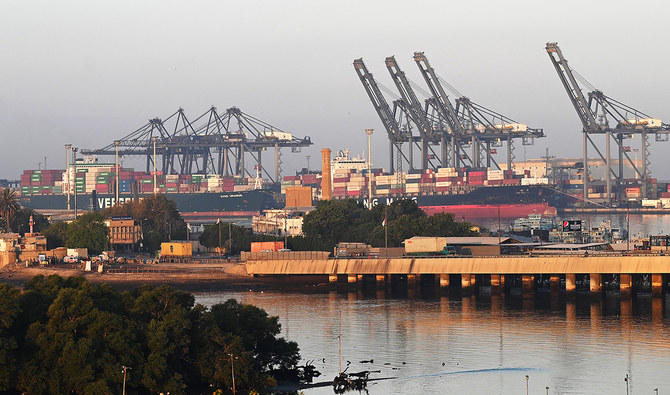
Shipping containers are seen stacked on a ship at a sea port in Karachi, Pakistan on April 6, 2023. (AFP/File)
Short Url
Updated 06 October 2023
Follow

UAE to pay $102 million over five years to operate Karachi port terminal — senate

  • Abu Dhabi Ports signed 50-year concession deal with Karachi Port Trust in June for handling port terminal
  • Joint venture will see investment of $220 million in Pakistan over first 10 years, the maritime ministry says

ISLAMABAD: The United Arab Emirates will invest $102 million over five years to develop and operate a bulk and general cargo terminal at Karachi port, minutes of the Senate Standing Committee on Maritime Affairs released on Friday said.

UAE’s Abu Dhabi Ports (AD Ports), a leading port operator, signed a 50-year concession agreement with the Karachi Port Trust (KPT) in June for the handling of one of its port terminals in Karachi.

Under the agreement, the Pakistan International Container Terminal (PICT) has been handed over to a joint venture (JV) between AD Ports Group, a majority shareholder, and Kaheel Terminals, a UAE-based company, formed to manage, operate and develop the Karachi Gateway Terminal Limited (KGTL) at berths 6-9 at Karachi Port’s East Wharf.

The joint venture will see an investment of $220 million in Pakistan over the first 10 years.

Pakistan’s Senate Standing Committee on Maritime Affairs met on Thursday for a briefing on the concession agreement with Abu Dhabi Port.

“It was briefed that the concession periods for the agreement is 25 years with USD 18.00 per cross berth move and a ground rent of PKR 1,100 square meters per annum and upfront payment of USD 50 M,” the minutes of the meeting revealed.
“It was briefed that an investment of USD 102 M will be made in next five years by the terminal operator.”

Pakistan says the handling of its port terminal by the Abu Dhabi Ports will increase the South Asian’s nation’s revenue generation by up to $7 million a year and pave the way for an additional $2 billion investment in its maritime sector.

The joint venture will include significant investments in infrastructure and superstructure over the next 10 years, with the bulk of it planned for 2026, according to AD Ports. Development works include the deepening of berths, an extension of quay walls, and an increase in the container storage area. As a result, the terminal will be able to handle post-panamax class vessels of up to 8,500 TEUs (Twenty-Foot Equivalent Units) and container capacity will increase from 750,000 to 1 million TEUs per annum.

The UAE port operator had also expressed interest in investing an additional $2 billion in Pakistan, including in a railway link between the country’s two main ports. 

The port deal comes at a time when Pakistan, reeling from an economic crisis, is desperately looking for external financing.

In June Pakistan set up the Special Investment Facilitation Council (SIFC), a civil-military forum, to attract foreign funding, especially from Gulf countries, by streamlining bureaucratic procedures and improve investment climate for businesses looking to set up operations in Pakistan.

The SIFC has prioritized five key sectors for attracting investment: agriculture, mining, information technology, defense production, and energy.


No casualties as blast derails Jaffar Express train in Pakistan’s south

Updated 26 January 2026
Follow

No casualties as blast derails Jaffar Express train in Pakistan’s south

  • Passengers were stranded and railway staffers were clearing the track after blast, official says
  • In March 2025, separatist militants hijacked the same train with hundreds of passengers aboard

QUETTA: A blast hit Jaffar Express and derailed four carriages of the passenger train in Pakistan’s southern Sindh province on Monday, officials said, with no casualties reported.

The blast occurred at the Abad railway station when the Peshawar-bound train was on its way to Sindh’s Sukkur city from Quetta, according to Pakistan Railways’ Quetta Division controller Muhammad Kashif.

No group immediately claimed responsibility for the bomb attack, but passenger trains have often been targeted by Baloch separatist outfits in the restive Balochistan province that borders Sindh.

“Four bogies of the train were derailed due to the intensity of the explosion,” Kashif told Arab News. “No casualty was reported in the latest attack on passenger train.”

The Jaffar Express stands derailed near Abad Railway Station in Jacobabad following a blast on January 26, 2026. (AN Photo/Saadullah Akhtar)

Another railway employee, who was aboard the train and requested anonymity, said the train was heading toward Sukkur from Jacobabad when they heard the powerful explosion, which derailed power van among four bogies.

“A small piece of the railway track has been destroyed,” he said, adding that passengers were now standing outside the train and railway staffers were busy clearing the track.

In March last year, fighters belonging to the Balochistan Liberation Army (BLA) separatist group had stormed Jaffar Express with hundreds of passengers on board and took them hostage. The military had rescued them after an hours-long operation that left 33 militants, 23 soldiers, three railway staff and five passengers dead.

The passenger train, which runs between Balochistan’s provincial capital of Quetta and Peshawar in the country’s northwest, had been targeted in at least four bomb attacks last year since the March hijacking, according to an Arab News tally.

The Jaffar Express stands derailed near Abad Railway Station in Jacobabad following a blast on January 26, 2026. (AN Photo/Saadullah Akhtar)

Pakistan Railways says it has beefed up security arrangements for passenger trains in the province and increased the number of paramilitary troops on Jaffar Express since the hijacking in March, but militants have continued to target them in the restive region.

Balochistan, Pakistan’s southwestern province that borders Iran and Afghanistan, is the site of a decades-long insurgency waged by Baloch separatist groups who often attack security forces and foreigners, and kidnap government officials.

The separatists accuse the central government of stealing the region’s resources to fund development elsewhere in the country. The Pakistani government denies the allegations and says it is working for the uplift of local communities in Balochistan.