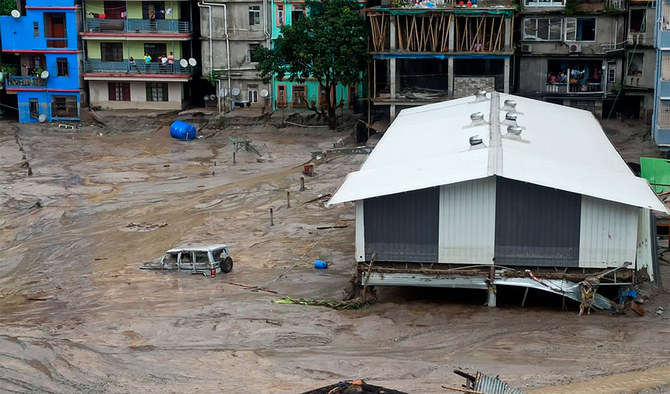

NEW DELHI: Hundreds of rescuers dug through slushy debris and fast-flowing, icy water Friday in a search for survivors after a glacial lake overflowed and burst through a dam in India’s Himalayan north, a disaster that many had warned was possible for years.
The flood began in the early hours of Wednesday, when water overflowed a mountain lake with enough force to break through the concrete of a major hydroelectric dam downstream. It then poured into the valley below, where it killed at least 41 people and forced thousands to flee their homes.
Police said that 22 of the dead were found kilometers (miles) downriver in West Bengal state, while 100 people are still missing.
It wasn’t clear what triggered the flood. Experts pointed to intense rain, and a 6.2 magnitude earthquake that struck nearby Nepal on Tuesday afternoon, as possible contributors.
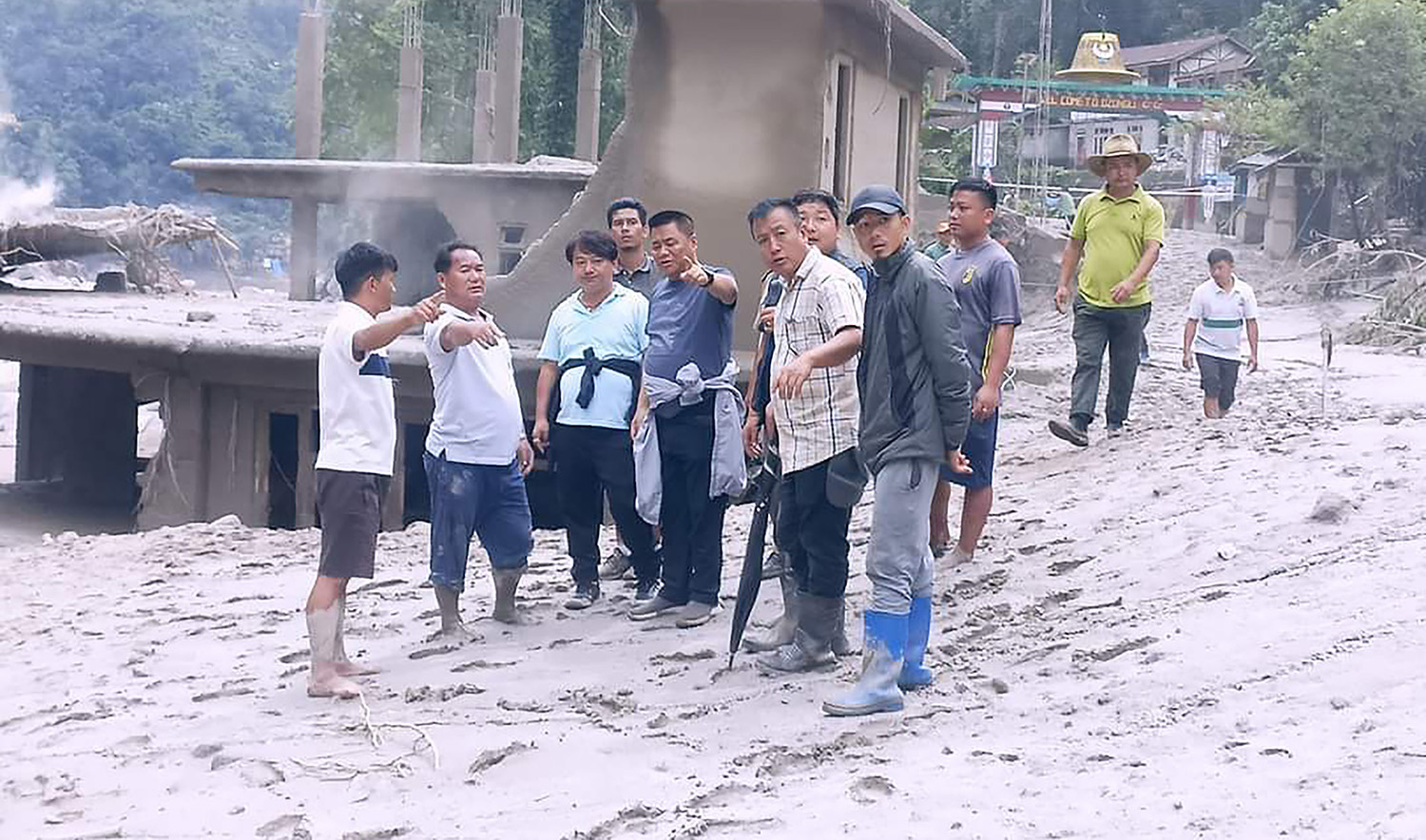
Locals assess damage after flash floods triggered by sudden heavy rainfall swamped Rangpo town in Sikkim, India, on October 6. 2023. (AP)
The deadly flood was the latest to hit northeast India in a year of unusually heavy monsoon rains. Nearly 50 people died in flash floods and landslides in August in nearby Himachal Pradesh state, and record rains in northern India killed more than 100 people over two weeks in July.
The design and placement of the 6-year-old Teesta 3 dam, the largest in Sikkim state, were controversial from the time it was built, part of an Indian push to expand hydropower energy.
Local activists argued that extreme weather caused by climate changes makes dam-building in the Himalayas too dangerous, and warned that the dam’s design didn’t include enough safety measures.
A report compiled by the Sikkim State Disaster Management Authority in 2019 had identified the lake the Teesta 3 dam was built to contain as “highly vulnerable” to flooding that could cause extensive damage to life and property in downstream areas, warning of the risk of flash floods that could break through dams.
The dam’s operator, and local agencies responsible for dam safety, did not respond to requests for comment Friday.
A 2021 study by researchers in India, the United States and Switzerland warned that a catastrophic flood was becoming more likely as melting glaciers caused water levels in the lake to rise.
The Teesta 3 hydropower project, built on the Teesta River, took nine years and cost $1.5 billion to construct. The project was capable of producing 1,200 megawatts of electricity — enough to power 1.5 million Indian homes — and began operation in 2017.
“Despite being the biggest project in the state, there were no early warning systems installed even though the glacier overflowing was a known risk,” said Himanshu Thakkar of the non-governmental organization South Asian Network for Rivers, Dams and People.

Buildings are inundated after flash floods triggered by sudden heavy rainfall swamped Rangpo town in Sikkim, India, on October 6. 2023. (AP)
According to a release from India’s National Disaster Management Agency Friday, they plan to set up early warning systems for real-time alerts at most of India’s 56 known at-risk glacial lakes.
Thakkar said authorities failed to apply the lessons from a 2021 dam breach in Himalayan state of Uttarakhand that killed 81 people, allowing an “eerily similar” disaster to occur.
“We knew that this was coming,” said Gyatso Lepcha, general secretary of Affected Citizens of Teesta, an environmental organization based in Sikkim. “The same can happen with other dams also,” he wrote, in a statement that called for a safety review of all dams in the state.
Disasters caused by landslides and floods are common in India’s Himalayan region during the June-September monsoon season. Scientists say they are becoming more frequent as global warming contributes to the melting of glaciers there.
Despite the risks, the Indian government has approved hundreds of new hydroelectric dams to be built across the Himalayan region. To meet ambitious clean energy goals, it aims to increase India’s hydroelectric dam output by half, to 70,000 megawatts, by 2030.
But the growing frequency and intensity of extreme weather, driven in part by climate change, puts many of these dams and the people living downstream from them at risk. A 2016 study found that over a fifth of the 177 dams built close Himalayan glaciers could fail if glacial lakes burst, including the dam in Sikkim.
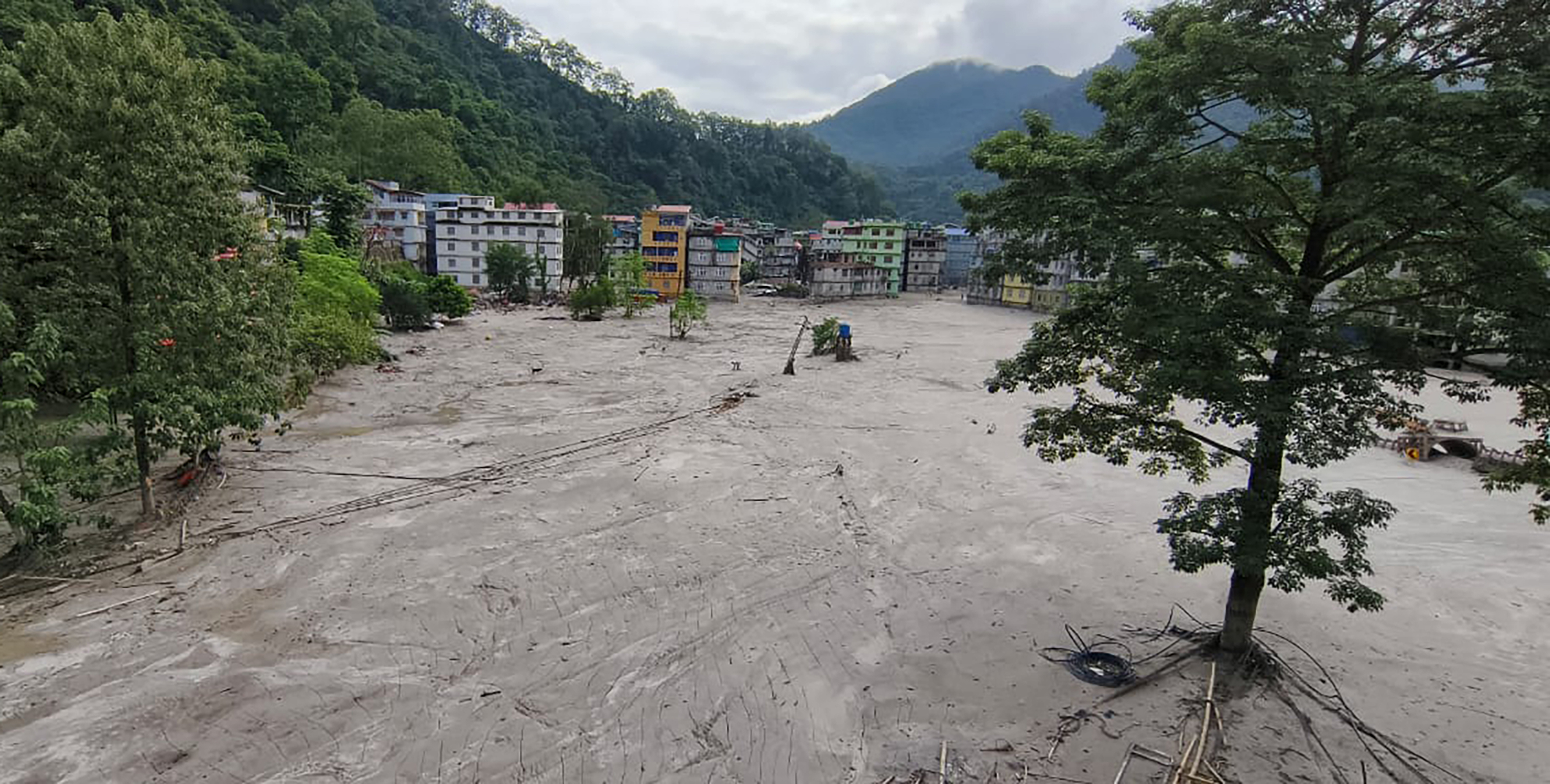
Buildings are inundated after flash floods triggered by sudden heavy rainfall swamped Rangpo town in Sikkim, India, on October 6. 2023. (AP)
In 2021, the Indian federal government passed a dam safety law that requires operators and local governments to plan for emergencies, but the Teesta-3 dam is not listed as being monitored for safety by India’s chief dam regulator, the Central Water Commission.
Last month, dam breaches caused by Storm Daniel caused devastating damage to the city of Derna in Libya.
More than 2,000 people were rescued after Wednesday’s floods, the Sikkim State Disaster Management Authority said in a statement, adding that state authorities set up 26 relief camps for more than 22,000 people impacted by the floods.
One soldier was previously reported missing was rescued, and the bodies of seven have been found, state police said.
Eleven bridges in the Lachan Valley were washed away by the floodwaters, which also hit pipelines and damaged or destroyed more than 270 houses in four districts, officials said.
The army said it was providing medical aid and phone connectivity to civilians in the areas of Chungthang, Lachung and Lachen, and local media reported that said the army was erecting temporary bridges to bring food to affected areas.