

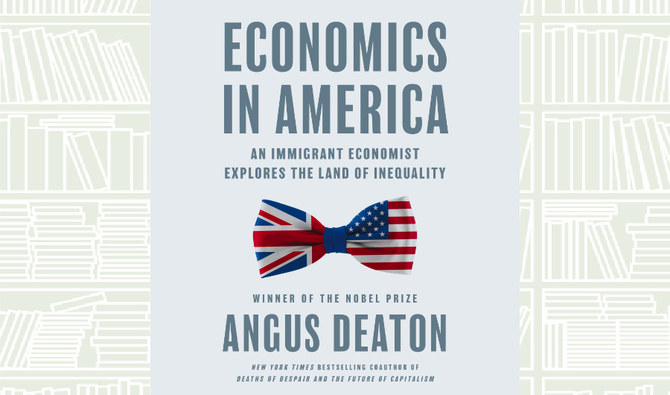
What We Are Reading Today: Economics in America

Short Url
Updated 06 October 2023
Follow

What We Are Reading Today: Economics in America

Author: Angus Deaton

When economist Angus Deaton immigrated to the US from Britain in the early 1980s, he was awed by America’s strengths and shocked by the extraordinary gaps he witnessed between people. 

“Economics in America” explains how the field of economics addresses the most pressing issues of our time — from poverty, retirement, and the minimum wage to the ravages of the nation’s uniquely disastrous healthcare system — and narrates Deaton’s account of his experiences as a naturalized US citizen and academic economist.

In this incisive, candid, and funny book, he describes the everyday lives of working economists, recounting the triumphs as well as the disasters, and tells the inside story of the Nobel Prize in economics and the journey that led him to Stockholm to receive one. 

He discusses the ongoing tensions between economics and politics and reflects on whether economists bear at least some responsibility for the growing despair and rising populism in America.


What We Are Reading Today: ‘How the Universe Got Its Spots’

Photo/Supplied
Updated 02 January 2026
Follow

What We Are Reading Today: ‘How the Universe Got Its Spots’

  • Nimbly explaining geometry, topology, chaos, and string theory, Levin shows how the pattern of hot and cold spots left over from the big bang may one day reveal the size of the cosmos

Author: JANNA LEVIN 

Is the universe infinite or just really big? With this question, cosmologist Janna Levin announces the central theme of this book, which established her as one of the most direct, unorthodox, and creative voices in contemporary science.

As Levin sets out to determine how big “really big” may be, she offers a rare intimate look at the daily life of an innovative physicist, complete with jet lag and the tensions between personal relationships and the extreme demands of scientific exploration.

Nimbly explaining geometry, topology, chaos, and string theory, Levin shows how the pattern of hot and cold spots left over from the big bang may one day reveal the size of the cosmos.