

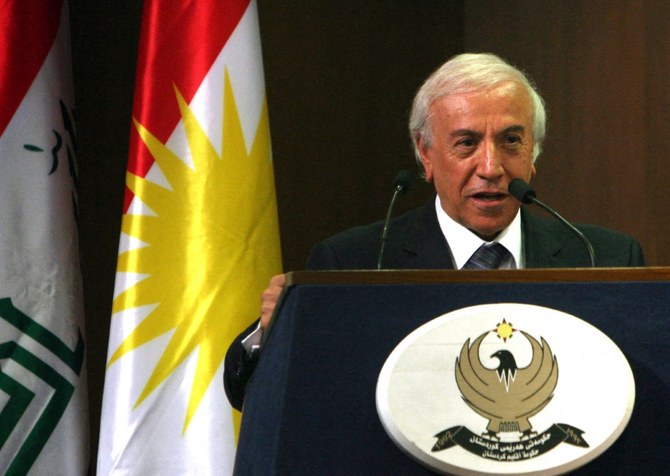
Campaigners raise alarm after former Kurdish oil minister sues journalists

The case is being closely watched by press freedom groups and journalists, who fear that it could set a dangerous precedent for press freedom in the UK. (AFP/File)
Short Url
Updated 05 October 2023
Follow

Campaigners raise alarm after former Kurdish oil minister sues journalists

  • In 2021 article, Will Jordan and Daniel Balint-Kurti accused Ashti Hawrami of misusing power to grant oil concessions
  • UK newspaper editors last month warned justice secretary over threat to press freedom

LONDON: Campaigners have expressed concern that UK courts are being used to silence critical reporting after a former Kurdish minister sued two journalists who accused him of misconduct, The Times reported.

Ashti Hawrami, who served as oil minister of the Kurdistan Regional Government from 2006 to 2019, is taking legal action against journalists Will Jordan and Daniel Balint-Kurti, reporters for the Organized Crime and Corruption Reporting Project, over a 2021 article that alleged he had misused his power to grant oil concessions.

Hawrami, who was a major player in the Kurdish oil industry, was linked to UK MP and former chancellor Nadhim Zahawi, who worked as a “fixer” for oil company Gulf Keystone.

Campaigners say Hawrami’s claim is a “strategic lawsuit against public participation,” or SLAPP, a legal strategy designed to intimidate journalists and discourage public interest reporting.

The practice has received increasing scrutiny in the UK, with lawsuits often filed by wealthy or powerful individuals against journalists and activists, who face having their financial resources drained amid costly litigation fees.

In a letter to the UK justice secretary last month, editors from several major newspapers, including The Times, The Telegraph and The Guardian, warned that SLAPPs represent a growing threat to press freedom in the UK and Europe.

“We are deeply concerned that human rights defenders are facing prison sentences and heavy fines for exercising their right to freedom of expression and opinion,” UN experts said in a statement last year.

It is unclear if the case against Jordan and Balint-Kurti will come to court.

Hawrami’s lawyers said that they decided to sue OCCRP only after contacting the outlet to dispute the accuracy of several claims.

A spokesman for Hawrami’s lawyers, Carter Ruck, said: “There is no proper basis whatsoever to assert that this case is a SLAPP. The position is that our client only very reluctantly brought proceedings in May 2022, over an article published in May 2021, when extensive attempts to resolve his complaint, without recourse to litigation, broke down.

“As well as making false claims, the article contains significant errors which to this day have never been corrected. Our client finds himself in the very regrettable position of having been defamed and is entitled to bring legal proceedings seeking to clear his name.”

The case is being closely watched by press freedom groups and journalists, who fear that it could set a dangerous precedent for press freedom in the UK.


Israel says ban on Gaza media access should stay: court document

Updated 05 January 2026
Follow

Israel says ban on Gaza media access should stay: court document

  • Israeli authorities have told the Supreme Court that a ban on international media access to Gaza should remain in place, arguing it is necessary for security reasons

JERUSALEM: Israeli authorities have told the Supreme Court that a ban on international media access to Gaza should remain in place, arguing it is necessary for security reasons, according to a government submission filed by the public prosecutor.
Since the outbreak of the Gaza war in October 2023, Israeli authorities have barred foreign journalists from independently entering the devastated territory.
Instead, Israel has allowed only a limited number of reporters to enter Gaza on a case-by-case basis, embedded with its military forces inside the blockaded territory.
The Foreign Press Association (FPA), which represents hundreds of foreign journalists working in Israel and the Palestinian territories, filed a petition with the Supreme Court in 2024 seeking immediate and unrestricted access for international media to the Gaza Strip.
Since then the court has given several extensions to the Israeli authorities to come up with a plan, but at a hearing last month it set January 4 as a final deadline.
Late on Sunday, the Israeli authorities filed their response with the court, a copy of which was obtained by AFP.
In the submission, the government said the ban on media access to Gaza should continue, citing security risks in the territory.
“Even at this time, entry of journalists into the Gaza Strip without escort, as requested in the petition, should not be permitted,” said the government submission.
“This is for security reasons, based on the position of the defense establishment, which maintains that a security risk associated with such entry still exists.”
The Israeli authorities said the ceasefire in Gaza, which came into effect on October 10, continues to face regular threats.
At least 420 Palestinians have been killed in Gaza by Israeli forces since the ceasefire took effect, according to Gaza’s health ministry.
The Israeli military said three of its soldiers have also been killed by militants during the same period.
The Israeli authorities said in their submission that the search for the remains of the last hostage held in Gaza is ongoing, suggesting that allowing journalists into the territory at this stage could hinder the operation.
The remains of Ran Gvili, whose body was taken to Gaza after he was killed during the Hamas attack on October 7, 2023, have still not been recovered despite the ceasefire.
All other 250 hostages seized on that day — both the living and the deceased — have been returned to Israel.
The Supreme Court is expected to issue a ruling on the matter, though it is unclear when a decision will be handed down.
An AFP journalist sits on the board of the FPA.