

Saudi surgical team separate Tanzanian conjoined twins

1 / 8
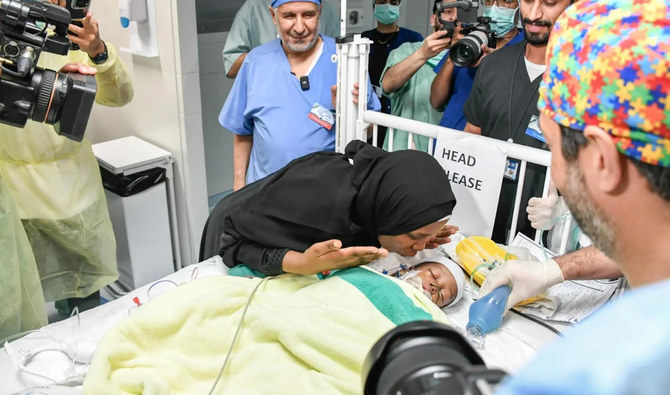
The medical and surgical team separated Hassan and Hussein, aged 2, at King Abdullah Specialist Children’s Hospital in the King Abdulaziz Medical City at the Ministry of National Guard in Riyadh. (SPA)
2 / 8
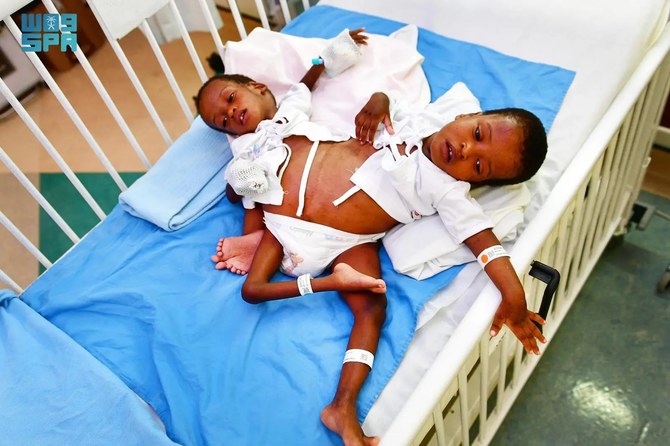
Conjoined Tanzanian twins Hassan and Hussein. (SPA)
3 / 8
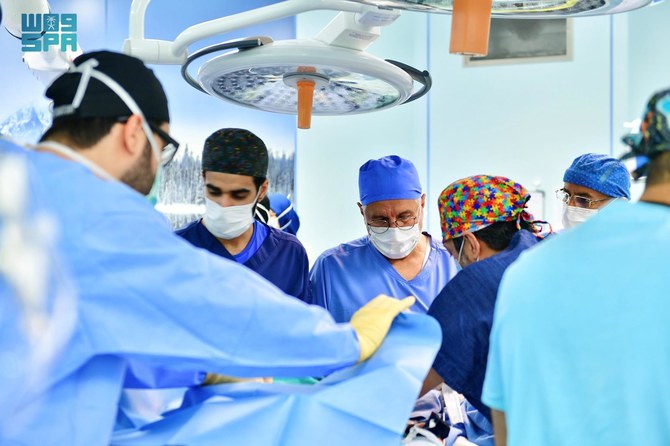
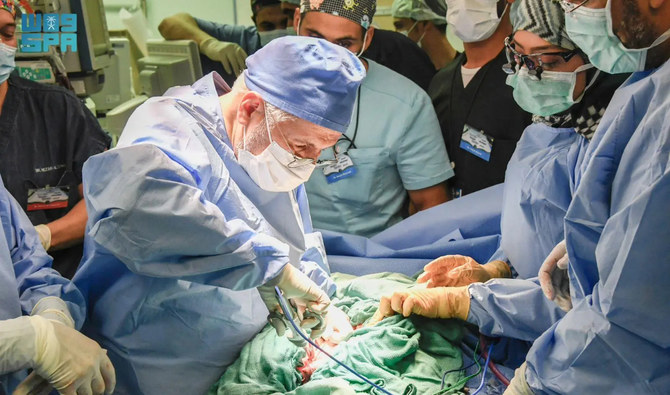
Work begins on separating conjoined Tanzanian twins Hassan and Hussein. (SPA)
4 / 8
Work begins on separating conjoined Tanzanian twins Hassan and Hussein. (SPA)
5 / 8
Work begins on separating conjoined Tanzanian twins Hassan and Hussein. (SPA)
6 / 8
The medical and surgical team separated Hassan and Hussein, aged 2, at King Abdullah Specialist Children’s Hospital in the King Abdulaziz Medical City at the Ministry of National Guard in Riyadh. (SPA)
7 / 8
The medical and surgical team separated Hassan and Hussein, aged 2, at King Abdullah Specialist Children’s Hospital in the King Abdulaziz Medical City at the Ministry of National Guard in Riyadh. (SPA)
8 / 8
The medical and surgical team separated Hassan and Hussein, aged 2, at King Abdullah Specialist Children’s Hospital in the King Abdulaziz Medical City at the Ministry of National Guard in Riyadh. (SPA)
Short Url
Updated 06 October 2023
Follow

Saudi surgical team separate Tanzanian conjoined twins

  • KSrelief chief Dr. Abdullah Al-Rabeeah to lead 16-hour surgery
  • Complex operation at Riyadh hospital gives new life to Hassan and Hussein, aged 2

RIYADH: A Saudi surgical team carried out a complex 16-hour operation on Thursday to separate conjoined Tanzanian twins.

The operation took place under the supervision of leading pediatric surgeon Dr. Abdullah Al-Rabeeah, head of the Saudi humanitarian aid agency KSrelief chief.

The medical and surgical team separated Hassan and Hussein, aged 2, at King Abdullah Specialist Children’s Hospital in the King Abdulaziz Medical City at the Ministry of National Guard in Riyadh.

The operation lasted 16 hours over nine stages, with 35 consultants, specialists, and technical, nursing and support staff taking part.

Following the surgery, which marked the 59th operation for the Saudi conjoined twins program, Dr. Al-Rabeeah thanked members of the medical team for their efforts and congratulated the mother of the twins and the Tanzanian people on the successful procedure.

He reiterated the Kingdom’s pioneering role in humanitarian work in general and medical work in particular, which would not have been achieved without the unlimited support from the Saudi government.

Al-Rabiah also said the achievement reflects the Saudi medical excellence in line with the goals of Saudi Vision 2030 to develop the health sector and raise its quality and efficiency. 

The mother of the twins expressed her thanks to the leadership and medical team, commending the Kingdom’s great humanitarian work and the warm reception and generous hospitality she received throughout her stay in Saudi Arabia.

Tanzania’s ambassador to Saudi Arabia Ali Mwadini expressed his thanks and gratitude to King Salman, Crown Prince Mohammed bin Salman, and members of the medical team.

He praised the development of the Saudi medical sector that reached prestigious international levels, wishing the twins a speedy recovery.

The twins arrived from Dar es Salaam in August for medical examinations that showed they were conjoined at the lower chest, abdomen, pelvis, liver, urinary tract, intestines and one reproductive organ.

The Kingdom is a world leader in one of the most complex surgical procedures in modern medicine. Since its launch in 1990, Saudi Arabia’s Conjoined Twins Program has treated about 130 cases of conjoined twins from countries around the world. Al-Rabeeah himself has conducted 58 operations on conjoined twins born to poor families from 23 countries.

King Abdullah Specialized Children’s Hospital plays a crucial role in the program. Equipped with state-of-the-art medical facilities and advanced technology, the hospital is staffed by a highly skilled medical team specializing in complex pediatric care. 

Operations carried out under the program are fully sponsored by the Saudi government. They offer children a chance to enjoy a long and healthy life, free of round-the-clock care, and relieved of the mental and physical strain of their condition. 

According to medical studies, about 60 percent of conjoined twins are stillborn, while some 40 percent of those who survive birth then die within a few days. About 70 percent of conjoined twins are girls. 


Ramadan is a time to train smarter, not harder

Updated 7 sec ago
Follow

Ramadan is a time to train smarter, not harder

  • Experts advise between six and eight hours of rest and steady fluid intake between sunset and dawn

RIYADH: Whether you’re a newcomer to the gym or a veteran, Ramadan is a time when everyone needs to reassess their workout regime: from calorie intake to the intensity of your exercise, from rep range to cardio zones, everything is up for alteration during the holy month.

One of the main priorities when it comes to maximizing training in general is to allow for muscle recovery through rest and sleep, which is why Calo, a Bahraini food and health startup, recommends prioritizing sahoor and sufficient rest; both of which will aid in physical recovery for the following day.

Cycling tracks in AlUla have witnessed increased turnout from various age groups seeking to engage in physical activity at suitable times during the blessed month. (SPA/Supplied)

Gym hours also differ during Ramadan. A GymTech representative told Arab News: “The highest attendance is usually in the late evening hours, mostly starting from 9 p.m.”

A representative from The Pilates Studio also spoke to Arab News and said its members are both “calmer and fitter” during Ramadan.

HIGHLIGHTS

• One of the main priorities when it comes to maximizing training in general is to allow for muscle recovery through rest and sleep. • Calo, a Bahraini food and health startup, recommends prioritizing sahoor and sufficient rest; both of which will aid in physical recovery for the following day. • Both GymTech and The Pilates Studio recommend cardio exercise during Ramadan.

Both GymTech and The Pilates Studio recommend cardio exercise during Ramadan. The Pilates Studio rep said: “Cardio pre-iftar and strength training after iftar.” 

Coach Jap in Riyadh explained why workout routines need to change during the holy month.

“The role of hydration and sleep is essential. Hydration is a must so your body will function properly and cleanse; and you should sleep at least six-to-eight hours, depending on your age. It’s essential, because this is when the body recovers and repairs,” he said.

He also discussed the necessary adjustments for those looking to maintain their energy and physical activity levels, as well as how those adjustments are altered for those looking to gain or lose weight throughout their fasting.

“If your goal is losing weight, it’s better to train before iftar, because your body is in the healing process wherein you’re able to burn the fats and lose some weight,” he said, adding that there are “some precautions” to take, such as only undertaking “light to moderate” exercise.

“You may need to have an average heart rate of 120-140 so you’ll be able to burn more calories and fats. Take note: there will be muscle wastage during this time as well,” he said. “For gaining weight, the best time to work out is after iftar, two-to-three hours after a good meal.”

When it comes to the link between dieting and muscle recovery or fat loss, Coach Jap had a warning. “The biggest mistake I see from people training in Ramadan is their food consumption. They fast and then binge eat during iftar,” he said. “Discipline is key; eat a medium meal and then, after a few hours, you can eat small frequent meals again, so your body will not be overloaded with food.” 

He added that a diet high in protein and carbohydrates (around 100-200 grams of the latter) is necessary, and added that, in the second half of Ramadan, the intensity of a person’s workouts usually decreases as their energy levels drop.