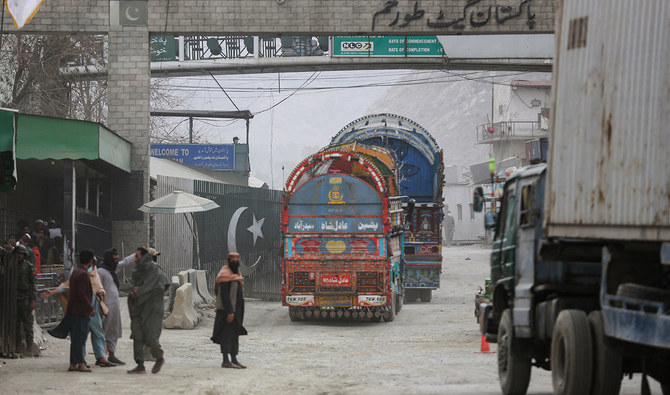
PESHAWAR: Pakistan announced on Tuesday to impose a 10 percent processing fee on several items imported from Afghanistan under a transit trade agreement in a step that has been viewed as an attempt to stop illegal entry of goods into the country from the neighboring state.
The government launched an intense crackdown against smugglers and black marketers last month to bolster the country’s weakening economy and bring down the prices of essential items in the market.
The counter smuggling operation prevented the flight of foreign currencies from Pakistan, leading to the stabilization of its value somewhat subsiding the inflationary pressure in the economy.
“In exercise of the powers conferred by section 18D of the Customs Act, 1969 (IV of 1969), the Federal Government is pleased to impose processing fee at the rate of 10 percent ad valorem on the following Afghan transit Commercial goods imported into Afghanistan in transit via Pakistan,” said a customs department notification while listing down the items.
These included confectionaries and chocolates, footwear, mechanical and electrical machinery, blankets and home textiles, and garments.
Pakistan’s Dawn newspaper reported customs officials “suspect that certain goods, though destined for Afghanistan, are clandestinely rerouted back into Pakistan, prompting this latest measure.”
However, the official notification said goods declarations filed prior to the decision on Tuesday would be exempt from the processing fee.
Pakistan has also announced to crack down on illegal immigrants, mostly Afghans, residing in the country, asking them to leave before the end of the month.

Pakistan imposes 10 percent fee on Afghan transit trade items
https://arab.news/v8fc8
Pakistan imposes 10 percent fee on Afghan transit trade items
- The decision comes amid an intense crackdown against smugglers and hoarders to bolster the weakening economy
- Officials say the move will prevent items destined for Afghanistan to be brought into Pakistani markets by traders
Islamic military coalition, Pakistan to deepen cooperation to combat ‘terrorism’ — Pakistani military
- Islamic Military Counter Terrorism Coalition is a 43-member alliance that includes Pakistan, Saudi Arabia, Egypt, Jordan, UAE and other nations
- The Pakistani military statement comes after a meeting between IMCTC secretary-general and the chief of Pakistani defense forces in Rawalpindi
ISLAMABAD: Pakistan and the Islamic Military Counter Terrorism Coalition (IMCTC) have reaffirmed their commitment to deepening cooperation, including intelligence sharing and capacity building, to jointly combat “terrorism” and “extremism,” the Pakistani military said on Monday.
The IMCTC is a 43-member military alliance that was formed on Saudi Arabia’s initiative in Dec. 2015 to consolidate Muslim countries’ efforts in countering “terrorism.”
A 17-member IMCTC delegation is visiting Pakistan from Feb. 2-6 to conduct a training at National University of Sciences and Technology on “Re-integration and Rehabilitation of Extremist Elements,” according to the Pakistani military.
On Monday, IMCTC Secretary-General Maj. Gen. Mohammed bin Saeed Al-Moghedi held a meeting with Chief of Pakistani Defense Forces Field Marshal Asim Munir to discuss cooperation among IMCTC member states.
“During the meeting, matters of mutual interest were discussed, with particular emphasis on regional security dynamics and enhanced cooperation in counter-terrorism efforts,” the Inter-Services Public Relations (ISPR), the Pakistani military’s media wing, said in a statement.
“Both sides reaffirmed their shared commitment to combating terrorism and extremism through collaborative strategies, intelligence sharing, and capacity building among member states.”
The IMCTC features Pakistan, Saudi Arabia, Türkiye, Afghanistan, Egypt, Jordan, Qatar, Palestine, UAE, Bangladesh and other nations. In 2017, Pakistan’s former army chief Gen. (retd) Raheel Sharif was appointed as the IMCTC commander-in-chief.
During discussions with Major General Al-Moghedi, Field Marshal Munir appreciated the role of IMCTC in fostering stability and promoting coordinated counterterrorism initiatives across the Islamic world, according to the ISPR.
The IMCTC secretary-general acknowledged Pakistan’s significant contributions and sacrifices in the fight against militancy and lauded the professionalism of Pakistan’s armed forces.
“The meeting underscored the resolve of both sides to further strengthen institutional collaboration for peace, stability, and security in the region,” the ISPR added.
Pakistan enjoys cordial ties with most Muslim countries around the world, particularly Gulf Cooperation Council countries. In Sept. 2025, Pakistan signed a landmark defense pact with Saudi Arabia according to which an act of aggression against one country will be treated as an act of aggression against both.


