Pakistan’s inflation rises to 31.4 percent y/y amid high energy prices

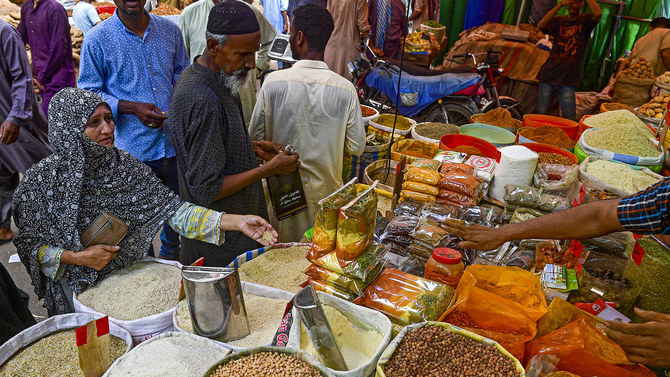
Customers bargain as they buy cereals and legumes at a shop in Karachi on June 8, 2023. (Photo courtesy: AFP/File)
Short Url
Updated 02 October 2023
Follow

Pakistan’s inflation rises to 31.4 percent y/y amid high energy prices

  • Inflation climbed 2 percent in September on month-on-month basis, official data shows
  • Statistics bureau report says Pakistan’s inflation expected to ease from Jan. 1

KARACHI: Pakistan’s inflation rate clocked in at 31.4 percent year-on-year in September, rising from 27.4 percent in August, statistics bureau data showed on Monday, as the nation reels from high fuel and energy prices.

The country is embarking on a tricky path to economic recovery under a caretaker government after a $3 billion loan program approved by the International Monetary Fund in July averted a sovereign debt default, but with conditions that complicated efforts to rein in inflation.

On a month-on-month basis, inflation climbed 2 percent in September, compared to an increase of 1.7 percent in August

Reforms required by the IMF bailout, including an easing of import restrictions and a demand that subsidies be removed, have already fueled annual inflation, which rose to a record 38.0 percent in May.

Interest rates have also risen to their highest at 22 percent, and the rupee hit all-time lows in August before recovering in September to become the best performing currency following a clampdown by authorities on unregulated FX trade.

On Friday, the ministry of finance said in its monthly report that it anticipated inflation remaining high in the coming month, hovering around 29-31 percent due to an upward adjustment in energy tariffs and a major increase in fuel prices.

The report added that inflation was, however, expected to ease, especially from the second half of the current fiscal year that starts on Jan. 1.

On Saturday Pakistan cut petrol and diesel prices from a record high, after two consecutive hikes. The finance ministry cited international prices of petroleum products and the improvement in the exchange rate, following the clampdown on unregulated FX trade.


Pakistan issues over $7 billion sukuk in 2025, nears 20 percent Shariah-compliant debt target

Updated 29 December 2025
Follow

Pakistan issues over $7 billion sukuk in 2025, nears 20 percent Shariah-compliant debt target

  • Finance Adviser Khurram Schehzad says this was the highest-ever Sukuk issuance in a single calendar year since 2008
  • Pakistan’s Federal Shariat Court ordered in 2022 the entire banking system to transition to Islamic principles by 2027

ISLAMABAD: Pakistan’s Finance Adviser Khurram Schehzad on Monday said the country achieved a landmark breakthrough in Islamic finance by issuing over Rs2 trillion ($7 billion) sukuk this year, bringing it closer to its 20 percent Shariah-compliant debt target by Fiscal Year 2027-28.

A sukuk is an Islamic financial certificate, similar to a bond, but it complies with Shariah law, which forbids interest. Pakistan’s Federal Shariat Court (FSC) had directed the government in April 2022 to eliminate interest and align the country’s entire banking system with Islamic principles by 2027.

Following the ruling, the government and the State Bank of Pakistan (SBP) have undertaken a series of measures, including legal reforms and the issuance of sukuk to replace interest-based treasury bills and investment bonds.

“In 2025, the Ministry of Finance (MoF) through its Debt Management Office, together with its Joint Financial Advisers (JFAs), successfully issued over PKR 2 trillion in Sukuk,” Schehzad said on X, describing it as “the highest-ever Sukuk issuance in a single calendar year since 2008 by Pakistan.”

Pakistan made a total of 61 issuances across one-, three-, five- and 10-year tenors, according to the finance adviser. The country also successfully launched its first Green Sukuk, a Shariah-compliant bond designed to fund environment-friendly projects.

He said the Green Sukuk was 5.4 times oversubscribed, indicating investor demand was more than five times higher than the amount the government planned to raise, which showed strong market confidence.

“The rising share of Islamic instruments in the government’s domestic securities portfolio (domestic debt) underscores strong momentum, growing from 12.6 percent in June 2025 to around 14.5 percent by December 2025, clearly positioning the MoF to achieve its 20 percent Shariah-compliant debt target by FY28,” Schehzad said.

“This milestone also reflects the structural deepening of Pakistan’s Islamic capital market, sustained investor confidence, and the strengthening of sovereign debt management.”

He said Pakistan was strengthening its government securities market by making it more resilient, diversified, and future-ready, supported by a stabilizing macroeconomic environment, a disciplined debt strategy, and a clear roadmap for Islamic finance.