

Pakistan kicks off anti-polio campaign to vaccinate over 40 million children

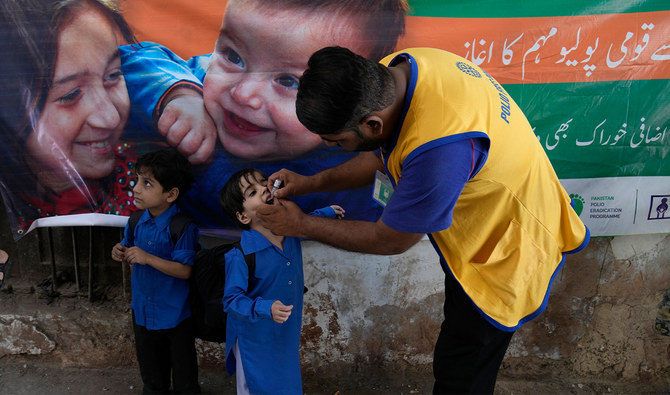
A health worker administers a polio vaccine to a child at a neighborhood of Lahore, Pakistan, on October 2, 2023. (AP)
Short Url
Updated 02 October 2023
Follow

Pakistan kicks off anti-polio campaign to vaccinate over 40 million children

  • Pakistan, Afghanistan remain the only two countries in the world where polio remains endemic
  • Pakistan’s caretaker health minister urges parents to cooperate with vaccination teams

ISLAMABAD: Pakistan’s Caretaker Prime Minister Anwaar-ul-Haq Kakar on Monday launched a national anti-polio campaign that aims to vaccinate 44 million children across the country, calling on the masses to partake in the drive to rid the country of the disease. 

Pakistan and neighboring Afghanistan are the only countries where the spread of polio has never been stopped. The potentially fatal, paralyzing disease mostly strikes children up to the age of 5 and typically spreads in contaminated water. So far this year, there have been seven cases of polio caused by the wild virus — all in Pakistan and Afghanistan.

At a ceremony held to mark the occasion in Islamabad, Kakar kicked off the campaign by administering polio drops to two children below the age of five. 

“Today we have kicked off the five-day anti-polio campaign by administering polio drops [to children],” Kakar said. “During this campaign, 44 million children will be administered polio drops and over 350,000 polio workers will take part in this national campaign, who are our real heroes and our frontline workers.”

He said the government would stand shoulder-to-shoulder with Pakistan’s international partners that are supporting the country’s bid to rid itself of polio. 

“We have to save our future generations. This is our religious, ethical and national responsibility,” Kakar said, calling on Pakistani religious scholars to take part in the campaign. 

Many Pakistanis are suspicious of the foreign entities funding the vaccination campaigns and of the Pakistan government itself. Many believe the conspiracy theory that the vaccines are part of a plot by Western outsiders to sterilize Pakistan’s population. The masses’ doubts regarding polio campaigns exacerbated in 2011 when the US Central Intelligence Agency set up a fake hepatitis vaccination program to gather intelligence on former Al-Qaeda chief Osama bin Laden.

The doubts and fears have triggered attacks on polio teams in Pakistan and the security personnel guarding them, especially in the country’s northwest. 

Earlier, Pakistan’s Caretaker Health Minister Dr. Nadeem Jan called on parents to cooperate with polio workers for the vaccination process.

To ensure the success of polio vaccinations, the government in Pakistan’s Sindh province introduced a bill last month that would imprison parents for up to one month if they fail to get their children immunized against polio or eight other common diseases. The bill was introduced after an alarming number of roughly 62,000 parents, mostly in Sindh, refused polio vaccinations for their children in January, prompting authorities there to propose the new law with penalties.

The bill is in the final stages of becoming law after Sindh’s provincial assembly approved it in August. It would punish parents with up to a month in prison for failing to vaccinate their children against certain diseases; they could also be fined up to 50,000 rupees ($168).


Bangladesh flag carrier to launch Dhaka–Karachi flights this month after over 13 years

Updated 7 sec ago
Follow

Bangladesh flag carrier to launch Dhaka–Karachi flights this month after over 13 years

  • Inaugural flight scheduled to depart from Dhaka to Karachi on Jan, 29, says Biman Bangladesh Airlines spokesperson
  • Airline will operate two weekly flights from the Bangladeshi capital to Pakistan’s commercial hub on Thursdays and Saturdays

ISLAMABAD: Bangladesh’s flag carrier Biman Bangladesh Airlines has announced it will launch direct passenger flights between the cities of Dhaka and Karachi after over 13 years later this month, the airline said on Thursday, as both nations improve historically bitter ties.  

Biman will operate two weekly flights to Karachi, Pakistan’s largest city by population and its commercial hub, on Thursdays and Saturdays, the airline’s spokesperson Boshra Islam told Arab News. 

“Biman is launching its Karachi operations on Thursday, Jan. 29, 2026,” she said, adding that the inaugural flight is scheduled to depart from Dhaka at 8:00 p.m. local time and arrive in Karachi at 11:00 p.m. Pakistan time. 

Pakistan has granted Biman initial permission to operate the route for three months until Mar. 26, according to a spokesperson for the Pakistan Civil Aviation Authority. The approval would be extended later, the official said. 

The restoration of the airline’s flights to Pakistan marks a significant step in restoring direct air connectivity between the two South Asian nations. 

Pakistan and Bangladesh were part of the same country until 1971, when the latter split from the former after a bloody civil war and became the independent state of Bangladesh.  

Ties between both have improved significantly since 2024, after the fall of former Bangladesh PM Sheikh Hasina’s government due to a student-led uprising. Hasina was widely viewed in Pakistan as being close to India and openly critical of Islamabad.  

The resumption of passenger flights comes as aviation and trade links between the two countries begin to recover after decades of limited engagement.  

In November last year, state-owned Pakistan International Airlines (PIA) said it had signed a cargo agreement with Biman Bangladesh Airlines aimed at streamlining air freight operations and boosting bilateral trade.  

A PIA spokesperson said the airlines had entered into a Cargo Interline Special Agreement as part of PIA’s strategy to expand its cargo business and offer more competitive services to customers.  

Pakistan has stepped up efforts to rebuild relations with Bangladesh as ties between Dhaka and New Delhi remain strained over India’s decision to grant asylum to Hasina after she fled the country.  

In February last year, a cargo vessel sailed directly from Pakistan to Bangladesh for the first time in decades and successfully unloaded its containers, port officials said. 

The two countries signed six agreements in August 2025 covering areas such as visa exemptions for diplomatic and official passport holders, trade cooperation, media collaboration and cultural exchanges, officials said.