

Pakistan kicks off anti-polio campaign to vaccinate over 40 million children

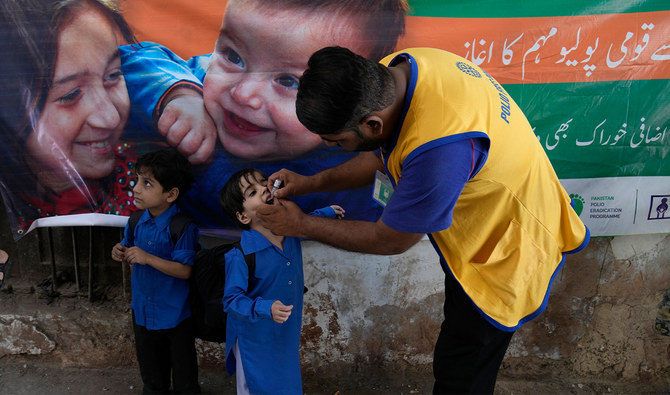
A health worker administers a polio vaccine to a child at a neighborhood of Lahore, Pakistan, on October 2, 2023. (AP)
Short Url
Updated 02 October 2023
Follow

Pakistan kicks off anti-polio campaign to vaccinate over 40 million children

  • Pakistan, Afghanistan remain the only two countries in the world where polio remains endemic
  • Pakistan’s caretaker health minister urges parents to cooperate with vaccination teams

ISLAMABAD: Pakistan’s Caretaker Prime Minister Anwaar-ul-Haq Kakar on Monday launched a national anti-polio campaign that aims to vaccinate 44 million children across the country, calling on the masses to partake in the drive to rid the country of the disease. 

Pakistan and neighboring Afghanistan are the only countries where the spread of polio has never been stopped. The potentially fatal, paralyzing disease mostly strikes children up to the age of 5 and typically spreads in contaminated water. So far this year, there have been seven cases of polio caused by the wild virus — all in Pakistan and Afghanistan.

At a ceremony held to mark the occasion in Islamabad, Kakar kicked off the campaign by administering polio drops to two children below the age of five. 

“Today we have kicked off the five-day anti-polio campaign by administering polio drops [to children],” Kakar said. “During this campaign, 44 million children will be administered polio drops and over 350,000 polio workers will take part in this national campaign, who are our real heroes and our frontline workers.”

He said the government would stand shoulder-to-shoulder with Pakistan’s international partners that are supporting the country’s bid to rid itself of polio. 

“We have to save our future generations. This is our religious, ethical and national responsibility,” Kakar said, calling on Pakistani religious scholars to take part in the campaign. 

Many Pakistanis are suspicious of the foreign entities funding the vaccination campaigns and of the Pakistan government itself. Many believe the conspiracy theory that the vaccines are part of a plot by Western outsiders to sterilize Pakistan’s population. The masses’ doubts regarding polio campaigns exacerbated in 2011 when the US Central Intelligence Agency set up a fake hepatitis vaccination program to gather intelligence on former Al-Qaeda chief Osama bin Laden.

The doubts and fears have triggered attacks on polio teams in Pakistan and the security personnel guarding them, especially in the country’s northwest. 

Earlier, Pakistan’s Caretaker Health Minister Dr. Nadeem Jan called on parents to cooperate with polio workers for the vaccination process.

To ensure the success of polio vaccinations, the government in Pakistan’s Sindh province introduced a bill last month that would imprison parents for up to one month if they fail to get their children immunized against polio or eight other common diseases. The bill was introduced after an alarming number of roughly 62,000 parents, mostly in Sindh, refused polio vaccinations for their children in January, prompting authorities there to propose the new law with penalties.

The bill is in the final stages of becoming law after Sindh’s provincial assembly approved it in August. It would punish parents with up to a month in prison for failing to vaccinate their children against certain diseases; they could also be fined up to 50,000 rupees ($168).


Pakistan promotes JF-17 fighter at Saudi defense show amid export push

Updated 4 sec ago
Follow

Pakistan promotes JF-17 fighter at Saudi defense show amid export push

  • Pakistan courts defense buyers at Riyadh show as it steps up military diplomacy and jet exports
  • JF-17 drew global attention after last year’s India conflict, with officials calling it combat-tested

ISLAMABAD: Pakistan’s air force is promoting its JF-17 fighter jet and Super Mushshak military training aircraft at a major defense exhibition in Saudi Arabia, according to an official statement on Tuesday, as Islamabad intensifies efforts to expand arms exports following heightened regional tensions with India last year.

The exhibition comes as Pakistan leans on defense diplomacy to market the JF-17 to foreign buyers, pitching the jet as a cost-effective, combat-ready alternative for countries in the Middle East, Central Asia and Africa.

Interest in the aircraft has grown since a brief but sharp military confrontation with India in May last year, which Pakistani officials have cited as evidence that the fighter jet is combat-tested.

“Pakistan Air Force contingent is participating in the World Defense Show — 2026 in the Kingdom of Saudi Arabia, featuring its cutting-edge JF-17 Thunder Block-III Multi-role fighter jet and the highly acclaimed Super Mushshak basic trainer aircraft,” the military’s media wing, Inter-Services Public Relations(ISPR), said in a statement.

“World Defense Show 2026 serves as a premier global platform for defense and security,” it added. “PAF’s participation at WDS-2026 reinforces Pakistan’s position as an emerging hub of aerospace innovation, operational competence and reliable defense solutions.”

Pakistan has been seeking to convert defense exhibitions into export opportunities, particularly for the JF-17 — jointly developed with China — and the Super Mushshak trainer, which has already been inducted by several foreign air forces.

ISPR said PAF’s presence at the exhibition in Riyadh reflects its leadership’s vision of fostering defense cooperation, promoting defense exports and strengthening strategic partnerships with friendly nations.

“The exhibition provides an opportunity for international delegations, defense officials and military industry leaders to engage with PAF representatives and explore avenues for collaboration, training and technology transfer,” it added.

The event in Riyadh comes amid closer security ties between Pakistan and Saudi Arabia.

During Prime Minister Shehbaz Sharif’s visit to the Kingdom in September, the two countries signed a joint defense pact pledging that aggression against one would be treated as an attack on both.

The accord was widely viewed as a step to formalize long-standing military cooperation into a binding security commitment aimed at strengthening joint deterrence in an increasingly volatile region.