

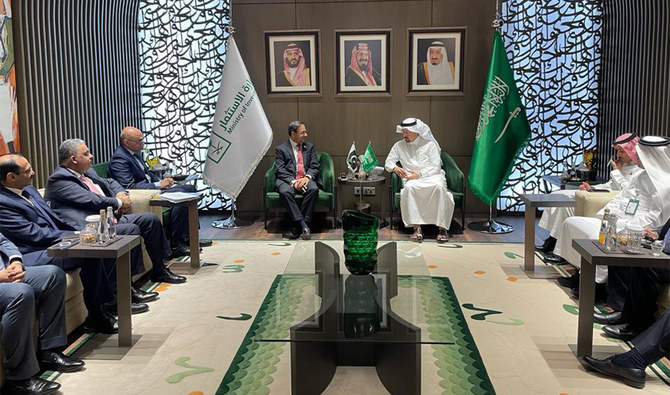

RIYADH: Saudi Arabia is set to create a dedicated desk to streamline the registration of Pakistani IT companies seeking to establish themselves in the Kingdom, announced Pakistan’s caretaker IT Minister Umar Saif on Sunday.
This development coincided with the signing of a memorandum of understanding in Riyadh between the two nations to bolster bilateral cooperation in information technology.
According to a statement by the Pakistan Embassy in Riyadh, the agreement focuses on accelerating digital transformation, fostering innovation and advancing digital infrastructure.
The MOU, signed by the Saudi Minister of Communication and Information Technology Abdullah Al-Swaha, stated that both countries will encourage small and medium-sized enterprises and startup ecosystems.
They plan to collaborate on initiatives related to the transfer of businesses and the exchange of information on accelerators and incubators for emerging technology.
On an official visit to the Kingdom, the Pakistani minister held meetings with several high-profile officials.
“We’re looking at opportunities for our startups to come here and raise investments from Saudi investors. These startups have raised over $800 million in just the last two years and are now at a point where they’re about to take off. I think each of these startups has the potential to become a billion-dollar company,” Saif told Arab News.
He announced his “incredibly productive meeting” with Saudi Minister of Investment Khalid Al-Falih on social media platform X.
“He (Al-Falih) has instructed (the Ministry of Investment) to establish a special desk for Pakistani IT companies to get registered in KSA (Kingdom of Saudi Arabia) and to grant (them) licenses to operate in KSA,” said Saif.
The Pakistani minister added: “I think there are huge opportunities for investment in Pakistan. We met with a lot of investors today (Sunday) and could meet with a few more with the PIF (Public Investment Fund) and STC to explore how they could come and be part of the telecom infrastructure, connectivity and payment systems in Pakistan.”
Furthermore, Saif mentioned that the Saudi minister of communication tasked him with identifying the top 100 Pakistani talents globally — individuals potentially poised to win Nobel Prizes and establish billion-dollar companies.
“There is certainly a commitment to now forge these partnerships and relationships beyond the call of duty,” said the Pakistani minister.
Furthermore, he emphasized the significance of chip manufacturing, which involves producing semiconductor chips in various electronic devices. This area of interest is mutually vital for both countries.
“The Kingdom has put together a lot of resources and facilities for the fabrication of semiconductors. We can do it, but we don’t have the resources. However, we certainly have the technical expertise to collaborate on this,” he said.
The minister concluded the interview by highlighting Pakistan’s substantial lithium reserves, recognizing their potential for lithium-ion battery production, which could play a crucial role in future sustainable energy solutions.
“We don’t have the resources to put our facilities to convert our lithium reserves into lithium-ion batteries and products,” he commented, adding that this is “an area in which there could be deep collaboration between the two countries.”
According to the embassy’s statement, the two nations will collaborate to explore how entrepreneurs and businesses can harness technology investments and venture capital.
Their primary objective is strengthening their digital economy connections by assessing and certifying companies for collaborative opportunities within their information and communication technology markets.
Furthermore, the agreement will facilitate cooperation in e-governance, smart infrastructure, e-health, e-education and emerging technologies such as artificial intelligence, robotics and blockchain.
Both countries will enhance their digital infrastructure, including fiber optic networks, data centers and cloud computing resources.
The agreement also encourages engagement in each other’s international events and fosters information exchange between their public and private sector entities involved in IT development and electronics.


