

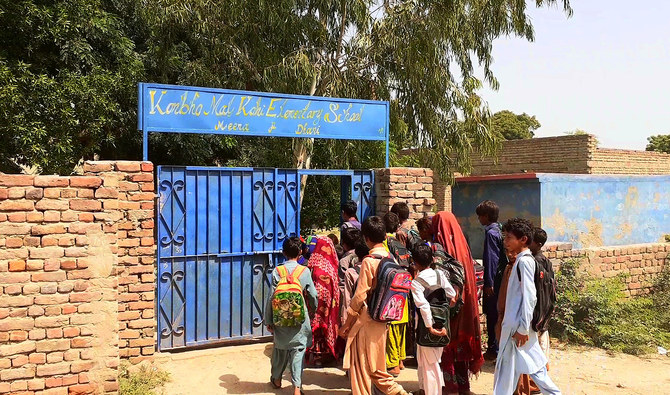

UMARKOT: A woman in her mid-30s is driven by her brother on a motorbike through narrow streets bustling with children clutching school bags, as she makes her way to the education institute she founded years ago in a secluded town in Pakistan’s southeastern province of Sindh.
Asoo Bai Kolhi’s morning journey is more than just a daily commute and can justly be viewed as a triumph over life’s challenges. Stricken with polio at the age of two due to a mis-administered injection, she refused to let her debilitating condition dictate her destiny and chose to make a significant impact on the lives of others.
A decade ago, in Meenaji Dhani – her village on the outskirts of Umarkot, Pakistan’s only Hindu-majority district – the importance of education was mostly overlooked. In 2014, Kolhi took it upon herself to enlighten underprivileged children, founding a school in her modest hut.
With no external funding, she tirelessly canvassed her village, engaging with families and encouraging parents to prioritize their children’s education. She even dipped into her own pockets to provide books and other learning material, demonstrating her unwavering commitment to uplift her whole community.
“We belong to a society where educating a girl is a far-fetched dream,” 36-year-old Kolhi told Arab News. “But my father, while living in the same society, thought of educating his daughter so the ignorance around us could be eradicated.”
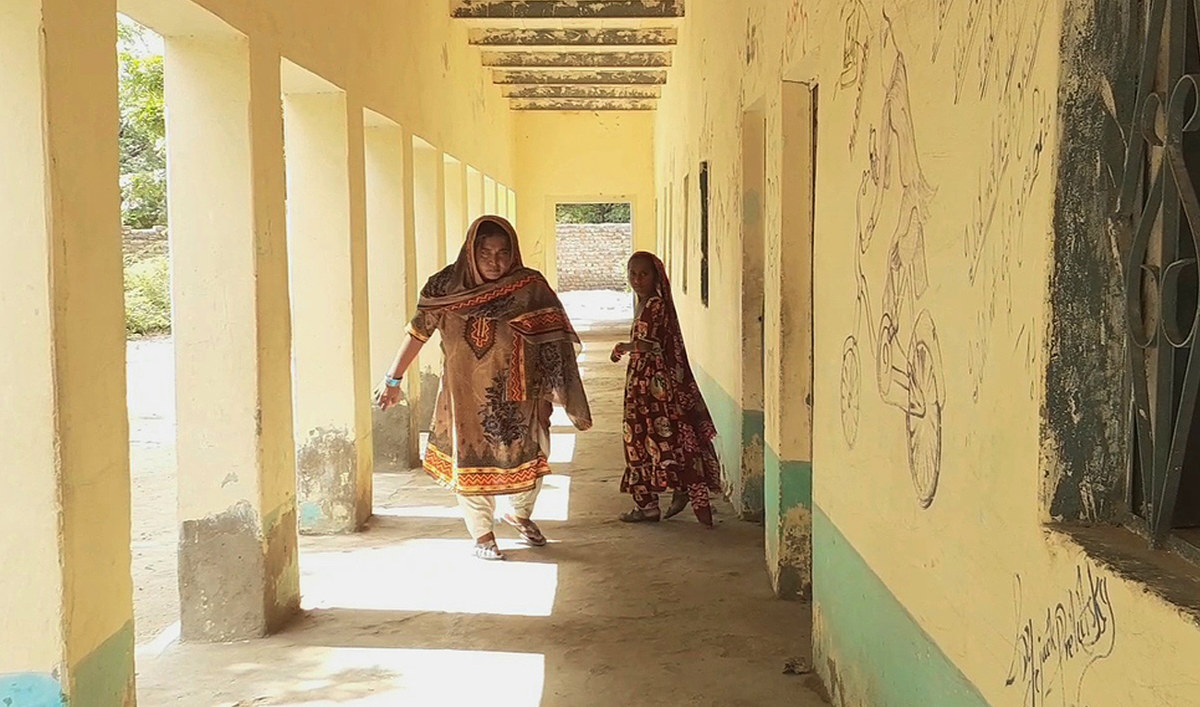
In this photograph, taken on September 27, 2023, Asoo Bai Kolhi, woman suffering from polio, heading towards her classroom at Kubho Mal Kolhi High School in Meenaji Dhani village in Umerkot district of Sindh province. (AN Photo)
She said while many parents hoped for their children to become doctors, engineers, or officers, her father had a different vision from the day she started her school and expressed his desire to see her become a teacher.
Before establishing the modest learning center, she used to visit homes in her village to educate children.
“I started teaching children up to fifth grade [at a time] when there was no consciousness among people of this village,” she recalled. “People used to send their children to work with the lure of Rs50 per day.”
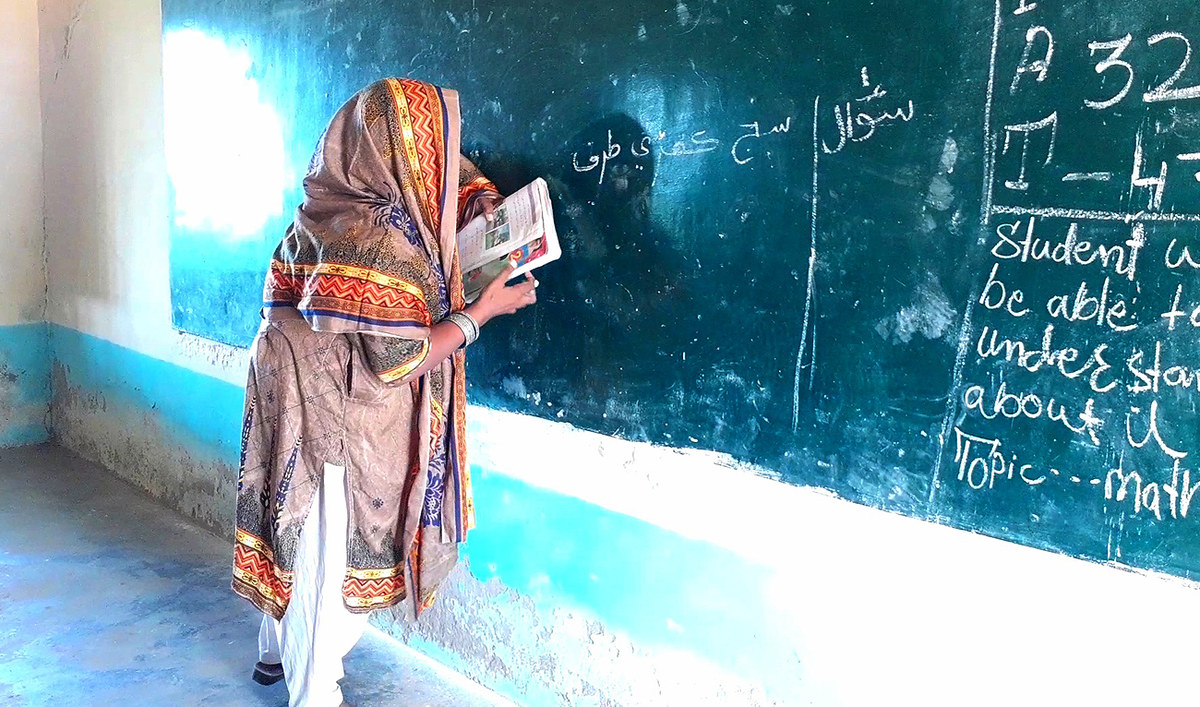
In this photograph, taken on September 27, 2023, Asoo Bai Kolhi, woman suffering from polio, writes on a board in a classroom at Kubho Mal Kolhi High School in Meenaji Dhani village in Umerkot district of Sindh province. (AN Photo)
As a result of her efforts, villagers became more open to the idea of education for their children. Many began approaching her to enroll their kids.
Today, Kubho Mal Kolhi High School boasts an enrollment of 500 students, including a growing number of young females, and has expanded its outreach.
Kaiser Bai, an 11-year-old sixth-grade student and a farmer’s daughter, commutes from a nearby village daily. Her aspiration is to follow in Kolhi’s footsteps, become a teacher, and serve her own community.
“I will continue to work for the school with the aim of helping these underprivileged children belonging to farming families and help them become doctors and officers,” Kolhi declared resolutely.
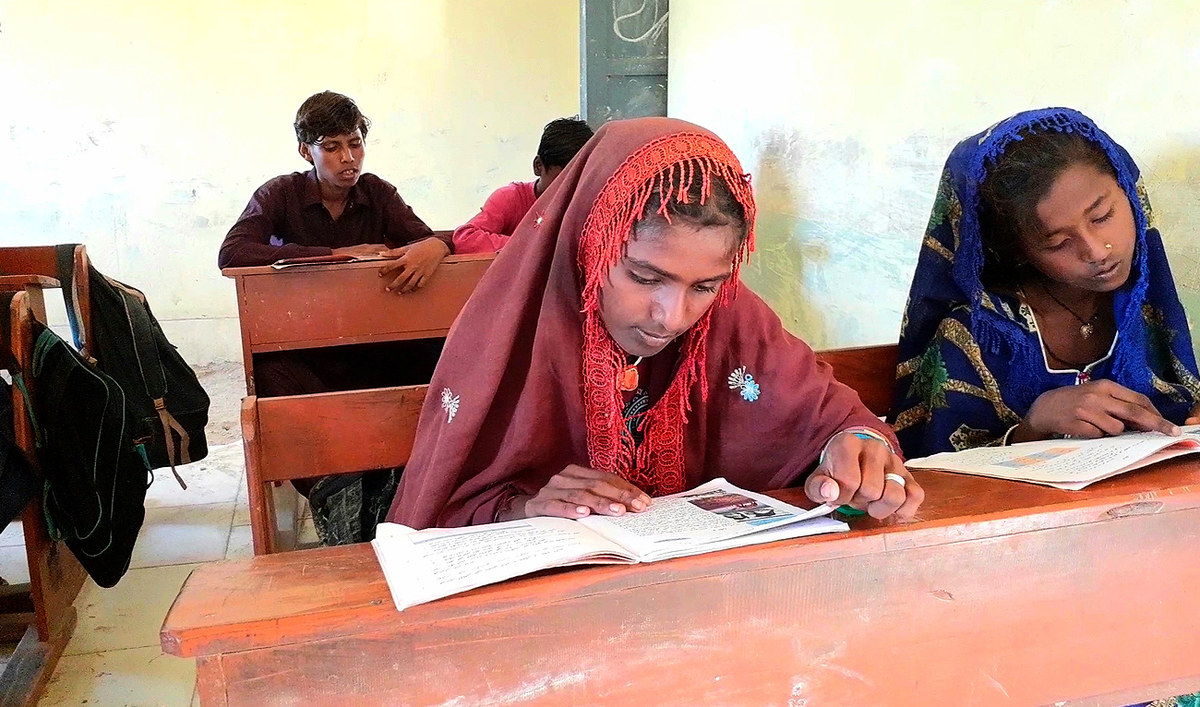
In this photograph, taken on September 27, 2023, Kaiser, 11, daughter of a farmer reads from her book in a classroom at Kubho Mal Kolhi High School in Meenaji Dhani village in Umerkot district of Sindh province. (AN Photo)
The school is currently supported by the Sindh Education Foundation and employs 10 male and two female teachers. Their salaries, averaging 15,000 rupees per month, are determined based on student enrollment numbers.
Janib Dalwani, a social worker from the village, said the school should also receive higher secondary status so girls can go on to university.
“The environment in the villages is so bad that a girl cannot go for study even a kilometer away,” he said while speaking to Arab News. “There should be such a facility in the village so that the girls can get an education.”
Dalwani added that if such impactful work could be carried out voluntarily from a humble hut, having more resources could enable Kolhi to enact change across the entire province of Sindh.
“The struggle of Asoo Bai will not be limited to this village but spread across the whole district and much of the rest of Sindh,” he said.
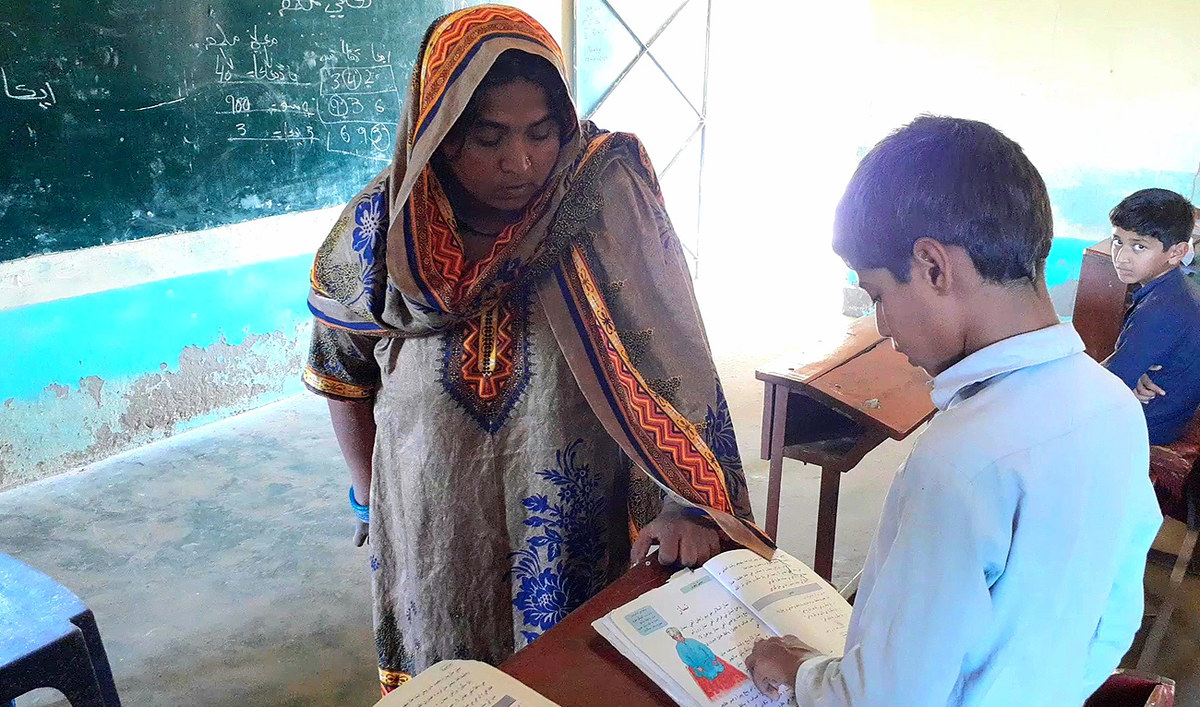
In this photograph, taken on September 27, 2023, Asoo Bai Kolhi, woman suffering from polio, teaches a student at Kubho Mal Kolhi High School in Meenaji Dhani village in Umerkot district of Sindh province. (AN Photo)


