

Italy signs judicial cooperation agreements with Algeria, Libya

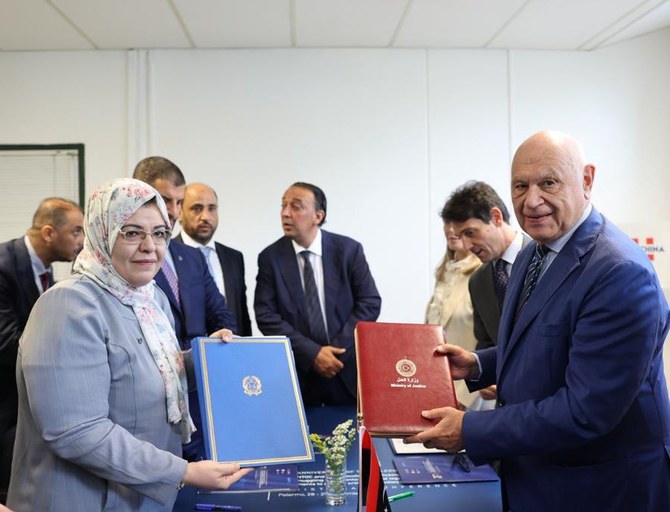
Italy on Friday signed with Libya and Algeria agreements on judicial cooperation and extradition of convicted criminals. (Supplied)
Short Url
Updated 29 September 2023
Follow

Italy signs judicial cooperation agreements with Algeria, Libya

  • Prisoners can serve sentence in country of origin following case-by-case evaluation procedure
  • Deals signed on sidelines of conference to mark 20th anniversary of UN Convention Against Transnational Organized Crime

ROME: Italy on Friday signed with Libya and Algeria agreements on judicial cooperation and extradition of convicted criminals.

The agreements were signed on the sidelines of an international conference in the Italian city of Palermo to mark the 20th anniversary of the UN Convention Against Transnational Organized Crime.

They enhance judicial cooperation, and provide that select prisoners can serve their sentence in their country of origin following a case-by-case evaluation procedure.

Before entering into force, the agreements must be approved by the Italian parliament through a specific ratification bill.

“The treaties we signed will be essential to boost fruitful judicial cooperation between our countries, and will be a useful tool in order to have faster extradition processes for criminals arrested in our countries,” Italian Justice Minister Carlo Nordio told reporters after signing the agreements.

“Italy is ready to increase its network of liaison magistrates in several countries in North Africa and sub-Saharan Africa,” he said.

“The experience we have so far has been very satisfactory, both for us and for the countries where our magistrates have been performing their duties alongside their local colleagues. That is a great way to learn best practices from both sides.”


Egypt’s historic mosques drenched in spirituality during Ramadan

Updated 5 sec ago
Follow

Egypt’s historic mosques drenched in spirituality during Ramadan

  • Arab News visits some of Cairo’s most historic mosques, including Al-Azhar, Sultan Hassan, and Amr ibn Al-As
  • ‘I have experienced an exceptional atmosphere in Egypt during Ramadan,’ says Mazen, a student at Al-Azhar University who is from Java in Indonesia

CAIRO: Cairo is home to more than 400 Islamic landmarks that represent a rich diversity of heritage and architectural styles, and the already spiritual atmosphere in the Egyptian capital receives a boost during Ramadan.

During the first week of the holy month, Arab News visited some of the city’s most historic mosques, including Al-Azhar, Sultan Hassan, and Amr ibn Al-As.

Al-Azhar Mosque hosts iftar, the evening meal that breaks the daily fast during Ramadan, at which it welcomes students from more than 100 countries as well as faculty members from Al-Azhar University. Thousands sit in organized circles throughout the mosque as they enjoy their meals.

“This is the third year I have attended this iftar since joining Al-Azhar University to study at the Faculty of Usul Al-Din (Islamic Theology),” Mazen, a student from Java in Indonesia, told Arab News. “I have experienced an exceptional atmosphere in Egypt during Ramadan.”

Gamal Abdel Rahim, a professor of Islamic antiquities, told Arab News that iftar tables first appeared in Egyptian mosques during the era of Ahmad ibn Tulun, founder of the Tulunid dynasty (835 to 884 A.D.). They became more widespread during the Mamluk and Fatimid periods at places of worship such as Amr ibn Al-As Mosque, one of the oldest in the country. The tradition continues.

“Ramadan preparations in Egypt’s historic mosques usually begin in the months of Rajab and Shaban, during which the mosque carpets are replaced,” Abdel Rahim said. “In olden times, mishkat (lamps) were filled with fresh olive oil during Ramadan.”

In the days of the Tulunid dynasty, he added, Ahmad ibn Tulun regulated working hours during Ramadan so that mosque workers could return home to their families after Asr prayer.

One of the most distinctive features of the holy month in Egypt is the firing of the Ramadan cannon, he said, a tradition that began in 1454 A.D. during the era of Sultan Khushqadam Al-Ahmadi.

“This ritual continues, linking modern practices to centuries of Islamic heritage,” he added.

At the Sultan Hussein Mosque, where original features of its construction in 1356 A.D. have been preserved, a large number of Muslims perform Taraweeh (late-night) prayers during Ramadan enveloped in a deeply spiritual and serene atmosphere that reflects the historical and religious significance of the mosque.

The mosque is also distinguished by its school, which is dedicated to teaching the four main schools of Sunni jurisprudence (Madhab). It features uniquely designed lamps that reflect the exquisite craftsmanship of its era and add to a spiritual ambiance that has attracted worshippers and scholars for centuries.

At Amr ibn Al-As Mosque, worshippers who gather for Isha and Taraweeh prayers are immersed in an atmosphere of devotion. The mosque is particularly notable for the magnificent dome at the center of its courtyard, which is a hallmark of its historic and architectural significance.

In areas around Egypt’s historic mosques, traditional lanterns and Ramadan decorations adorn the streets as Egyptians gather in these historic districts at night during the holy month to celebrate and socialize into the early hours, creating a lively and festive atmosphere that blends tradition and spirituality with communal joy.