

FX clampdown boosts Pakistani rupee 6.1 percent to become September’s top currency

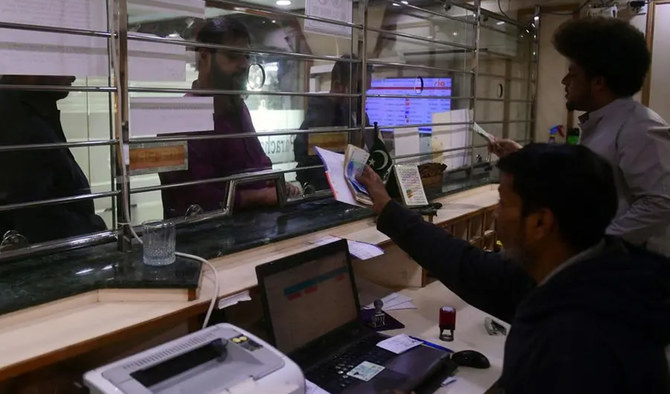
Customers exchange currency at a money exchange market in Karachi, Pakistan on January 26, 2023. (AFP/File)
Short Url
Updated 29 September 2023
Follow

FX clampdown boosts Pakistani rupee 6.1 percent to become September’s top currency

  • September’s gains have almost made up for all of the rupee’s losses in August
  • Gains technically make rupee the best-performing currency in the world this month

KARACHI: Pakistan’s rupee has gained 6.1 percent against the dollar so far in September, following an official clampdown on illegal foreign exchange trade in grey and black markets by security agencies.

September’s gains have almost made up for all of the rupee’s losses in August and technically make it the best-performing currency in the world this month. The rupee hit a record low of 307.1 against the dollar on Sept. 5 but has made a sharp recovery since the country’s financial regulator and security agencies began taking action the next day to curb black market operations.

The Pakistani rupee closed 0.3 percent up in the interbank market at 287.8 per dollar on Thursday.

The crackdown on black market operators against the informal market resulted in tens of millions of dollars pouring back into Pakistan’s interbank and open markets, dealers said.

“The government’s stern administrative action against the unlawful foreign exchange dealers and hoarders in commodity markets is stabilizing the exchange rate, providing a respite to the imported inflation and easing out commodity prices,” the Finance Ministry said in its monthly report.

“The rupee has indeed performed well but this data does not reflect the sharp depreciation preceding this performance. Pakistan’s currency has been one of the worst-performing in recent years,” said Fahad Rauf, Head of Research at Ismail Iqbal Securities.

A market-determined exchange rate is a key condition for Pakistan receiving a $3 billion bailout loan from the International Monetary Fund (IMF) that was agreed in July to help avert a sovereign default.

Rauf added that the recent performance of the rupee is more of a recovery than an actual out-performance. He said the reserves situation is still far from comfortable.

On Thursday, Pakistan’s reserves clocked in at $7.637 billion, enough for less than two months’ worth of imports.

The report added that inflation is anticipated to remain high in the coming month, hovering around 29-31 percent due to an upward adjustment in energy tariffs and a major increase in fuel prices.


Pakistan bank enables Shariah-compliant digital payment facility for passengers at Islamabad airport

Updated 23 February 2026
Follow

Pakistan bank enables Shariah-compliant digital payment facility for passengers at Islamabad airport

  • Pakistan is a cash-dominated market where a significant portion of transactions in the informal sector are made without any taxes, officials say
  • The move comes amid Pakistan’s efforts to introduce a cashless model at airports under which only digital service providers can provide services

KARACHI: Aik, Pakistan’s first Islamic digital bank, has enabled fully digital payments at Islamabad International Airport to offer travelers and passengers secure, Shariah compliant digital transaction facility.

The development comes amid Pakistan’s efforts to introduce a cashless model at airports across the country, under which only digital service providers can provide services to customers.

Aik, a subsidiary of Bank Islami, said it has onboarded merchants across the Islamabad airport and integrated QR code deployments at key touchpoints to allow passengers and visitors to make secure, seamless, and Shariah-compliant digital transactions at all counters, retail outlets, and service points.

It said the implementation complies with the regulations and framework set by the State Bank of Pakistan (SBP) and is a working model for a large-scale adoption of cashless systems in public infrastructure.

“This deployment reflects our commitment to building practical digital infrastructure that improves everyday transactions,” Aik Chief Officer Ashfaque Ahmed said in a statement.

“By enabling a fully cashless environment at a major national gateway, we are supporting efficiency, transparency, and financial inclusion at scale. This is not only a project; it is a foundation for Pakistan’s cashless future.”

Pakistan is a cash-dominated market where a significant portion of transactions, particularly in the informal sector, are conducted in cash. Officials say many of these transactions are aimed at avoiding taxes.

In recent years, the SBP has taken steps to ensure a transition toward a more cashless economy so that transactions are more traceable, reducing chances of tax evasion and corruption.

By digitizing Islamabad airport, aik said it continues to invest in secure and accessible financial solutions that “expand digital participation and support national economic modernization.”