

200 Pakistani Taliban militants arrested by Afghan authorities, foreign minister confirms

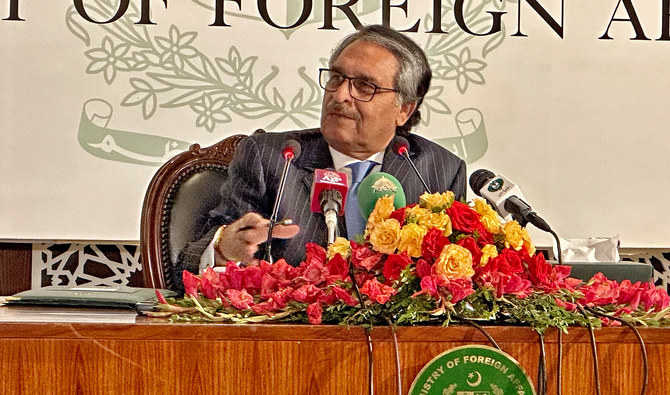
Pakistan’s caretaker Foreign Minister Jalil Abbas Jilani speaks during a press briefing in Islamabad, Pakistan on September 28, 2023. (AN photo)
Short Url
Updated 28 September 2023
Follow

200 Pakistani Taliban militants arrested by Afghan authorities, foreign minister confirms

  • Foreign minister Jalil Abbas Jilani says no change in Pakistan’s stance on Palestine
  • Says new investment council becoming “extremely popular” among Middle East investors

ISLAMABAD: Pakistan’s caretaker Foreign Minister Jalil Abbas Jilani on Thursday confirmed that 200 members of the banned Tehreek-e-Taliban Pakistan (TTP) had been arrested by Afghan authorities, saying Pakistan would ask for them to be extradited if they were not Afghan citizens.

Pakistan says the Pakistani Taliban, or TTP, have become emboldened since the Afghan Taliban seized power in Afghanistan in August 2021 as US and NATO troops were in the final stages of their pullout from the country after 20 years of war. Authorities say the insurgents, who are allied but separate from the Afghan Taliban, have found sanctuaries and have even been living openly in Afghanistan since the Taliban takeover.

The TTP has stepped up its attacks on Pakistan since November last year when it unilaterally called off a tenuous peace deal that had been brokered by Kabul.

The Afghan government says it does not permit its soil to be used by armed groups against other nations.

“During our last meeting, they [Afghan Taliban] have told us about it [arrests] and we expect these [TTP] people will be kept behind bars and dealt with according to the law,” Jilani told reporters, adding that Islamabad would ask for them to be extradited if they were not Afghans.

A spokesperson for the Afghan Taliban did not respond to request for comment on the arrests.
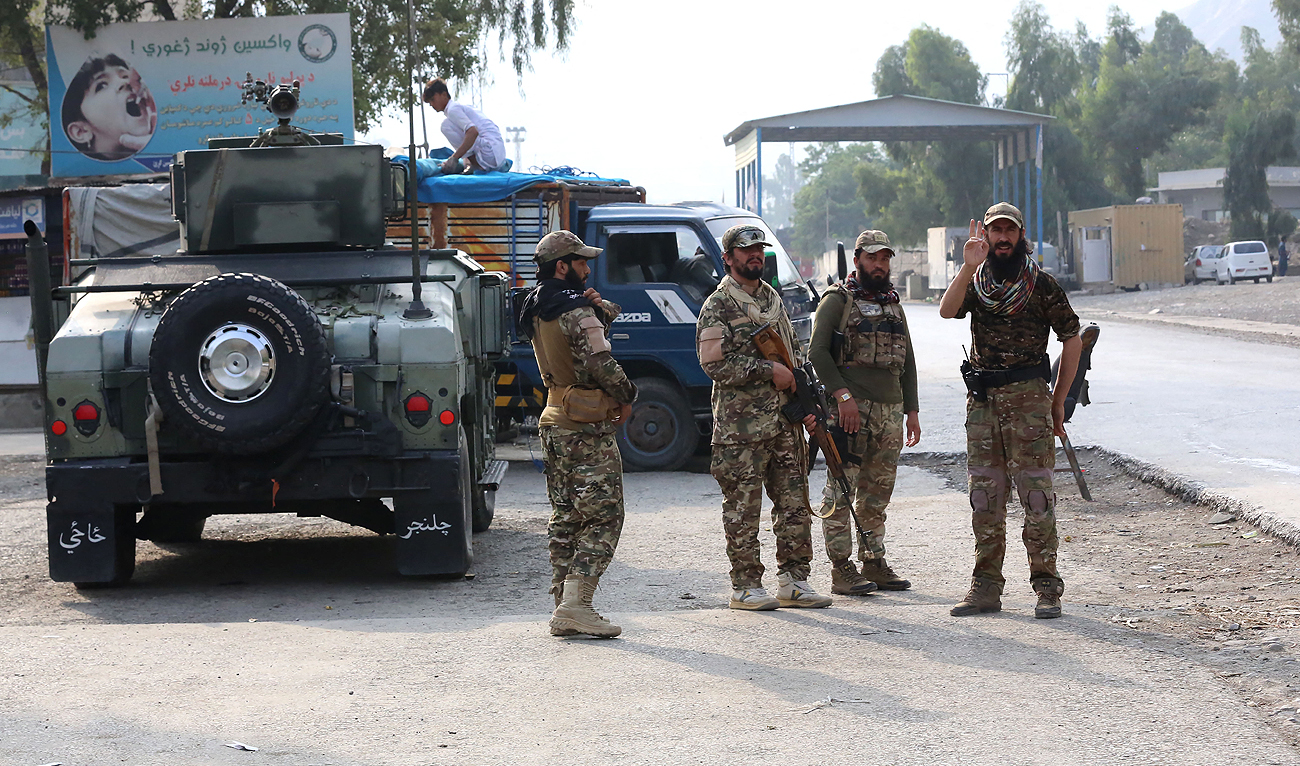


Taliban security personnel stand guard at the Pakistan-Afghanistan border in Torkham on September 15, 2023. (AFP/File)

Jilani said Pakistan’s position on Palestine had not changed, amid US-sponsored efforts to normalize Israeli relations with Muslim states, including Saudi Arabia.

Israel has moved closer to the United Arab Emirates, Bahrain, Sudan and Morocco following a US-driven diplomatic initiative in 2020 which pushed for normalization of relations. Expectations that Israel might normalize relations with Saudi Arabia, the home of Islam’s two holiest shrines, were ratcheted up last week after the Saudi crown prince said in an interview the two countries were moving steadily closer to normalizing relations with Israel.

Pakistan does not recognize the state of Israel and has repeatedly called for an independent Palestinian state based on “internationally agreed parameters” and the pre-1967 borders with Al-Quds Al-Sharif as its capital.

“The position of Pakistan on Israel and Palestine was the same yesterday and is the same today, and it will always be the same in the future as well,” the Pakistani foreign minister said.

“Our policy is linked to the rights of Palestinian people,” Jilani added.

“The issue of Palestine’s right to self-determination is the same as Kashmiris and if we say that it is the same for the Palestinians and Kashmiris then it becomes part of our national interest to support both.”

Speaking about the Special Investment Facilitation Council (SIFC) — a civil-military hybrid forum — set up in June to attract foreign funding, particularly from GCC nations, in agriculture, mining, information technology, defense production and energy, Jilani said the forum had become “extremely popular” among international investors and was attracting interest from Middle Eastern countries.

“There are a lot of MOUs and agreements which are in the works, and we are expecting delegations from respective GCC countries very soon,” Jilani said, adding that agreements would be finalized in the fields of agriculture, information technology, mines, and minerals, energy, and defense production, mostly as joint ventures.

On reports that India was denying visas to Pakistani fans wanting to travel to the neighboring country to watch the Cricket World Cup from Oct. 5-Nov. 19, Jilani said Islamabad would take it up with Delhi through “diplomatic channels.”

“I believe PCB [Pakistan Cricket Board] should also play an active role in talking to the Indian Cricket Board because this is also in ICC [International Cricket Council] rules, that if a team is visiting your country, you allow its spectators to visit,” the foreign minister said.

“And if ICC has this rule to allow spectators of the visiting team to go to that place, then they should put pressure on India to implement it.”

Travel between the two arch-rivals is usually an issue for players also due to the diplomatic tensions between the governments. Pakistan and India haven’t played a bilateral series in any format since 2012-13. 


Imran Khan’s party seeks ‘confidence-building measures’ after government’s talks offer

Updated 03 January 2026
Follow

Imran Khan’s party seeks ‘confidence-building measures’ after government’s talks offer

  • PTI says access to jailed founding leader essential for talks to be considered credible
  • Government says it’s ready for dialogue but nothing will happen until Khan favors the idea

ISLAMABAD: Pakistan’s jailed former prime minister Imran Khan’s party said on Saturday it would only consider the government’s offer for talks credible if it is accompanied by “concrete confidence-building measures,” such as unhindered access to its founding leader in a high-security prison in Rawalpindi.

Last month, Prime Minister Shehbaz Sharif said the government was fully prepared to hold a dialogue with Khan’s Pakistan Tehreek-e-Insaf (PTI) party to address political polarization that has deepened since the downfall of the PTI administration in a parliamentary no-confidence vote in 2022.

PTI has frequently complained about a state crackdown against its top leadership, including Khan and his wife, who are serving prison sentences in multiple cases ranging from corruption charges to inciting violence against state institutions and attacks on government properties.

Sharif’s offer for talks came amid media reports that PTI wanted a dialogue with the government, though he noted that negotiations would not be allowed to proceed on the basis of “blackmailing” or unlawful demands and would only cater to legitimate issues.

“Announcements of talks, without concrete confidence-building measures, cannot be treated as credible progress,” Azhar Leghari, PTI’s central deputy information secretary, told Arab News.

He recalled that Khan had authorized Mahmood Khan Achakzai and Allama Raja Nasir Abbas to carry forward with the dialogue process, adding that talks “require trust, and trust cannot be built at the cost of constitutional rights or democratic legitimacy.”

“For dialogue to be meaningful, it is essential that these authorized representatives are allowed regular and unhindered access to Imran Khan so that any engagement accurately reflects his views and PTI’s collective position,” he added.

Khan’s family, party and legal team have complained in the past they are stopped by the authorities from meeting the ex-PM in prison. Last month, they also raised concerns about his health, prompting the officials to allow one of his sisters to meet him, who said he was fine.

Shortly thereafter, a scathing message was posted on his social media account, criticizing the army chief. Khan’s post elicited a bitter response from the government and the military amid accusations of inciting people against state institutions.

Leghari’s comments came only a day after Rana Sanaullah, adviser to Prime Minister Sharif on political affairs, said PTI’s “second- or third-tier leadership” wanted dialogue, but nothing was going to happen until Khan favored these negotiations.

He also maintained that while the government was ready for talks, “uncertainty and delays from PTI are preventing progress.”

Meanwhile, a newly formed National Dialogue Committee of former PTI leaders told Arab News it had organized a session on Wednesday, January 7, in the federal capital that will bring together all major political parties, journalists, lawyers and representatives of civil society.

“Our goal is to bring political leaders together so that, while discussing their own issues, they can collectively seek solutions to the nation’s challenges,” Mahmood Baqi Moulvi, a Pakistani politician and member of the committee, said.

“The initiative also builds on previous efforts, including a letter to the prime minister requesting confidence-building measures to enable talks with PTI,” he added.

The National Dialogue Committee had urged the government in the letter to grant parole to jailed party figures in Lahore, including former foreign minister Shah Mahmood Qureshi and Dr. Yasmin Rashid, describing the move as vital for building trust ahead of negotiations.

It had also maintained such a step “would not only create an extremely positive, conducive, and trust-filled environment for the negotiations but would also lay a strong foundation for restoring mutual confidence among all stakeholders.”

While the government has also offered dialogue in the past, PTI leaders have conditioned participation on substantive measures, including what they describe as an end to politically motivated prosecutions and arrests, restoration of fundamental rights, respect for judicial independence and a credible roadmap toward free and fair elections.

“Reconciliation is possible, but it must be based on correcting injustices rather than managing optics,” Leghari said. “A genuine reset requires restoring respect for the Constitution, ending political victimization and allowing democratic processes to function without interference.”

Rana Sanaullah and Deputy Law Minister Barrister Aqeel Malik did not respond to requests for comment.