NATO’s secretary-general meets with Zelensky to discuss battlefield and ammunition needs in Ukraine

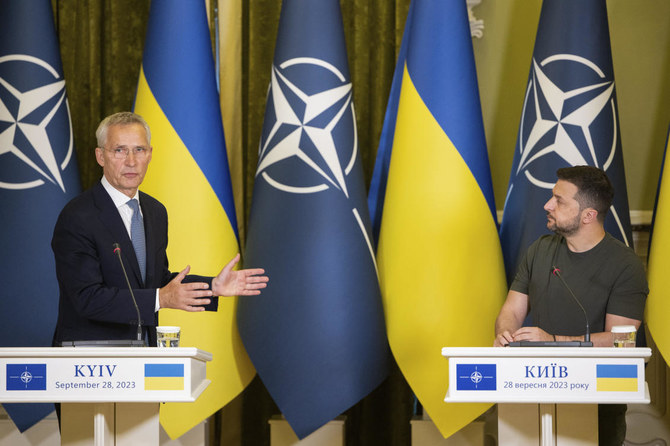
NATO Secretary General Jens Stoltenberg and Ukrainian President Volodymyr Zelensky attend their press conference in Kyiv on Sept. 28, 2023. (AP)
Short Url
Updated 28 September 2023
Follow

NATO’s secretary-general meets with Zelensky to discuss battlefield and ammunition needs in Ukraine

  • Zelensky said that Stoltenberg agreed to make efforts to get NATO members to help provide additional air defense systems to protect Ukraine’s power plants
  • Stoltenberg said that NATO has contracts for $2.5 billion in ammunition for Ukraine

KYIV: NATO Secretary-General Jens Stoltenberg met with President Volodymyr Zelensky to discuss the status of the war and needs of troops on Thursday, the day after Russia accused Ukraine’s Western allies of helping plan and conduct last week’s missile strike on the Black Sea Fleet’s headquarters on the annexed Crimean Peninsula.
Zelensky said that Stoltenberg agreed to make efforts to get NATO members to help provide additional air defense systems to protect Ukraine’s power plants and energy infrastructure that were badly damaged in relentless and deadly attacks by Russia last winter. He also reminded the secretary-general of the persistent attacks that often strike civilian areas, including 40 drone attacks overnight.
“In the face of such intense attacks against Ukrainians, against our cities, our ports, which are crucial for global food security, we need a corresponding intensity of pressure on Russia and a strengthening of our air defense,” Zelensky said. “The world must see how Russia is losing dearly so that our shared values ultimately prevail.”
Stoltenberg said that NATO has contracts for 2.4 billion euros ($2.5 billion) in ammunition for Ukraine, including 155 mm Howitzer shells, anti-tank guided missiles and tank ammunition.
“The stronger Ukraine becomes, the closer we become to ending Russia’s aggression,” Stoltenberg said. “Russia could lay down arms and end its war today. Ukraine doesn’t have that option. Ukraine’s surrender would not mean peace. It would mean brutal Russian occupation. Peace at any price would be no peace at all.”
On Wednesday, Russian Foreign Ministry spokeswoman Maria Zakharova had said the attack on the Black Sea Fleet headquarters in Crimea had been coordinated with the help of US and UK security agencies, and that NATO satellites and reconnaissance planes also played a role.
Ukraine said without providing supporting evidence that the attack had killed 34 officers and wounded 105 others. But it also claimed to have killed the fleet’s commander, Adm. Viktor Sokolov, who was shown on Russian state television on Wednesday speaking with reporters in the Black Sea city of Sevastopol.
Unconfirmed news reports said Storm Shadow missiles provided to Ukraine by the UK and France were used in the attack on the Russian navy installation. The UK Ministry of Defense, which in the past has declined to discuss intelligence-related matters, didn’t comment on Zakharova’s remarks.
The meeting with Stoltenberg came the same day the French Defense Minister Sebastien Lecornu visited the memorial wall that honors fallen soldiers in Kyiv and the day after UK Defense Secretary Grant Shapps met with Zelensky to reaffirm the UK’s support for Ukraine and pledged to provide more ammunition as Kyiv’s counteroffensive plods forward toward the season when damp and cold weather could slow progress.
Shapps, who hosted a Ukrainian family in his home for a year, said that he was personally aggrieved by what the country had endured.
“Our support for you, for Ukraine remains absolutely undented,” Shapps said in a video posted by Zelensky. “We stand shoulder to shoulder with you. We feel your pain of what’s happened and we want to see a resolution, which is the resolution that you want and require.”
Zelensky has pushed for Ukraine to join NATO, but at the organization’s annual summit this summer in Lithuania, members of the trans-Atlantic military alliance pledged more support for Ukraine but stopped short of extending an invitation for the country to join the alliance.
NATO leaders said during the summit that they would allow Ukraine to join the alliance “when allies agree and conditions are met.” They also decided to remove obstacles on Ukraine’s membership path so that it can join more quickly once the war with Russia is over.
Zelensky said Thursday that Ukraine is working on a plan that will outline practical steps for Ukraine to align with the principles and standards of NATO.
“And it is very important that the allies have agreed that Ukraine does not need an action plan for NATO membership,” Zelensky said.


Coast Guard is pursuing another tanker helping Venezuela skirt sanctions, US official says

Updated 22 December 2025
Follow

Coast Guard is pursuing another tanker helping Venezuela skirt sanctions, US official says

  • US oil companies dominated Venezuela’s petroleum industry until the country’s leaders moved to nationalize the sector, first in the 1970s and again in the 21st century under Maduro and his predecessor, Hugo Chávez

WEST PALM BEACH, Florida: The US Coast Guard on Sunday was pursuing another sanctioned oil tanker in the Caribbean Sea as the Trump administration appeared to be intensifying its targeting of such vessels connected to the Venezuelan government.
The pursuit of the tanker, which was confirmed by a US official briefed on the operation, comes after the US administration announced Saturday it had seized a tanker for the second time in less than two weeks.
The official, who was not authorized to comment publicly about the ongoing operation and spoke on the condition of anonymity, said Sunday’s pursuit involved “a sanctioned dark fleet vessel that is part of Venezuela’s illegal sanctions evasion.”
The official said the vessel was flying a false flag and under a judicial seizure order.
The Pentagon and Department of Homeland Security, which oversees the US Coast Guard, deferred questions about the operation to the White House, which did not offer comment on the operation.
Saturday’s predawn seizure of a Panama-flagged vessel called Centuries targeted what the White House described as a “falsely flagged vessel operating as part of the Venezuelan shadow fleet to traffic stolen oil.”
The Coast Guard, with assistance from the Navy, seized a sanctioned tanker called Skipper on Dec. 10, another part of the shadow fleet of tankers that the US says operates on the fringes of the law to move sanctioned cargo. It was not even flying a nation’s flag when it was seized by the Coast Guard.
President Donald Trump, after that first seizure, said that the US would carry out a “blockade” of Venezuela. It all comes as Trump has ratcheted up his rhetoric toward Venezuelan President Nicolás Maduro.
This past week Trump demanded that Venezuela return assets that it seized from US oil companies years ago, justifying anew his announcement of a “blockade” against oil tankers traveling to or from the South American country that face American sanctions.
Trump cited the lost US investments in Venezuela when asked about his newest tactic in a pressure campaign against Maduro, suggesting the Republican administration’s moves are at least somewhat motivated by disputes over oil investments, along with accusations of drug trafficking. Some sanctioned tankers already are diverting away from Venezuela.
US oil companies dominated Venezuela’s petroleum industry until the country’s leaders moved to nationalize the sector, first in the 1970s and again in the 21st century under Maduro and his predecessor, Hugo Chávez. Compensation offered by Venezuela was deemed insufficient, and in 2014, an international arbitration panel ordered the country’s socialist government to pay $1.6 billion to ExxonMobil.
Maduro said in a message Sunday on Telegram that Venezuela has spent months “denouncing, challenging and defeating a campaign of aggression that goes from psychological terrorism to corsairs attacking oil tankers.”
He added: “We are ready to accelerate the pace of our deep revolution!”
Sen. Rand Paul, R-Kentucky, who has been critical of Trump’s Venezuela policy, called the tanker seizures a “provocation and a prelude to war.”
“Look, at any point in time, there are 20, 30 governments around the world that we don’t like that are either socialist or communist or have human rights violations,” Paul said on ABC’s’ “This Week.” ”But it isn’t the job of the American soldier to be the policeman of the world.”
The targeting of tankers comes as Trump has ordered the Defense Department to carry out a series of attacks on vessels in the Caribbean and eastern Pacific Ocean that his administration alleges are smuggling fentanyl and other illegal drugs into the United States and beyond.
At least 104 people have been killed in 28 known strikes since early September. The strikes have faced scrutiny from US lawmakers and human rights activists, who say the administration has offered scant evidence that its targets are indeed drug smugglers and that the fatal strikes amount to extrajudicial killings.
Trump has repeatedly said Maduro’s days in power are numbered. White House chief of staff Susie Wiles said in an interview with Vanity Fair published last week that Trump “wants to keep on blowing boats up until Maduro cries uncle.”
Sen. Tim Kaine, D-Virginia, told NBC’s “Meet the Press” on Sunday that Trump’s use of military to mount pressure on Maduro runs contrary to Trump’s pledge to keep the United States out of unnecessary wars.
Democrats have been pressing Trump to seek congressional authorization for the military action in the Caribbean.
“We should be using sanctions and other tools at our disposal to punish this dictator who is violating the human rights of his civilians and has run the Venezuelan economy into the ground,” Kaine said. “But I’ll tell you, we should not be waging war against Venezuela. We definitely should not be waging war without a vote of Congress.