

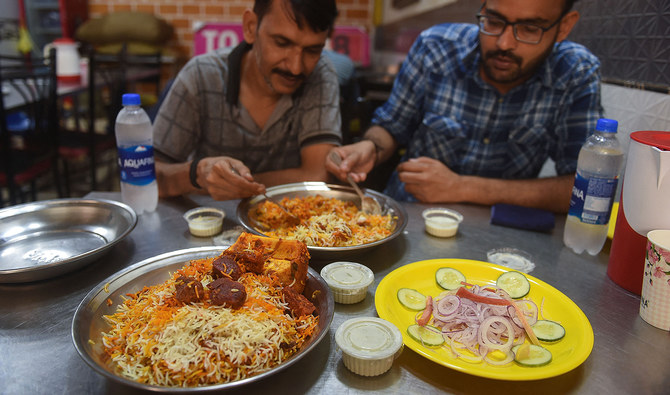

KARACHI: Eying each other across a stream of traffic, rival Pakistani biryani joints vie for customers, serving a fiery medley of meat, rice, and spice that unites and divides South Asian appetites.
Both sell a niche version of the dish, steeped in the same vats, with matching prices and trophies commending their quality.
But in Karachi, where a biryani craze boomed after the creation of Pakistan, it is the subtle differences that inspire devotion.
“Our biryani is not only different from theirs but unique in the world,” says restaurateur Muhammad Saqib, who layers his “bone marrow biryani” with herbs.
“When a person bites into it he drowns in a world of flavors,” the 36-year-old says.
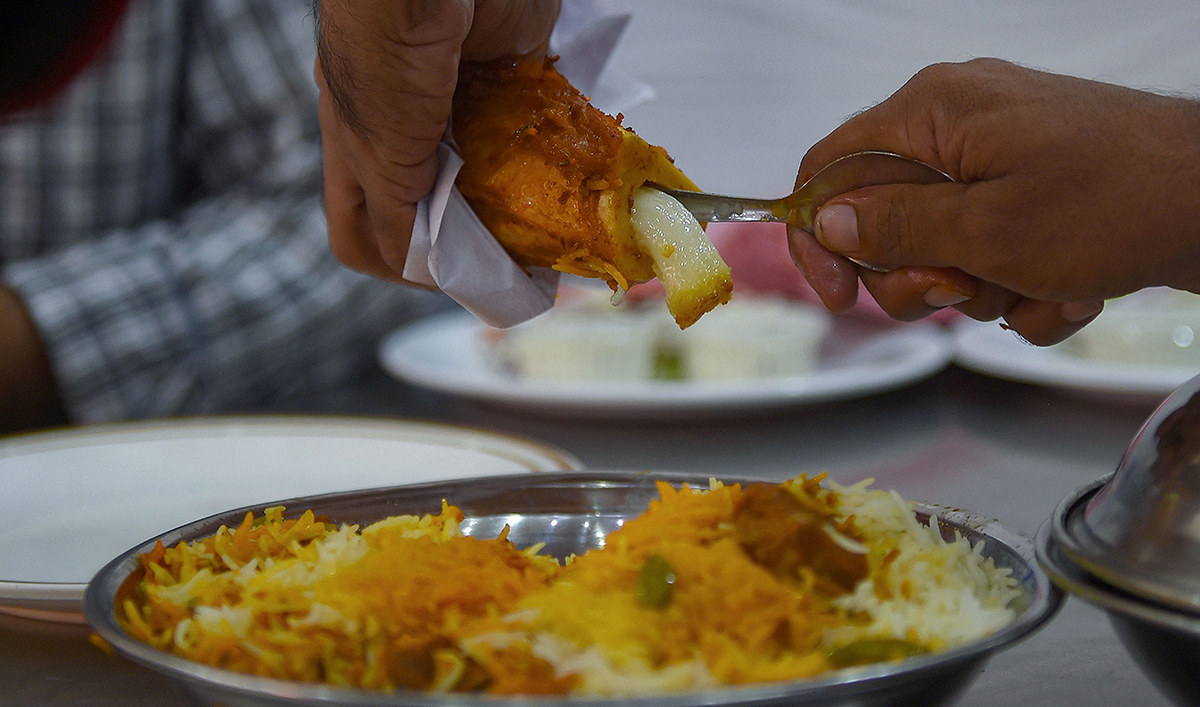
In this photograph taken on September 16, 2023, people eat biryani at a restaurant in Karachi. (AFP)
Across the road, Muhammad Zain sees it differently.
“We were the ones who started the biryani business here first,” the 27-year-old claims, as staff scoop out sharing platters with a gut-punch of masala.
“It’s our own personal and secret recipe.”
Both agree on one thing.
“You can’t find biryani like Pakistan’s anywhere in the world,” says Saqib.
“Whether it’s a celebration or any other occasion, biryani always comes first,” according to Zain.
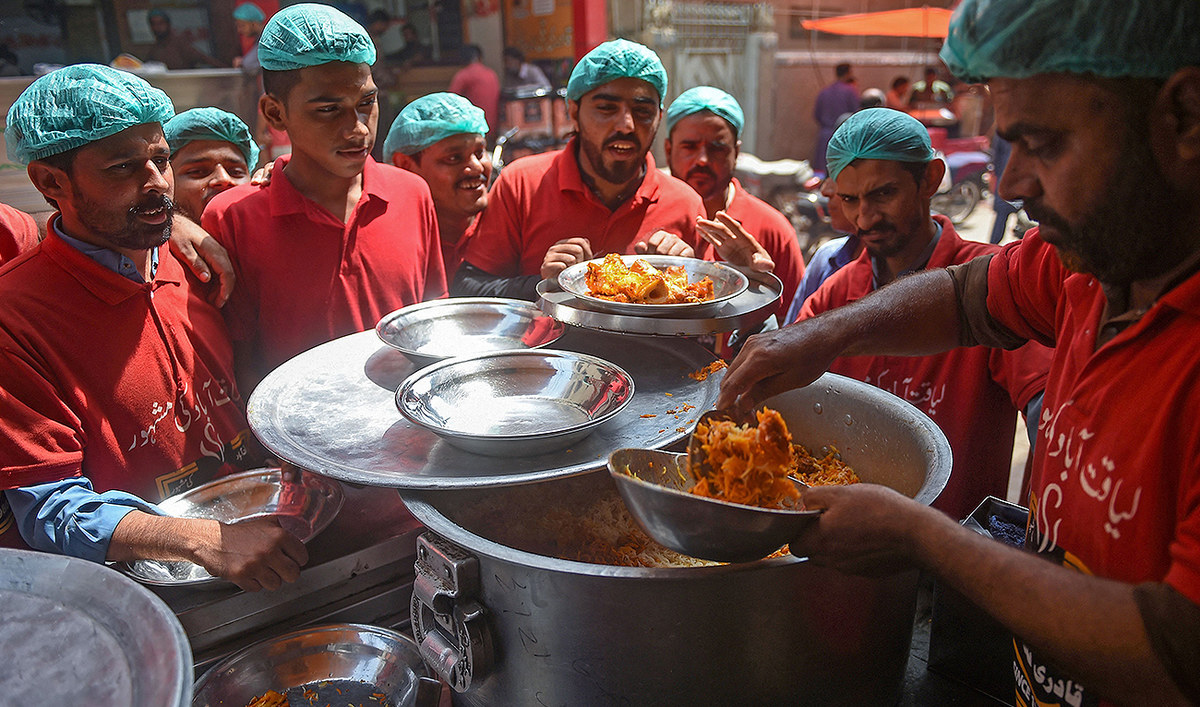
In this photograph taken on September 16, 2023, a staff serves plates of biryani at a restaurant in Karachi. (AFP)
British colonial rule in South Asia ended in 1947 with a violent rupture of the region along religious lines.
Hindus and Sikhs in newly created Pakistan fled to India while Muslim “MoHajjirs” — refugees — went the other way.
India and Pakistan have been arch-rivals since, fighting wars and locked in endless diplomatic strife. Trade and travel have been largely choked off.
Many MoHajjirs settled in Karachi, home to just 400,000 people in 1947 but one of the world’s largest cities today with a population of 20 million.
For Indian food historian Pushpesh Pant, biryani served in South Asia’s melting-pot cities such as Karachi is a reminder of shared heritage.
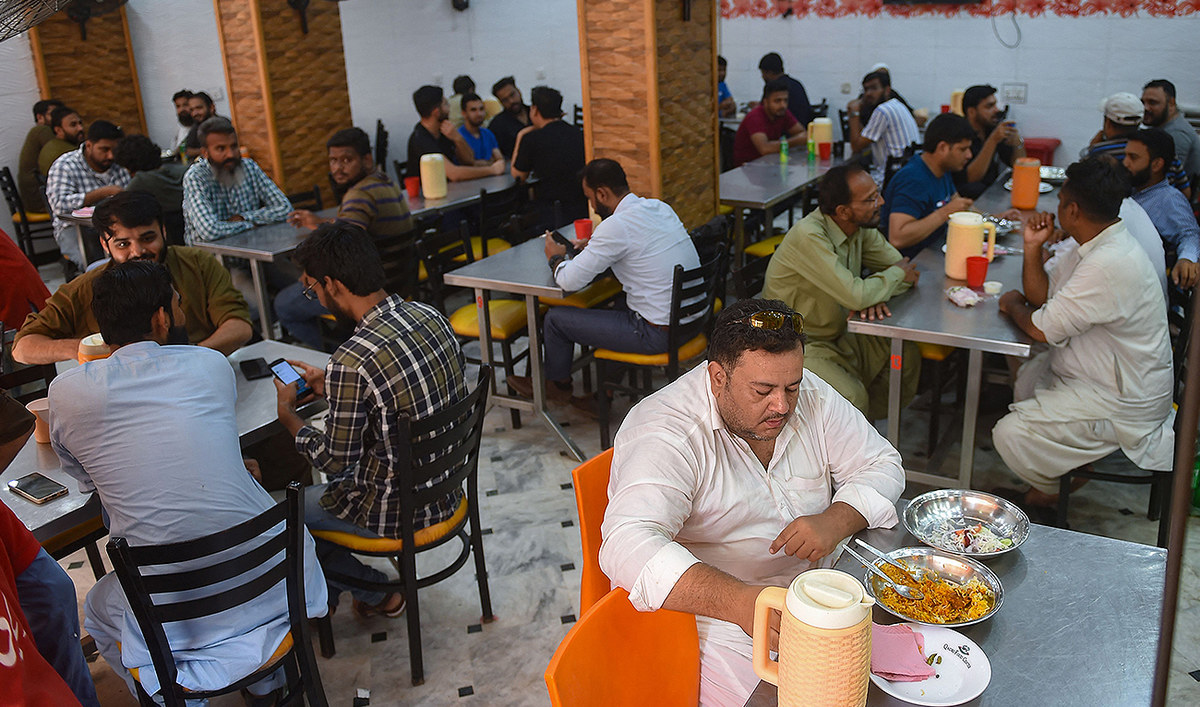
In this photograph taken on September 16, 2023, people eat biryani at a restaurant in Karachi. (AFP)
“Hindus ate differently, Nanakpanthis (Sikhs) ate differently, and Muslims ate differently, but it was not as if their food did not influence each other,” he told AFP from the city of Gurugram outside Delhi.
“In certain parts of Pakistan and certain parts of India, the differences in flavors and foods are not as great as man-made borders would make us think.”
Every Karachi neighborhood has its own canteens fronted by vendors clanking a spatula against the inside of biryani pots.
The recipe has endless variations.
The one with beef is a favorite in Pakistan, while vegetarian variants are more popular in largely India.
Chicken is universal. Along coastlines, seafood is in the mix.
And purists debate if adding potatoes is heresy.
“Other than that, there is Pulao Biryani which is purely from Delhi,” says 27-year-old pharmacist Muhammad Al Aaqib, describing a broth-stewed variation.
“My roots lead back to Delhi too so it’s like the mother of biryanis for us.”
“Perhaps every person has a different way of cooking it, and their way is better,” says 36-year-old landlord Mehran Khoso.
The origins of biryani are hotly contested.
However, it is generally accepted the word has Persian roots and it is argued the dish was popularised in the elite kitchens of the Mughal Empire, which spanned South Asia between the 16th and 19th centuries.
In spite of that pedigree, its defining quality is permutation.
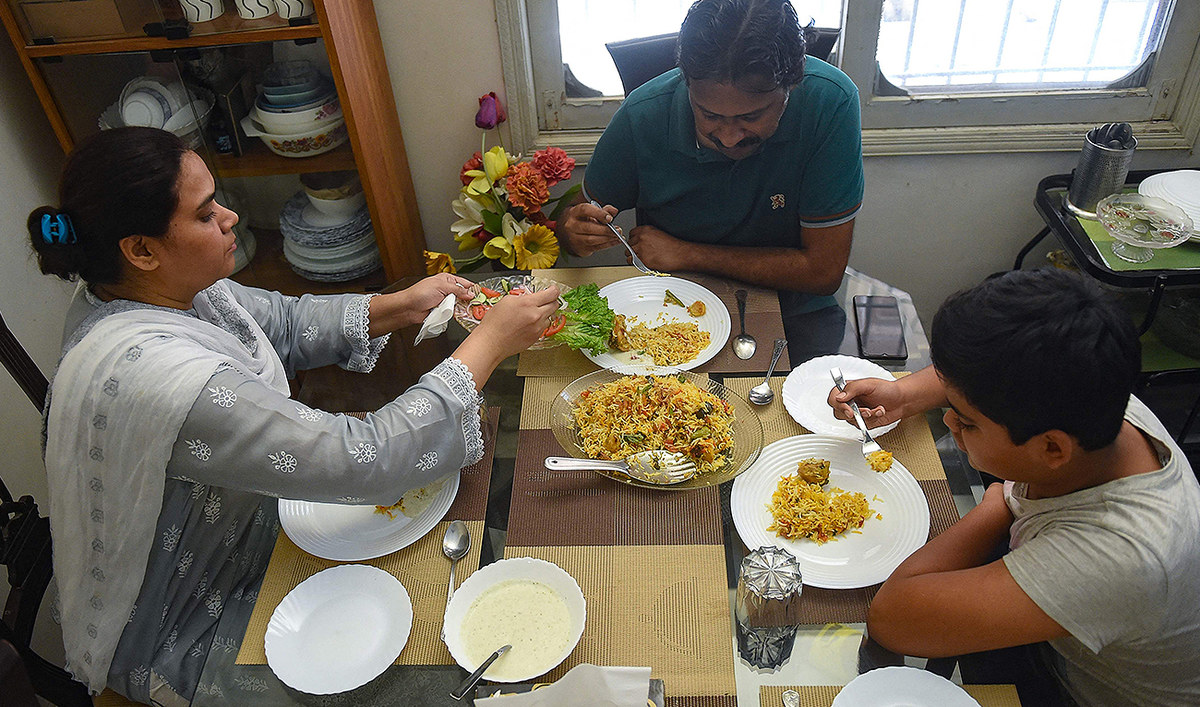
In this photograph taken on September 17, 2023, Quratul ain Asad (L), a homemaker serves biryani for her family members at her house in Karachi. (AFP)
Quratul Ain Asad, 40, spends Sunday morning cooking for her husband and son, MoHajjir descendants of a family that arrived in Karachi from the Indian town of Tonk in 1948.
But at the dinner table, they feast not on an heirloom recipe but a TV chef’s version with a cooling yogurt sauce and a simple shredded salad.
Asad insists on Karachi’s biryani supremacy.
“You will not like biryani from anywhere else once you’ve tasted Karachi’s biryani,” she says.
“There is no secret ingredient. I just cook with a lot of passion and joy,” she adds. “Perhaps that’s why the taste comes out good.”
Cooked in bulk, biryani is also a staple of charity donations.
At Ghazi Foods, 28-year-old Ali Nawaz paddles out dozens of portions of biryani into plastic pouches, which are delivered to poor neighborhoods on motorbikes.
A minute after one of those bikes stops, the biryani is gone, seized by kids and young adults.
“People pray for us when they eat it,” says Nawaz. “It feels good that our biryani reaches the people.”


