

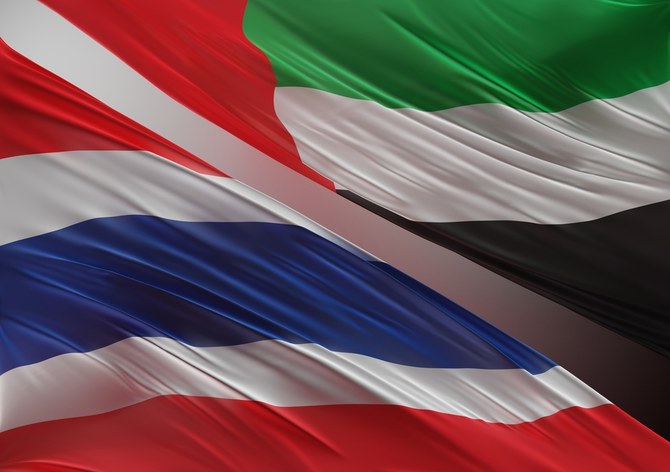
UAE-Thailand economic agreement to strengthen bilateral trade, says envoy

Bilateral trade between the UAE and Thailand reached $11.1 billion in the first seven months of 2023. Shutterstock
Short Url
Updated 28 September 2023
Follow

UAE-Thailand economic agreement to strengthen bilateral trade, says envoy

RIYADH: Trade and economic relationships between the UAE and Thailand are poised for significant growth as both nations prepare to sign a Comprehensive Economic Partnership Agreement amid ongoing negotiations, according to a senior envoy. 

Sorayut Chasombat, ambassador of Thailand to the UAE, stated during a media briefing that the CEPA is expected to contribute $300 million to the country’s gross domestic product. 

“We want to be a strong partner of the UAE in this region. We recognize the UAE’s role in this part of the world in promoting peace, stability, and prosperity within the region,” said Chasombat during the briefing at the Royal Thai embassy.  

He added: “With the completion of CEPA, it will add at least $300 million to the Thai GDP. It will add at least $250 million to the bilateral trade between the two countries.”  

Negotiations for the free trade CEPA between Thailand and the UAE began in May, and the latest round of negotiations, currently taking place in Bangkok, is scheduled to conclude on Sept. 28. 

The UAE is Thailand’s sixth-largest trading partner globally and holds the first position in the Middle East. Bilateral trade between the two countries reached $11.1 billion in the first seven months of 2023. 

As of July 2023, Thailand exported goods worth $1.81 billion to the UAE, while imports from the Arab nation amounted to $9.3 billion. 

Chasombat also affirmed Thailand’s robust participation in COP28, given the country’s commitment to becoming carbon neutral by 2050 and achieving net-zero emissions by 2065. 

“Thailand is well known for sustainable development. We plan to have strong participation at the upcoming COP28, next year’s World Government Summit, and the World Trade Organization Ministerial Conference. We would give our utmost support to the UAE,” he noted.  

COP28, the UN Climate Change Conference, is scheduled to take place in Dubai from Nov. 30 to Dec. 12 this year. 

Highlighting tourism ties, Chasombat disclosed that the UAE is second only to Saudi Arabia in terms of the number of tourists visiting Thailand. 


Saudi tourism employment surpasses 1m as hospitality sector expands 

Updated 08 January 2026
Follow

Saudi tourism employment surpasses 1m as hospitality sector expands 

RIYADH: Saudi Arabia’s tourism workforce surpassed 1 million in the third quarter of 2025, underscoring the sector’s rapid expansion as the Kingdom continues to develop its hospitality infrastructure and visitor economy. 

According to the latest Tourism Establishments Statistics report released by the General Authority for Statistics, the total number of employees in tourism activities reached approximately 1,009,691 in the third quarter of 2025, marking a 6.4 percent increase compared to the same period in 2024, when employment stood at 948,629. 

The growth in employment comes alongside a significant rise in the number of licensed tourism hospitality facilities, which increased by 40.6 percent year on year to reach 5,622 in the third quarter. Of these, serviced apartments and other hospitality facilities accounted for 52.6 percent, while hotels represented 47.4 percent. 

The robust growth reflected in the latest tourism statistics aligns directly with the goals of Vision 2030, as the Kingdom aims to double tourism’s gross domestic product contribution to 10 percent. The sector is also seeking to create 1.6 million jobs, and attract 150 million visitors annually by 2030.

The report showed that non-Saudi employees made up the majority of the tourism workforce, numbering 764,520 and accounting for 75.7 percent of the total. Saudi nationals employed in the sector reached 245,171, representing 24.3 percent of all tourism workers. 

In terms of gender distribution, male employees dominated the sector with 875,658 workers, while female employees totaled 134,033, making up just 13.3 percent of the workforce. 

Hotel performance showed positive momentum, with the average room occupancy rate rising to 49.1 percent during the quarter, an increase of 2.9 percentage points from 46.1 percent in the same period a year earlier. 

In contrast, serviced apartments and other hospitality facilities experienced a slight dip in occupancy, recording 57.4 percent compared to 58 percent in the same quarter of 2024. 

The average daily room rate in hotels decreased by 3.6 percent to SR341 ($90.9), down from SR354 in the third quarter of 2024. Meanwhile, serviced apartments and similar facilities saw their average daily rate rise by 4.1 percent to SR208, up from SR200 a year earlier. 

The average length of stay in hotels was 4.1 nights, down 1 percent from 4.2 nights in the third quarter of 2024. For serviced apartments and other hospitality facilities, the average stay was 2.1 nights, reflecting a marginal decrease of 0.2 percent year-on-year. 

The statistics draw on administrative records, surveys and secondary data to capture activity across the Kingdom’s tourism sector, GASTAT said.