

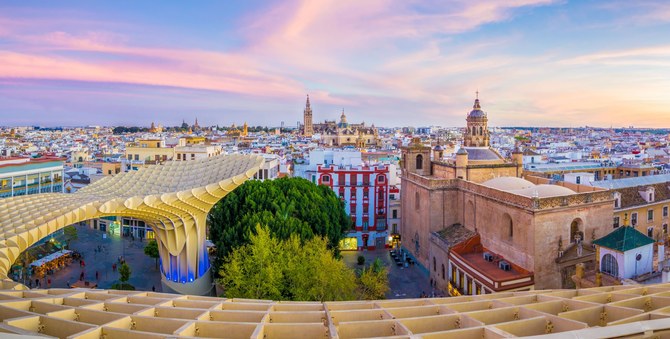

SEVILLE: The southern Spanish city of Seville is, as its various nicknames — ‘The Pearl of Andalusia,’ ‘The Frying Pan of Europe’ and ‘The City of Oranges’ — renowned for its cuisine and its beauty. Films and TV shows including “Lawrence of Arabia,” “Kingdom of Heaven” and “Game of Thrones” have been shot here. But wandering the Andalusian capital’s ancient streets, you quickly realize just how much of a historical powerhouse it is when it came to politics, knowledge, commerce, and culture, too.
For instance, it is believed that the passionate dance of flamenco and the staple cuisine of bite-size tapas were developed here. In the close-by port city of Huelva, the Italian explorer Christopher Columbus (known in Spain, where he died in 1506, as Cristobal Colon) famously set sail to the ‘New World’ of the Americas in 1492 — under the sponsorship of Spanish royalty — changing the course of history. There are clear Middle Eastern influences here too, in both the architecture and the language. The city’s Spanish name — Sevilla — is based on the way the ruling Arabs pronounced the name of the land in their control: Ishbiliyya. In Seville, prosperous, centuries-long Arab rule lasted until 1248, when Christian forces recaptured it in a campaign known as the ‘Reconquista.’

Plaza de Espana Seville. (Shutterstock)
Seville is a city that will delight history buffs and curious roamers alike. Take the time to explore its narrow paths, tiled walls, quaint shops, and majestic interiors.
We are staying at the centrally-located Hotel Vincci Molviedro, situated in a peaceful square just a 10-minute walk away from the two most-visited attractions the city has to offer: the Alcazar and the cathedral. Inside the hotel, near reception, there is a fascinating view of an ancient, 22-meter stretch of a centuries-old Arab-built defensive wall.
The nearby Castelar road leads to a bustling web of streets where tapas bars, cafes, and speciality shops (and, of course, souvenir sellers) sit side-by-side. It’s a fun place to explore on your way to the Real Alcazar, a World Heritage Site that is still used by the Spanish royal family today. This ancient palace boasts airy courtyards, carved ceilings, calligraphy-covered walls, and sophisticated apartments that reveal an evolution in style from Moorish to Renaissance. It can be a tricky venue to navigate, but make sure to see its main highlight, the intricate, golden-dome-topped Hall of Ambassadors.

Seville is home to the world’s largest gothic cathedral — its vast interior can be overwhelming at first, with its high golden altar and detailed chapels. (Shutterstock)
Seville is home to the world’s largest gothic cathedral — its vast interior can be overwhelming at first, with its high golden altar and detailed chapels. But, if there’s a point of historical interest that you shouldn’t miss it’s the grand tomb of Columbus, whose remains were transported from Cuba to Seville in 1902.
The cathedral is paired with the iconic La Giralda tower, which used to operate as a minaret for the mosque that was formerly sited here. You are allowed up its 34 flights of ramps, but the bell-covered top will likely be congested and your view blocked by tourists and metal bars. For far superior 360-degree views of the city, head to Las Setas — the mushrooms —at the Plaza de la Encarnacion. Billed as the world’s largest wooden structure, it stands around 26 meters high and houses a theater, a market, a museum, restaurants, and a rooftop terrace with views of the old city.
If you want to simply sit back, relax, and do some people-watching, head to the colorful, tile-studded benches of the vast Plaza de Espana. Inside its semi-circle are bridges, balustrades and numerous ceramic murals portraying scenes from Spanish history.
After all that sight-seeing, you’ll need a bite to eat. Near the cathedral, there’s a popular casual eatery called La Paella. Most customers opt for the eponymous rice dish, but if you want to try something different, go for the arroz negro — rice infused with squid ink — and add a few dollops of garlicky alioli sauce for a kick in taste.
Elsewhere, lively Guichot street near the charming Plaza Nueva also has several dining options. We recommend El Atun, which specializes in tuna dishes.
If you really want to treat yourself, then a meal on the terrace of Mariatrifulca restaurant on the Triana Bridge is a wonderful way to take in the breathtaking scenery of the Guadalquivir River (another name based on an Arabic term: Wadi Al-Kabir or ‘the great river’) — the beating heart of Seville which brought prosperity to the area and its people over centuries.


