

Saudi Arabia’s overall unemployment rate drops to 4.9% in Q2   

Short Url
Updated 28 September 2023
Follow

Saudi Arabia’s overall unemployment rate drops to 4.9% in Q2   

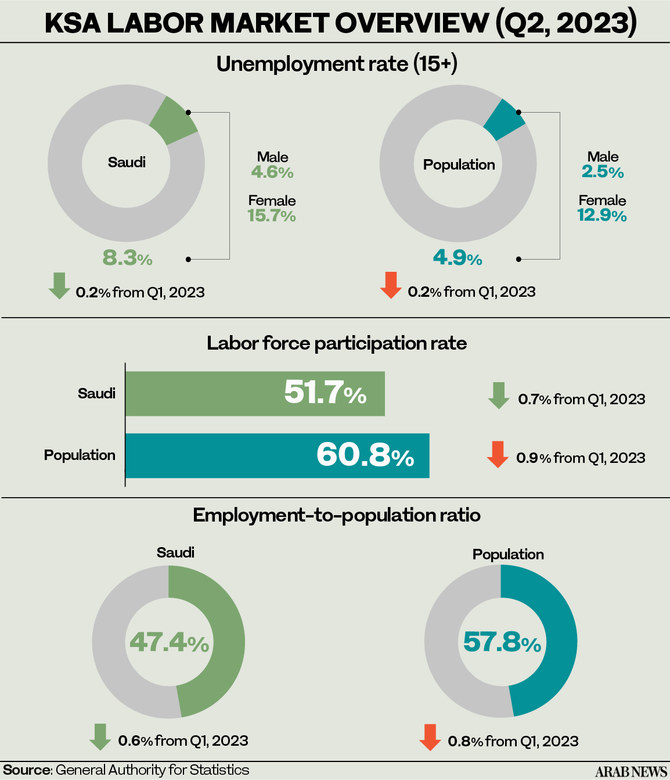
RIYADH: Saudi Arabia’s Vision 2030 has started paying dividends, with the Kingdom’s overall unemployment rate declining to 4.9 percent in the second quarter of this year, a dip of 0.2 percentage points compared to the previous three months, official data showed.   

The report released by the General Authority for Statistics revealed that the rate of joblessness among Saudi nationals reached 8.3 percent in the second quarter, dropping 0.2 percentage points compared to the first quarter of this year.   

The overall unemployment rate in the Kingdom decreased by 1.4 percentage points in the second quarter of this year, compared to the same period in 2022, the report added.  

The GASTAT data further revealed that Saudi Arabia’s employment-to-population ratio decreased by 0.6 percentage points in the second quarter to hit 47.4 percent compared to the previous quarter.  

Saudi Arabia’s Vision 2030 has set ambitious targets for the joblessness rate to drop to 7 percent by the end of the decade, alongside a predicted women’s participation rate in the workforce of 30 percent. 

According to the GASTAT report, the unemployment rate among Saudi females decreased to 15.7 percent, down by 0.4 percentage points from the previous quarter. Meanwhile, the rate among Saudi males remained unchanged at 4.6 percent in the second quarter. 

The report also acknowledged that a significant 95.3 percent of unemployed Saudis are open to job opportunities in the private sector. 

Regarding commuting preferences, the GASTAT survey revealed that 58.9 percent of Saudi females without jobs and 44.9 percent of unemployed Saudi males would be willing to commute for a maximum of one hour. 

Furthermore, 75 percent of such Saudi females and 90 percent of Saudi males who are jobless expressed their readiness to work for eight hours or more each day. 

Among Saudi job seekers, the most commonly used active search method was seeking assistance from friends and relatives, with 85.6 percent of aspirants using this method. Some 70.9 percent applied directly to employers, while 61.3 percent utilized the National Employment Platform, known as Jadarat. 

Meanwhile, Minister of Culture Prince Badr bin Abdullah announced that the cooperation agreement between his ministry and the Human Resources Development Fund had boosted employment support in the cultural sector from 30 percent to 50 percent. 

“This initiative was introduced, in cooperation between the Ministry of Culture and the Human Resources Development Fund under the Ministry of Human Resources and Social Development, to enhance professional sustainability in the cultural sectors,” said the minister.  

He further added that the supported cultural professions encompassed a wide range of jobs in language, books and publishing as well as libraries, fashion arts, theatre, and performing arts. 


Saudi-French cooperation to localize veterinary vaccine manufacturing

Updated 16 sec ago
Follow

Saudi-French cooperation to localize veterinary vaccine manufacturing

RIYADH: In the presence of sector leaders, the National Livestock and Fisheries Development Program signed a memorandum of understanding with French company Ceva under the patronage of Minister of Environment, Water and Agriculture Abdulrahman bin Abdulmohsen Al-Fadhli, who also chairs the program’s board.

The agreement aims to localize vaccine manufacturing, transfer technology and technical expertise, and expand the industrial and commercial production of veterinary vaccines across the Kingdom.

According to the MoU, the two parties will work to achieve high efficiency in mass production scale-up and establish a clear path for sustainable commercial operation that meets the needs of the local and national market, as well as strengthen the biosecurity and food security system.

The MoU also includes the development and modernization of messenger RNA vaccine technologies, along with joint research and development of a Middle East Respiratory Syndrome vaccine for camels. This involves designing, evaluating, and developing vaccines specifically tailored to combat the virus.

The agreement also covers the development of a rabies vaccine and related solutions, as well as supporting national efforts to control the disease through vaccine provision, capacity building, and the implementation of integrated prevention strategies.

The collaboration between the program and Ceva aims to meet the needs of the poultry vaccine market in the Kingdom, currently estimated at around SR750 million ($199 million).

The company will work to cover approximately 30 percent of this market with an initial investment of around SR250 million.

With continued government support for poultry projects and increased production in the sector, the market is expected to grow at a rate exceeding 10 percent annually, reaching approximately SR1.25 billion by 2030.

The addition of the world’s leading poultry vaccine manufacturer to Biotech Park highlights the program’s key role in developing new industries within the livestock and fisheries sector.

It also highlights the program’s commitment to building international partnerships with global companies, organizations, research centers, and universities to support advanced biotechnology industries and attract high-quality investments. It also seeks to create new economic sectors based on biotechnology, enhance veterinary health security, and support the sustainable economic development of the livestock sector, as well as empower national and emerging companies and provide advanced research and industrial infrastructure.

This will solidify the Kingdom’s position as a global hub for biotechnology industries and the development of national capabilities.

Ceva is the first international partner to join Biotech Park, the future veterinary biotechnology city launched by the program in Dhurma Governorate. The city is the world’s first specialized and fully integrated hub for veterinary biotechnology, serving as a benchmark for sector development and a platform supporting markets across the Kingdom, the Gulf, the Middle East, Africa and beyond.

The signing of Ceva is a significant step, given its position as the world’s leading manufacturer of poultry vaccines and medicines, and one of the most prominent international companies in the field of biotechnology.

The MoU aims to localize the veterinary vaccine industry, ensuring its compatibility with the strains of poultry diseases prevalent in Saudi Arabia. This includes the transfer of technology and technical expertise from Ceva, along with the implementation of specialized training programs to guarantee that manufacturing facilities comply with international Good Manufacturing Practice standards.
