

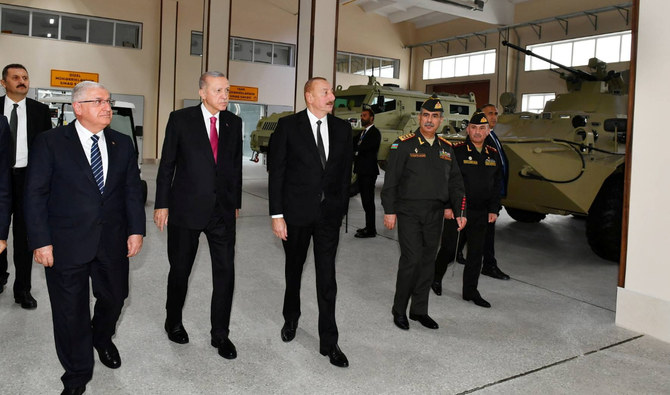

ANKARA: Turkish President Recep Tayyip Erdogan said the so-called Zangezur trade corridor passing through Armenia, Azerbaijan, and Iran must be completed, broadcasters reported on Tuesday, a day after he met Azerbaijan’s leader.
Speaking to reporters on his return flight from the Azeri exclave of Nakhchivan, where he met President Ilham Aliyev, Erdogan said that if Armenia does not allow the trade corridor to pass through its territory then Iran was warm to the idea of allowing it passage through its territory.
Following Azerbaijan’s rout of Armenian forces in a 24-hour blitz in Nagorno-Karabakh last week, Baku has raised hopes of opening a land bridge between Nakhchivan and the rest of Azerbaijan, known as the Zangezur Corridor.
Erdogan said Turkiye and Azerbaijan would “do our best to open this corridor as soon as possible.”
The Zangezur corridor aims to give Baku unimpeded access to Nakhchivan through Armenia. Both Turkiye and Azerbaijan have been calling for its implementation since the Second Karabakh War in 2020.
Erdogan also said all materials required by civilians in the Karabakh region were being provided by trucks after Azerbaijan’s lightning offensive to retake control of the region last week.
Meanwhile, Erdogan said in remarks published on Tuesday that Turkiye’s chances of acquiring F-16 fighter jets from the US have been boosted by Sen. Bob Menendez stepping down as chairman of the Senate Foreign Relations Committee.
Menendez, the senior Democratic senator for New Jersey, has been a vocal opponent of Turkiye receiving aircraft to update its fighter fleet.
He stood down from the influential role last week following federal charges that he took cash and gold in illegal exchange for helping the Egyptian government and New Jersey business associates.
“One of our most important problems regarding the F-16s were the activities of US Sen. Bob Menendez against our country,” Erdogan told journalists on a flight back from Azerbaijan on Monday.
His comments were widely reported across Turkish media.
“Menendez’s exit gives us an advantage but the F-16 issue is not an issue that depends only on Menendez,” Erdogan added.
Ankara has been seeking to buy 40 new F-16s, as well as kits to upgrade its existing fleet.
The request was backed by the White House but ran into opposition in Congress, where Menendez raised concerns about Turkiye’s human rights records as well as blaming Ankara for fractious relations with neighboring Greece.
Referring to talks between US Secretary of State Antony Blinken and Turkish Foreign Minister Hakan Fidan in recent days, Erdogan said: “It would be beneficial to turn this situation into an opportunity and meet with (Blinken) again.
“In this way, we may have the opportunity to accelerate the process regarding the F-16s. Not only on the F-16s, but on all other issues, Menendez and those with his mindset are carrying out obstructive activities against us.”
Erdogan also openly linked Turkiye’s F-16 bid to Sweden’s application for NATO membership, which is expected to be debated by the Turkish parliament after it returns from summer recess on Oct. 1.
He said Blinken and Fidan had discussed Sweden’s NATO bid, adding: “I hope that if they stay true to their promise, our parliament will also stay true to its promise.”
Questioned on whether the bid was tied to Turkiye receiving the F-16s, Erdogan said: “They are already making Sweden dependent on the F-16 … Our parliament follows every development regarding this issue in minute detail.”
Erdogan also raised the prospect of a visit to Turkiye by Israeli Prime Minister Benjamin Netanyahu in October or November.
The Turkish president also addressed the issue of Cyprus, divided between ethnic Turkish and Greek communities for 49 years.
He reiterated his support for a two-state solution, with international recognition for the Turkish administration in the island’s north.
Turkiye is the only country to recognize the breakaway entity. The international community broadly supports the unification of the island under a federal system.


