

Historic Iraq-Iran railway link ‘to be ready in 18 months’

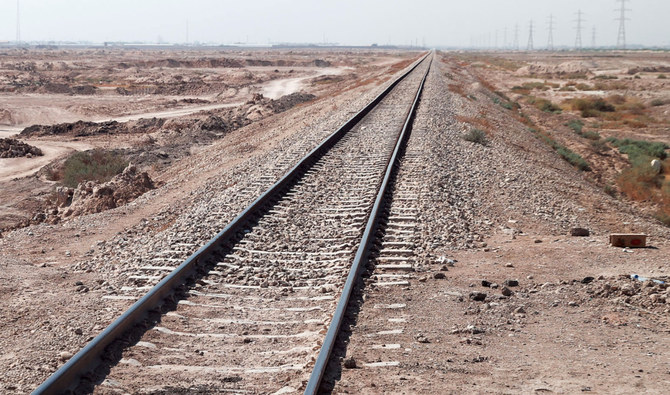
A view of the new railroad track during the ceremony to lay the foundation stone for the railway connection project at the Shalamcheh border crossing in Iraq’s southern province of Basra on September 2, 2023. (AFP)
Short Url
Updated 26 September 2023
Follow

Historic Iraq-Iran railway link ‘to be ready in 18 months’

  • The project largely aims to help facilitate the transport of millions of pilgrims that visit Shiite shrines in Iraq each year

BAGHDAD: Iraq hopes to complete its first railway link with neighboring Iran within 18 months, largely to help facilitate the transport of millions of pilgrims that visit Shiite shrines in Iraq each year, a senior transport adviser said.

The roughly 30-km line will run between Iraq’s southern city of Basra and the Iranian border-town of Shalamja, linking nations with ties that have deepened since the 2003 US invasion of Iraq, after which pro-Tehran Shiite Muslim parties enhanced their influence in Baghdad.

“We should see the trains moving in about 18 months because it’s a small distance,” Nasser Al-Asadi, transport adviser to the Iraqi prime minister, said.

He added the government also planned a metro link between Karbala and Najaf, the seat of Iraqi Shiite clergy.

Iraq and Iran fought a devastating eight-year war in the 1980s, during which much of the border area was heavily mined.

But since the US toppled former leader Saddam Hussein in 2003, Shiite Muslim parties close to Tehran have become key political players in Baghdad and economic and religious ties between both nations have expanded.

Asadi said work was underway to clear the area before ground work could begin on the rail link.

Up to 20 million mostly Shiites takes part in the annual religious gathering of “Arbaeen” pilgrimage to Iraq’s city of Karbala.

Many pilgrims walk hundreds of kilometers from the Iran-Iraq border to Karbala, or drive there in overcrowded cars and buses, and deadly accidents have been frequent.

Asadi said the rail link would reduce the risk of such accidents and allow Iraq to benefit financially from ticket sales.

The projects are part of major transport-sector development planned by the government, including an overhaul of Baghdad’s international airport and a 1,200-km rail, road and services project from a major commodities port in the south to its border with Turkiye.


Trump says ‘someone from within’ Iranian regime might be best choice to lead once war ends

Updated 8 sec ago
Follow

Trump says ‘someone from within’ Iranian regime might be best choice to lead once war ends

  • Trump had earlier called on Iranians to “take over your government” once the war US-Israel strikes end
  • He now appears to drift away from the idea of putting an end Iran's theocratic rule
WASHINGTON: President Donald Trump on Tuesday said that “someone from within” the Iranian regime might be the best choice to take power once the US-Israel military campaign is completed — but said “most of the people we had in mind are dead.”
The president, who four days ago had emphatically called on Iranians to “take over your government” once the US-Israel bombardment ends, appeared to drift further away from the idea that the war presents an opportunity to end the theocratic rule that has been in place since the country’s 1979 Islamic revolution.
Trump said that many Iranian officials his administration had viewed as potential new leaders for the country had been killed in the US-Israeli campaign that killed Iranian Supreme Leader Ali Khamenei and many other top officials.
Trump has not publicly identified anyone whom he views as a credible future leader for Iran. And it’s unclear what, if any, outreach the White House had with Iranian officials since the war started.
“Most of the people we had in mind are dead,” he said in an exchange with reporters in the Oval Office. “Now we have another group, they may be dead also, based on reports. So you have a third wave coming. Pretty soon we’re not going to know anybody.”
Trump said Reza Pahlavi, the exiled crown prince of Iran’s last shah who is trying to position himself for a return should Iran’s Shiite theocracy fall, is not someone that his administration has considered in depth to take over leadership in Iran.
“It would seem to me that somebody from within maybe would be more appropriate,” Trump said, adding that it may make sense for “somebody that’s there, that’s currently popular, if there is such a person” to emerge from the power vacuum.
Trump’s comments came as he hosted German Chancellor Friedrich Merz for his first in-person engagement with a foreign leader since the US and Israel launched the war against Iran.
Trump said he wanted to avoid a “worst case” scenario where “somebody takes over who’s as bad as the previous person.”
“That could happen. We don’t want that to happen,” Trump added. “You go through this, and then in five years you realize you put somebody in who was no better.”
The White House is trying to counter criticism
The White House has stepped up its push to counter criticism that it moved unnecessarily quickly to launch a war of choice against Iran.
Trump’s decision to strike last week followed lengthy negotiations by the president’s envoy Steve Witkoff and son-in-law Jared Kushner with the Iranians — talks the US increasingly viewed as an effort to stall any progress.
After the most recent round of discussions in Geneva, Switzerland, last week, Witkoff and Kushner told Trump that reaching a nuclear agreement similar to one that former President Barack Obama struck in 2015 was possible, according to a senior administration official.
The official, who briefed journalists on condition of anonymity, described it as a potential “Obama-plus deal” and Witkoff and Kushner believed such an agreement would take months, but was possible.
Still, even as they expressed their willingness to pursue diplomacy and “fight for every point that we can” if that’s what Trump wanted, the negotiators stressed to the president that the Iranians were not willing to make a deal that would be satisfactory to the US
Trump snaps at the UK, Spain over lack of support
Meanwhile, Trump sharply criticized Britain and Spain for their reluctance to aid the US-Israeli strikes on Iran.
“This is not Winston Churchill that we’re dealing with,” Trump fumed about British Prime Minister Keir Starmer.
Starmer had initially blocked American planes from using British bases for the attacks on Iran that started on Saturday. He later agreed to let the United States use bases in England and on Diego Garcia in the Indian Ocean to strike Iran’s ballistic missiles and their storage sites, but not to hit other targets.
Trump also said he was going to “cut off all trade with Spain,” the day after Foreign Minister José Manuel Albares said his country would not allow the US to use jointly operated bases in southern Spain in any strikes not covered by the United Nations’ charter.
Trump disputes that Israel forced his hand
The president also sought to push back on criticism from some of his staunchest allies over the decision to go to war — questions that grew louder after Secretary of State Marco Rubio said on Monday that the US had decided to strike because “we knew that there was going to be an Israeli action.”
“And we knew that if we didn’t preemptively go after them before they launched those attacks, we would suffer higher casualties,” Rubio said.
But Trump rejected the notion that the White House had been dragged into the conflict by Israel. “We were having negotiations with these lunatics, and it was my opinion that they were going to attack,” Trump said. “If anything, I might have forced Israel’s hand.”
Rubio on Tuesday echoed Trump’s insistence that the decision to attack Iran was made independent of Israel.
Merz said during his visit with Trump at the Oval Office that Germany is “looking forward to the day after” the Iran war is over.
He said Berlin wants to work with the US on a strategy for when the current Iranian government no longer exists.
“We are having a high interest in common approach and common work and what we can do,” Merz said. “And this is this is important not just for the Americans,” he said. “This is extremely important for Europe and extremely important for Israel and their security.”
Merz also noted surging oil prices were damaging the world economy, laying down an argument for finding a quick endgame to the conflict.
The president acknowledged that oil and gas prices were going to rise as the US remains engaged in the strikes — yet argued it would be fleeting.
“We have a little high oil prices for a little while, but as soon as this ends, those prices are going to drop, I believe, lower than even before,” Trump said.
The average price for a gallon of gasoline in the US jumped 11 cents overnight Tuesday to about $3.11 in the United States, according to the AAA.