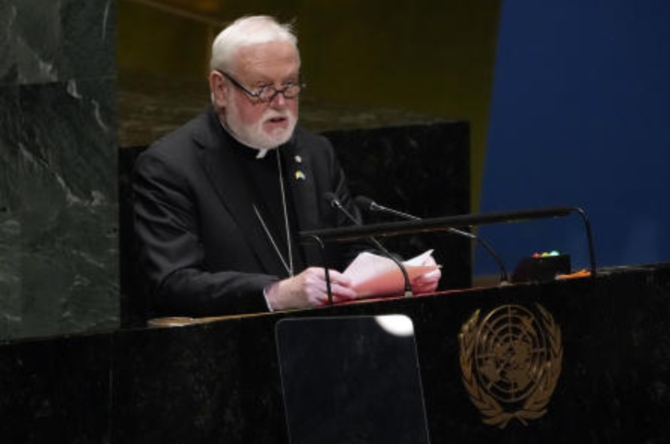
NEW YORK: A “profound rethink” of the multilateral system is needed to respond to the world’s growing challenges, the Catholic Church’s central governing body told the UN General Assembly on Tuesday.
The Holy See was represented by Archbishop Paul Richard Gallagher, secretary of relations with states, who said: “We’re living at a crucial moment for humanity, in which peace seems to give way to war. Conflicts are growing and stability is increasingly put at risk.”
He lauded the UN’s historical efforts to reduce poverty, help migrants and promote nuclear disarmament, but he warned: “In these last years we’ve seen crumbling trust among nations, clear evidence of which is the increase in number and gravity of conflicts and wars.”
This has resulted in an “inevitable and equally significant increase in the number of meetings held at different levels, though not always in direct proportion to the effectiveness required in pursuing the proposed goals.”
And though “rivers of words” are spent by delegations at international forums, “one doesn’t always find … the same willingness to listen,” Gallagher said.
He relayed a message from Pope Francis decrying “ideological colonization,” which he defined as richer, more powerful countries “attempting to impose their worldview on poorer countries.” The rule of law “seems sometimes to be replaced by the law of the strongest,” Gallagher added.
He called for a return to listening and dialogue in the international arena, in an effort to avoid further conflicts and lessen the suffering of humanity.
He added: “All states must rediscover a spirit of service with the intention of building a global solidarity that expresses itself concretely in helping those who suffer.
“As part of this shared commitment, rulers must put aside their own needs, expectations and desires for sovereignty or omnipotence before the concrete gaze of the most fragile.”
Gallagher said the conflict in Ukraine “has been instrumental to bringing back the elevated threat of nuclear escalation into the discussion.”
He described the use of nuclear energy in warfare as a crime “not only against the dignity of human beings, but against any possible future for our common home.”
Another pressing concern for the Holy See is the proliferation of artificial intelligence, Gallagher said. The “expanding digital galaxy we inhabit … touches every aspect of our lives and community,” he added.
As a result, there is an “urgent need” to engage in ethical debate on the use and integration of AI in daily life around the world, Gallagher said.
He relayed a message from Pope Francis: “We must be vigilant and work to ensure that the discriminatory use of these instruments doesn’t take root at the expense of the most fragile and excluded.
“It isn’t acceptable that the decision about someone’s life and future be entrusted to an algorithm.”
The Holy See’s concern over AI extends to the use of autonomous weapons systems in conflicts, with “only humans” being “truly capable of seeing and judging the ethical impact of their actions.”
The Catholic governing body called for the creation of a global organization to oversee the use of AI.
But technological developments can offer hope to the global fight against climate change, Gallagher said, adding that the international community “needs to focus on a positive outcome” at the upcoming UN Climate Change Conference in the UAE.
Turning to the issue of human rights, he said: “Let us never forget that the true litmus test to see if human rights are being protected is the degree to which people have freedom of religion or belief in a country.”
Gallagher added: “Disturbingly, we continue to live in a world where people are persecuted simply for professing their faith in public.”
He also noted the Holy See’s concern at the subjective use of the terms “hate crime” and “hate speech,” adding that they are being used to keep people from expressing their religious beliefs. “Religious freedom is one of the absolute minimum requirements necessary to live in dignity,” Gallagher said.
The Holy See is also concerned by the humanitarian situation in Syria, with people in the country “plagued by 12 years of war, earthquakes and great poverty,” he added. The Church is encouraging the resumption of a political process of reconciliation in Syria.
Sudan is also of great concern to the Holy See, Gallagher said, adding that the governing body “makes a heartfelt appeal for the laying down of arms so that dialogue can prevail and the suffering of the population can be alleviated.”
Frequent violence as a result of coups in sub-Saharan Africa has “disrupted the democratic process, caused death and destruction, and caused humanitarian and migration crises,” Gallagher said.
“Behind episodes of terrorism and violence are also international economic interests that encourage the unjust dynamics of colonialism,” he added.
The Holy See expressed “serious concern” over events in Jerusalem and its status as a holy city.
Gallagher said: “I renew my appeal not only to the Israelis and Palestinians to open to sincere dialogue, but also to the entire international community.”
He ended is address by urging the world to move away from “the logic of the legitimacy of war,” adding: “The battlefield has become practically unlimited and the effects potentially catastrophic. Peace is possible if it’s truly willed, and if peace is possible it’s a duty.”


![]()

World must ‘profoundly rethink’ global order, Holy See tells UN
Short Url
https://arab.news/6hs79
World must ‘profoundly rethink’ global order, Holy See tells UN
- Catholic Church’s governing body expresses concern over events in Syria, Sudan, Palestine
- Increase in conflict ‘clear evidence of crumbling trust among nations’: Archbishop Paul Gallagher


Latest updates


© 2026 SAUDI RESEARCH & PUBLISHING COMPANY, All Rights Reserved And subject to Terms of Use Agreement.