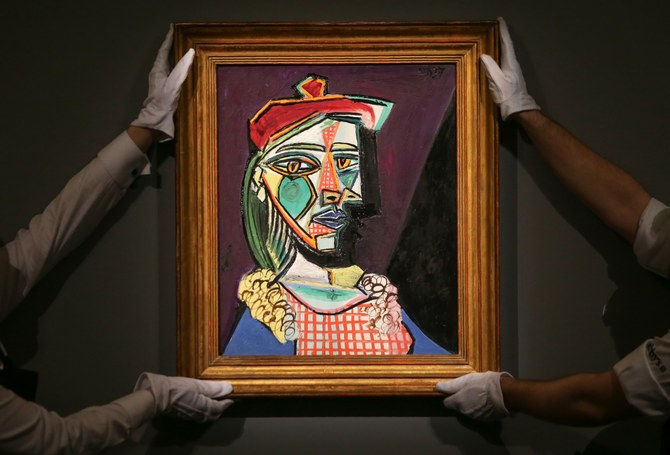
Picasso masterpiece begins pre-auction tour in Dubai

The painting titled “Femme a la montre” will be sold in November as part of a two-day auction of late New Yorker Emily Fisher Landau’s prestigious collection (AFP)
Short Url
Updated 25 September 2023
Follow

Picasso masterpiece begins pre-auction tour in Dubai

  • The 1932 portrait of Marie-Therese Walter, Picasso’s mistress and “golden muse,” is being exhibited for two days before heading to Hong Kong and London

Dubai: A Pablo Picasso masterpiece expected to fetch at least $120 million at auction went on show Monday in Dubai, kicking off a set of rare viewings outside the United States.
The 1932 portrait of Marie-Therese Walter, Picasso’s mistress and “golden muse,” is being exhibited for two days before heading to Hong Kong and London, a boon for the United Arab Emirates’ bid to establish itself as a cultural powerhouse.
The viewing “marks the first time a painting of this calibre by the world-renowned artist has ever been exhibited in the UAE,” Sotheby’s Dubai said in a statement, noting it is the first time the portrait had been shown outside the US in half a century.
“Over the years the UAE has earned the status of being a global art destination, which receives a further boost as this rare Picasso is unveiled here,” said UAE Culture Minister Sheikh Salem bin Khalid Al-Qassimi.
The painting titled “Femme a la montre” will be sold in November as part of a two-day auction of late New Yorker Emily Fisher Landau’s prestigious collection.
Walter met Picasso in Paris in 1927, when the Spaniard was still married to Russian-Ukrainian ballet dancer Olga Khokhlova, and while Walter was 17.
Walter, whose daughter with Picasso passed away last year, was also featured in “Femme assize pres d’une fenetre (Marie-Therese),” which sold in 2021 for $103.4 million by Christie’s auction house.
Fifty years after his death in 1973 at age 91, Picasso remains one of the most influential artists of the modern world, often hailed as a dynamic and creative genius.
But in the wake of the #MeToo movement against sexual harassment and assault, the reputation of this workaholic with a vast output of paintings, sketches and sculpture has been tarnished by accusations he exerted a violent hold over the women who shared his life and inspired his art.


Lebanese filmmaker turns archival footage into a love letter to Beirut

Updated 28 February 2026
Follow

Lebanese filmmaker turns archival footage into a love letter to Beirut

LONDON: Lebanese filmmaker Lana Daher’s debut feature “Do You Love Me” is a love letter of sorts to Beirut, composed entirely of archival material spanning seven decades across film, television, home videos and photography.

The film premiered at the 82nd Venice International Film Festival in September and has since traveled to several regional and international festivals.

Pink Smoke (2020) by Ben Hubbard. (Supplied)

With minimal dialogue, the film relies heavily on image and sound to reconstruct Lebanon’s fragmented history.

“By resisting voiceover and autobiography, I feel like I had to trust the image and the shared emotional landscape of these archives to carry the meaning,” Daher said.

A Suspended Life (Ghazal el-Banat) (1985) by Jocelyne Saab. (Supplied)

She explained that in a city like Beirut “where trauma is rarely private,” the socio-political context becomes the atmosphere of the film, with personal memory expanding into a collective experience — “a shared terrain of emotional history.”

Daher said: “By using the accumulated visual representations of Beirut, I was, in a way, rewriting my own representation of home through images that already existed."

Whispers (1980) by Maroun Bagdadi. (Supplied)

Daher, with editor Qutaiba Barhamji, steered clear of long sequences, preferring individual shots that allowed them to “reassemble meaning” while maintaining the integrity of their own work and respecting the original material, she explained.

The film does not feature a voice-over, an intentional decision that influenced the use of sound, music, and silence.

The Boombox (1995) by Fouad Elkoury. (Supplied)

“By resisting the urge to fill every space with dialogue or score, we created room for discomfort,” Daher said, adding that silence allows the audience to sit with the image and enter its emotional space rather than being guided too explicitly.

 The film was a labor of love, challenging Daher personally and professionally.

“When you draw from personal memory, you’re not just directing scenes, you’re revisiting parts of yourself and your childhood,” she said. “There’s vulnerability in that.”