

Pakistan ‘can’t be forced’ to change stance on Israel — information minister

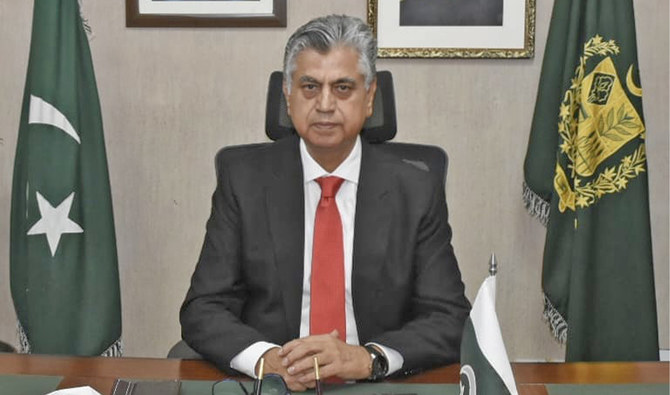
The undated picture shows Murtaza Solangi, Pakistan's Caretaker Federal Minister for Information and Broadcasting. (Photo courtesy: PID/File)
Short Url
Updated 25 September 2023
Follow

Pakistan ‘can’t be forced’ to change stance on Israel — information minister

  • The country’s interim information minister calls it the discretion of other Muslim states how they view relations with Israel
  • Murtaza Solangi says Pakistan respects all countries and their policies but can’t be forced by them to change its position

ISLAMABAD: Caretaker Information Minister Murtaza Solangi on Sunday reaffirmed Pakistan’s unchanged stance of not establishing diplomatic relations with Israel, citing the well-being of the Palestinian people as the primary reason in an interview.

Solangi’s comments came hours after Geo News reported that Pakistan’s interim foreign minister Jalil Abbas Jilani had said any decision to establish bilateral relations with Israel would hinge on the nation’s own interests and the well-being of the Palestinian people.

Jilani’s remarks were said to be in response to claims by his Israeli counterpart, Eli Cohen, who indicated he had met with leaders of several Islamic nations in recent days who were likely to forge diplomatic ties with Israel soon.

However, the Pakistani foreign minister clarified there had been no recent meetings between his country’s officials with Israeli authorities.

“Some Muslim countries in the world have long maintained diplomatic relations with Israel,” Solangi told GTV News. “But we don’t have such ties for the last 75 or 76 years. Pakistan has taken a traditional and principled stand [over the issue], and the state and its institutions stand by it.”

“Pakistan’s position on Israel is related to the future of the people of Palestine,” he continued. “As long as Palestinians do not get their free country and their right to self-determination, which is recognized in the United Nations resolutions, Pakistan will not abandon its Palestinian brothers.”

The information minister said how other Muslim countries viewed their relations with Israel was their discretion.

“We respect all countries and their policies,” he said. “But we cannot be forced by any country to alter our position as well.”

Prime Minister Anwaar-ul-Haq Kakar also advocated for a two-state solution as a path to enduring peace in Palestine during his United Nations General Assembly speech on Friday.

He reiterated Pakistan’s position on the matter, calling for the “establishment of a viable and contiguous Palestinian state within the pre-June 1967 borders with Al-Quds as its capital.”

Kakar also criticized Israeli military raids against Palestinians and its expansion of settlements in the Occupied Territories.

However, Geo News quoted an unnamed Pakistani diplomat in its report as saying he hoped that his country “would not have to make a decision on this matter [of normalizing relations with Israel] in the near future.”

Pakistan reports current account surplus in Jan. owing to improved trade, remittances

Updated 17 February 2026
Follow

Pakistan reports current account surplus in Jan. owing to improved trade, remittances

  • Pakistan’s exports crossed the $3 billion mark in Jan. as the country received $3.5 billion in remittances
  • Last month, IMF urged Pakistan to accelerate pace of structural reforms to strengthen economic growth

ISLAMABAD: Pakistan recorded a current account surplus of more than $120 million in January, the country’s finance adviser said on Tuesday, attributing it to improved trade balance and remittance inflows.

Pakistan’s exports rebounded in January 2026 after five months of weak performance, rising 3.73 percent year on year and surging 34.96 percent month on month, according to data released by the country’s statistics bureau.

Exports crossed the $3 billion mark for the first time in January to reach $3.061 billion, compared to $2.27 billion in Dec. 2025. The country received $3.5 billion in foreign remittances in Jan. 2026.

Khurram Schehzad, an adviser to the finance minister, said Pakistan reported a current account surplus of $121 million in Jan., compared to a current account deficit of $393 million in the same month last year.

“Improved trade balance in January 2026, strong remittance inflows, and sustained momentum in services exports (IT/Tech) continue to reinforce the country’s external account position,” he said on X.

Pakistan has undergone a difficult period of stabilization, marked by inflation, currency depreciation and financing gaps, and international rating agencies have acknowledged improvements after Islamabad began implementing reforms such as privatizing loss-making, state-owned enterprises (SOEs) and ending subsidies as part of a $7 billion International Monetary Fund (IMF) loan program.

Late last month, the IMF urged Pakistan to accelerate the pace of these structural reforms to strengthen economic growth.

Responding to questions from Arab News at a virtual media roundtable on emerging markets’ resilience, IMF’s director of the Middle East and Central Asia Jihad Azour said Islamabad’s implementation of the IMF requirements had been “strong” despite devastating floods that killed more than 1,000 people and devastated farmland, forcing the government to revise its 4.2 percent growth target to 3.9 percent.

“What is important going forward in order to strengthen growth and to maintain the level of macroeconomic stability is to accelerate the structural reforms,” he said at the meeting.

Azour underlined Pakistan’s plans to privatize some of the SOEs and improve financial management of important public entities, particularly power companies, as an important way for the country to boost its capacity to cater to the economy for additional exports.

“This comes in addition to the effort that the authorities have made in order to reform their tariffs, which will allow the private sector of Pakistan to become more competitive,” the IMF official said.