

Pakistan ‘can’t be forced’ to change stance on Israel — information minister

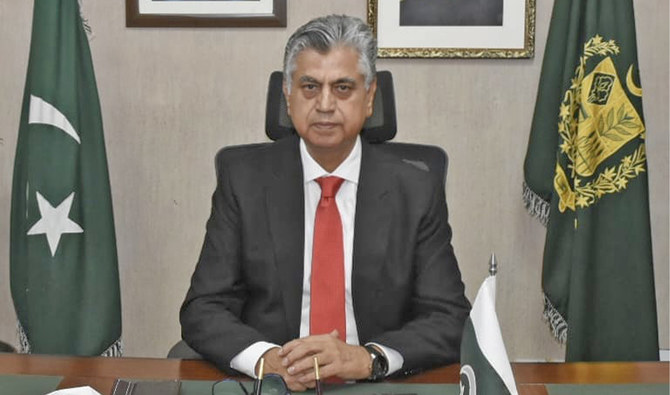
The undated picture shows Murtaza Solangi, Pakistan's Caretaker Federal Minister for Information and Broadcasting. (Photo courtesy: PID/File)
Short Url
Updated 25 September 2023
Follow

Pakistan ‘can’t be forced’ to change stance on Israel — information minister

  • The country’s interim information minister calls it the discretion of other Muslim states how they view relations with Israel
  • Murtaza Solangi says Pakistan respects all countries and their policies but can’t be forced by them to change its position

ISLAMABAD: Caretaker Information Minister Murtaza Solangi on Sunday reaffirmed Pakistan’s unchanged stance of not establishing diplomatic relations with Israel, citing the well-being of the Palestinian people as the primary reason in an interview.

Solangi’s comments came hours after Geo News reported that Pakistan’s interim foreign minister Jalil Abbas Jilani had said any decision to establish bilateral relations with Israel would hinge on the nation’s own interests and the well-being of the Palestinian people.

Jilani’s remarks were said to be in response to claims by his Israeli counterpart, Eli Cohen, who indicated he had met with leaders of several Islamic nations in recent days who were likely to forge diplomatic ties with Israel soon.

However, the Pakistani foreign minister clarified there had been no recent meetings between his country’s officials with Israeli authorities.

“Some Muslim countries in the world have long maintained diplomatic relations with Israel,” Solangi told GTV News. “But we don’t have such ties for the last 75 or 76 years. Pakistan has taken a traditional and principled stand [over the issue], and the state and its institutions stand by it.”

“Pakistan’s position on Israel is related to the future of the people of Palestine,” he continued. “As long as Palestinians do not get their free country and their right to self-determination, which is recognized in the United Nations resolutions, Pakistan will not abandon its Palestinian brothers.”

The information minister said how other Muslim countries viewed their relations with Israel was their discretion.

“We respect all countries and their policies,” he said. “But we cannot be forced by any country to alter our position as well.”

Prime Minister Anwaar-ul-Haq Kakar also advocated for a two-state solution as a path to enduring peace in Palestine during his United Nations General Assembly speech on Friday.

He reiterated Pakistan’s position on the matter, calling for the “establishment of a viable and contiguous Palestinian state within the pre-June 1967 borders with Al-Quds as its capital.”

Kakar also criticized Israeli military raids against Palestinians and its expansion of settlements in the Occupied Territories.

However, Geo News quoted an unnamed Pakistani diplomat in its report as saying he hoped that his country “would not have to make a decision on this matter [of normalizing relations with Israel] in the near future.”


Pakistan’s Balochistan establishes threat assessment center amid surge in militant attacks

Updated 14 sec ago
Follow

Pakistan’s Balochistan establishes threat assessment center amid surge in militant attacks

  • Provincial Intelligence Fusion and Threat Assessment Center brings police, CTD, intelligence agencies together on one platform, says official
  • Says center helps disrupt terror financing, narcotics trafficking, organized crime and enables action against unregulated communication networks

ISLAMABAD: The government in Pakistan’s southwestern Balochistan province has established a state-of-the-art threat assessment center to strengthen early warning and prevention against “terrorism” incidents, a senior official said on Monday amid a surge in militant attacks recently. 

Balochistan Additional Chief Secretary Hamza Shafqaat wrote on social media platform X that the Provincial Intelligence Fusion and Threat Assessment Center (PIFTAC Balochistan) brings police, the counter-terrorism department (CTD), intelligence agencies and civil administration together on one platform for real-time information sharing and joint analysis. 

“PIFTAC strengthens early warning and prevention against terrorism, helps disrupt terror financing, narcotics trafficking, and organized crime, and enables coordinated action against illegal spectrum and unregulated communication networks,” he wrote.

“Information that was once scattered is now shared and acted upon in time, allowing the state to move from reacting after incidents to preventing them before they occur.”

https://x.com/beyondfiles/status/2010444397163532547

The development takes place amid a steep rise in combat-related deaths in Pakistan during 2025. According to statistics released by the Pakistan Institute for Conflict and Security Studies (PICSS) last month, combat-related deaths in 2025 rose 73 percent to 3,387.

These deaths included 2,115 militants, 664 security forces personnel, 580 civilians and 28 members of pro-government peace committees, the local think tank said. 

Pakistan military spokesperson Lt. Gen. Ahmed Sharif Chaudhry last week highlighted Pakistan’s counter-terrorism efforts in 2025, saying that security forces had conducted 75,175 intelligence-based operations (IBOs) and killed 2,597 militants last year. He also said Pakistan reported 5,397 “terrorism incidents” last year. 

Pakistan frequently accuses Afghanistan of allowing militant groups, including the Tehreek-e-Taliban Pakistan (TTP) and the separatist Balochistan Liberation Army (BLA) to operate from its soil, charges Kabul has repeatedly denied.

Islamabad also accuses India of backing these militant groups against Pakistan. New Delhi rejects the allegations.