

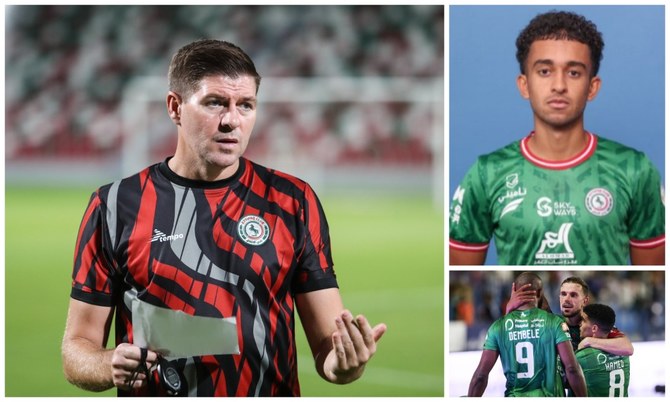

RIYADH: The young Saudi midfielder Ahmed Al-Ghamdi admits to being “starstruck” for the first few days after Steven Gerrard took over as manager of his club, Ettifaq.
Al-Ghamdi, 21, joined the Dammam-based club in 2020 after returning to Saudi Arabia from Canada, where he had lived since the age of one, and has witnessed the transformation at the club first-hand.
While much of the recent investment in Saudi football has focused on the four major clubs from Riyadh and Jeddah, Ettifaq have been making headlines of their own after signing England and Liverpool legend Gerrard as manager, then adding another former Liverpool captain Jordan Henderson, Scottish international Jack Hendry, Lyon striker Moussa Dembele and, most recently, Dutch midfielder Gini Wijnaldum to their squad.
It has heralded a new era for the club and catapulted the two-time Saudi champions into the global spotlight.
“It was kind of a shock to see someone you’ve been watching on TV, on social media all the time and then finally, he’s here; he’s your coach,” Al-Ghamdi told Arab News.
“So for the first (few) days, I was kind of starstruck. But then, after it sank in, I realized what a great opportunity I have to learn from such a player, such a coaching staff, and all the experience they have.”
Al-Ghamdi’s journey to professional football was somewhat unconventional compared to most of his Saudi counterparts. Though he was born in Jeddah, Al-Ghamdi grew up almost 12,000 km away in Vancouver, Canada, where his parents moved when he was just one in search of greater opportunities for both themselves and their children.
“(Growing up in Canada has) given me a different perspective on life,” Al-Ghamdi said. “There’s more diversity over there, you get introduced to all different cultures from around the world, all different kinds of immigrants, you learn new things, new customs, and you just understand everything through a broader perspective.”
While there were frequent trips back to his homeland, Al-Ghamdi, one of four brothers, grew up in a typically North American environment, and while football was always a passion — passed down from his father — he also had other sporting interests.
“Obviously, when you’re in North America, football isn’t the biggest sport, it’s more ice hockey and basketball,” he said. “At school, they always gave you opportunities to play different sports and, at the time, I was really into basketball. Even now I still love watching the NBA. When I was younger, I used to play on the teams there, and you could say it helped develop my athletic ability as well.”
While sport was a constant throughout his childhood, Al-Ghamdi was no slouch in the classroom either, and, were it not for fate intervening, he could very well be on his way to becoming a doctor. After signing for Vancouver-based Pacific FC in the Canadian Premier League when he was just 17, Al-Ghamdi had earned a place at the prestigious University of British Columbia, which counts Canadian Prime Minister Justin Trudeau among its alumni, to study medicine.
With one season of professional football under his belt, he was ready to pursue his academic ambitions, but a trip back to — ironically — Dammam with the Saudi under-19 national team changed everything.
“I signed a one-year contract with Pacific in the first season of the CPL,” he explained. “I really didn’t have a plan for after that, I was just thankful that I was doing what I love at 17. I saw (it) as a massive opportunity, because it’s very difficult to play professionally out of Vancouver because there’s not that many pathways
“After my contract finished, I thought I was going to leave football. My parents are really big on education, so the plan was to find some sort of agreement (to see if) I could stay (at Pacific) and go to UBC. If I couldn’t reach an agreement with Pacific, I would just go to UBC and focus on my degree,” he continued. “But, at the same time, I was introduced to football in Saudi through the youth national team. I went with them for the U19 Asian Cup qualifiers in Dammam. After the qualifiers finished, I heard that there were clubs in Saudi interested in me, so I decided to take the semester off and see where it took me.”
Now playing under Gerrard, and alongside so many international stars, it’s safe to say that Al-Ghamdi is happy with his decision.
Having made his senior international debut earlier this year at the Gulf Cup — a moment he described as “unbelievable” — Al-Ghamdi is part of a generation of talent hoping to force their way into Roberto Mancini’s reckoning over the next three years ahead of the next FIFA World Cup.
He played a leading role in helping Saudi Arabia win last year’s AFC U23 Asian Cup, scoring the opening goal in the final as the Green Falcons prevailed 2-0 over host nation Uzbekistan, and impressed again at the Gulf Cup earlier this year, making two appearances off the bench.
With the next World Cup due to take place in the USA, Mexico and Canada, the prospect of ‘completing the circle’ and playing for Saudi Arabia in a World Cup match in Canada — possibly even in Vancouver — is one that understandably excites the 21-year-old.
“That would be amazing. It would be a full-circle moment for me to play for Saudi, in Canada, at the 2026 World Cup,” he said. “That would be a really amazing moment for me and my family.”


