

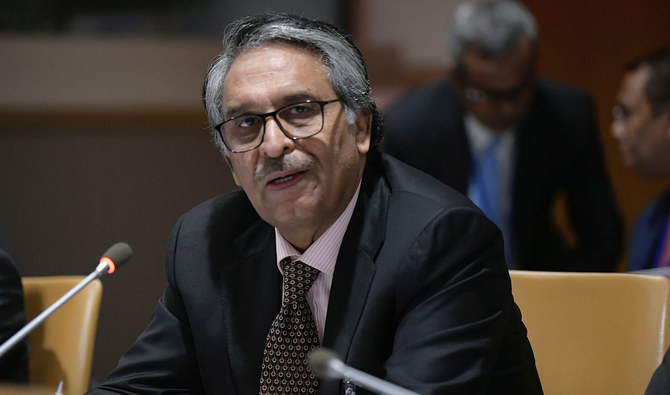

NEW YORK: Pakistan is “hopeful” that pledged reconstruction funding to rebuild parts of the country damaged by floods last year will be disbursed soon, Foreign Minister Jalil Abbas Jilani said on Friday.
At a press conference during the UN General Assembly in New York, he told Arab News: “Pakistan is one of the worst affected as far as climate change is concerned because it has affected about 33 million people.
“One-third of the country was inundated with water, and about $30 billion worth of losses were suffered.”
Pakistan was devastated by the 2022 floods, which were the world’s deadliest since those in southern Asia in 2020.
About a month after last year’s disaster, Pakistan and other countries attending the UN Climate Change Conference in Egypt decided to establish the Loss and Damage Fund to assist countries in dealing with the effects of climate change.
Many donors have pledged funds to help Pakistan rebuild flood-affected areas. The Islamic Development Bank pledged more than $4 billion, the World Bank $2 billion and Saudi Arabia $1 billion.
“So far, there has been very little which has trickled down from the international community as far as the rehabilitation and reconstruction work that has to be carried out. Pakistan is doing that from its own resources,” Jilani told Arab News.
“Our banks are issuing loans on easy terms to all those people who were affected. But then obviously, there are limits to what the banking industry can do.
“This is the kind of situation we’re in. I think we’re hopeful that most of the promises which were made by the donors will be fulfilled shortly.”
Regarding foreign policy, Jilani described the formation of new blocs and rivalries in the Asia-Pacific region as “a very uncomfortable situation” for Pakistan.
“Asia-Pacific has been a very peaceful region, a prosperous region, and it has made great economic strides in the last 40-50 years. Any tension within the Asia-Pacific region, from our point of view, is certainly not good for peace and stability in the region,” he said, adding that Pakistan prioritizes good relations with all countries, specifically mentioning China and the US.
When asked about Islamabad’s potential to confront the Pakistani Taliban, which operates along the border with Afghanistan, Jilani said: “Afghanistan is a sovereign country. Pakistan follows a policy of non-interference … while respecting the sovereignty of other countries.
“At the same time, we have expectations that the Afghan side would take action against all groups who are violating Afghanistan’s soil to carry out terrorist activities against other countries.”
Jilani added that during a meeting between the foreign ministers of China, Pakistan and Afghanistan in May, “there was a reiteration of this commitment by the Afghan side that they won’t allow Afghan soil to be used against other countries.”
Jilani also praised Pakistan’s commitment to democracy and free elections. “We’re a democratic country. There’s absolutely no doubt about it. In Pakistan, when parliament has completed its full term, it’s a constitutional requirement that there’s a caretaker setup which is meant to ensure neutrality in the next elections,” he said.
“This is meant to ensure that the elections are free and fair, and is meant to ensure that people are able to participate in the voting process without any violence.”
Jilani said Pakistan is heavily involved in efforts to tackle Islamophobia in Europe, and had made a case for the criminalization of religious-based hate speech in the Organisation of Islamic Cooperation’s Contact Group on Muslims in Europe.
“We also appreciated the introduction of a bill by the government of Denmark which would criminalize such offenses, either the burning of holy books or insulting the prophets of any religion. I think this is a good step they’ve taken,” he added, saying he is hopeful that if such a bill passed in Demark, other European nations may follow suit.


