

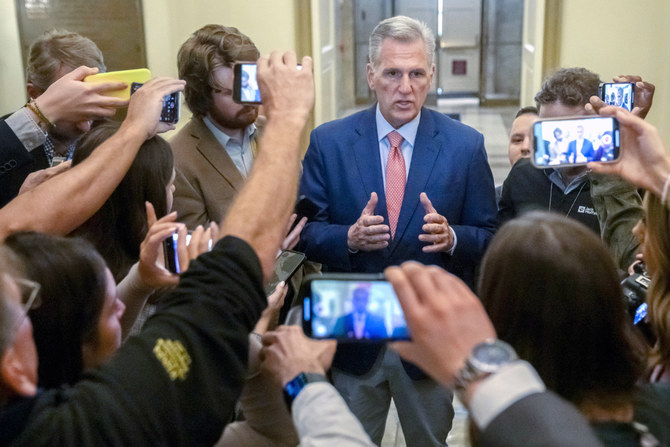

WASHINGTON: The White House on Friday directed federal agencies to get ready for a shutdown after House Republicans left town for the weekend with no viable plan to keep the government funded and avert politically and economically costly disruption of federal services.
A federal shutdown after Sept. 30 seems all but certain unless Speaker Kevin McCarthy can persuade his rebellious hard-right flank of Republicans to allow Congress to approve a temporary funding measure to prevent closures as talks continue. Instead, he’s launched a much more ambitious plan to try to start passing multiple funding bills once the House returns Tuesday, with just five days to resolve the standoff.
“We got members working, and hopefully we’ll be able to move forward on Tuesday to pass these bills,” McCarthy, R-Calif., told reporters at the Capitol.
McCarthy signaled his preference for avoiding a closure, but a hard-right flank of his House majority has effectively seized control. “I still believe if you shut down you’re in a weaker position,” he said.
The standoff with House Republicans over government funding puts at risk a range of activities — including pay for the military and law enforcement personnel, food safety and food aid programs, air travel and passport processing — and could wreck havoc with the US economy.
White House press secretary Karine Jean-Pierre said Friday that if federal workers go unpaid it would be Republicans’ fault. “Our message is: This doesn’t have to happen,” she said. “They can do their job and keep these vital programs continuing, keeping the government open.”
With the Oct. 1 start of a new fiscal year and no funding in place, the Biden administration’s Office of Management and Budget began to advise federal agencies to review and update their shutdown plans, according to an OMB official. The start of this process suggests that federal employees could be informed next week if they’re to be furloughed.
President Joe Biden has been quick to blame the likely shutdown on House Republicans, who are intent on spending cuts beyond those laid out in a June deal that also suspended the legal cap on the government borrowing’s authority until early 2025.
“They’re back at it again, breaking their commitment, threatening more cuts and threatening to shut down government again,” Biden during a recent speech in suburban Maryland.
McCarthy faces immense pressure for severe spending cuts from a handful of hard-right conservatives in his caucus, essentially halting his ability to lead the chamber. Many on the right flank are aligned with Donald Trump — the Republican front-runner to challenge Biden in the 2024 election. They opposed the budget deal the speaker reached with Biden earlier this year and are trying to dismantle it.
Trump has urged the House Republicans on, pushing them to hold the line against federal spending.
Led by Trump ally Rep. Matt Gaetz, R-Fla., the right flank has all but commandeered control of the House debate in a public rebuke to the speaker.
Late Thursday, the hard-right faction pushed McCarthy to consider their idea to shelve plans for a stopgap funding measure, called a continuing resolution, or CR, and instead start bringing up the 12 individual bills needed to fund the government.
The House GOP leadership then announced just that — it would begin processing a package of four bills to fund Defense, Homeland Security, State and Foreign Operations and Agricultural departments, setting up voting for Tuesday when lawmakers return. Work on some bills had been held up by the same conservatives demanding passage now.
“Any progress we are making is in spite of, not due to McCarthy,” Gaetz posted on social media, deriding the speaker for having sent lawmakers home for the weekend. “Pathetic.”
Gaetz and his allies say they want to see the House engage in the hard work of legislating — even if it pushes the country into a shutdown — as they pursue sizable reductions and cuts.
The House Rules Committee was holding a Friday afternoon session to begin preparing those bills, which historically require weeks of floor debate, with hundreds of amendments, but now are slated to be rushed to the floor for next week’s votes. The panel was expected to wrap up its work Saturday.
It’s a capstone to a difficult week for McCarthy who tried, unsuccessfully, to advance a typically popular defense spending bill that was twice defeated in embarrassing floor votes. The speaker seemed to blame the defeat of the bill on fellow lawmakers “who just want to burn the whole place down.”
McCarthy’s top allies, including Rep. Garrett Graves, R-Louisiana, insisted Friday they were still working toward both ends — passing annual spending bills and pushing for the most conservative stopgap CR with border security provisions — in time to prevent a shutdown.
Shutdowns happen when Congress and the president fail to complete a set of 12 spending bills, or fail to approve a temporary measure to keep the government operating. As a result, federal agencies are required to stop all actions deemed non-essential. Since 1976, there have been 22 funding gaps, with 10 of them leading to workers being furloughed.
The last and longest shutdown on record was for 35 days during Trump’s administration, between 2018 and 2019, as he insisted on funding to build a wall along the US southern border that Democrats and some Republicans refused.
Because some agencies already had approved funding, it was a partial closure. The Congressional Budget Office estimated it came at a cost of $3 billion to the US economy. While $3 billion is a lot of money, it was equal to just 0.02 percent of US economic activity in 2019.
There could be costs to parts of the economy and difficulties for individuals.
Military and law enforcement officials would go unpaid during the shutdown. The disaster relief fund of the Federal Emergency Management Agency could be depleted, hurting the victims of wildfires, hurricanes, tornadoes and flooding.
Clinical trials on new prescription drugs could be delayed. Ten thousand children could lose access to care through Head Start, while environmental and food safety inspections would get backlogged.
Food aid for Americans through the Women, Infants and Children program could be cut off for nearly 7 million pregnant women, mothers, infants and children.
Brian Gardner, chief Washington strategist at the investment bank Stifel, said that air traffic controllers largely continued to work without pay during the previous shutdown. He noted that visa and passport applications would not be processed if the government is closed.
The US Travel Industry Association estimates that the travel sector could lose $140 million daily in a shutdown.
But in a sign of how little damage that 35-day shutdown did to the overall economy, the S&P 500 stock index climbed 11.6 percent during the last government closure.


